

This guide explains how counter-drone systems protect large public events, from stadiums and concerts to political rallies and festivals. It covers why these gatherings are disproportionately attractive targets, the four coordinated capabilities effective event protection requires, and a structured deployment walkthrough showing exactly how a C-UAS deployment works before, during, and after an event.
Public event drone security requires four coordinated capabilities: continuous 360-degree surveillance, real-time detection and tracking, autonomous neutralization, and integration with existing on-ground security protocols. Because these environments are dense with people, effective systems prioritize non-kinetic mitigation, since debris from a kinetic intercept over a crowd creates its own hazard.
Key takeaways
- High-profile public events like concerts, sports tournaments, political rallies, festivals, are attractive drone-attack targets precisely because of their visibility, symbolic weight, and the scale of crowds involved; India’s 2024 T20 World Cup victory parade, for example, drew over 300,000 attendees and roughly 5,000 security personnel in a single location.
- Real-world incidents, including the 2018 drone attack targeting then-Venezuelan President Nicolás Maduro during a military parade and the July 2024 assassination attempt against then-candidate (now President) Donald Trump, have underscored the vulnerability of large public gatherings to aerial threats.
- Effective event protection requires four coordinated capabilities: continuous 360-degree surveillance, real-time detection and tracking, autonomous neutralization, and integration with existing on-ground security protocols.
- A structured deployment – pre-event mapping, active monitoring during the event, and post-event analysis – is what separates a genuinely effective event security posture from a reactive one.
Table of Contents
- The Rising Need for Airborne Security at Public Events
- The Rising Airborne Threats
- Why Are Public Events a Popular Target?
- Benefits of Using Anti-Drone Systems in Public Gatherings
- Understanding Indrajaal™’s Approach to Event Security
- Case Study: Safeguarding a Major Sporting Event
- The Future of Public Event Security
- Frequently Asked Questions
- Conclusion
The Rising Need for Airborne Security at Public Events
Public events – concerts, sports games, political rallies, festivals — play a vital role in social and cultural life. They draw large crowds and often carry real cultural, political, or economic weight. India’s 2024 T20 World Cup victory parade, for instance, drew over 300,000 supporters and around 5,000 security personnel in a single event.
That scale and visibility is exactly what makes public events an attractive target for malicious actors, including drone-based attacks. Real-world incidents have made this risk concrete rather than theoretical: a 2018 drone attack targeted then-Venezuelan President Nicolás Maduro during a military parade (he was unharmed, but the incident exposed how vulnerable high-profile public events can be), and the July 2024 assassination attempt against then-candidate, now President, Donald Trump at a campaign rally further underscored how exposed large public gatherings are to security threats of all kinds, drones included.
In high-risk environments like these, an AI-powered counter-drone system that monitors, detects, and neutralizes rogue drones in real time isn’t a luxury – it’s a baseline security requirement.
For a broader look at critical infrastructure and public safety, see: Securing the Skies: Safeguarding Critical Infrastructure Against Drone Threats
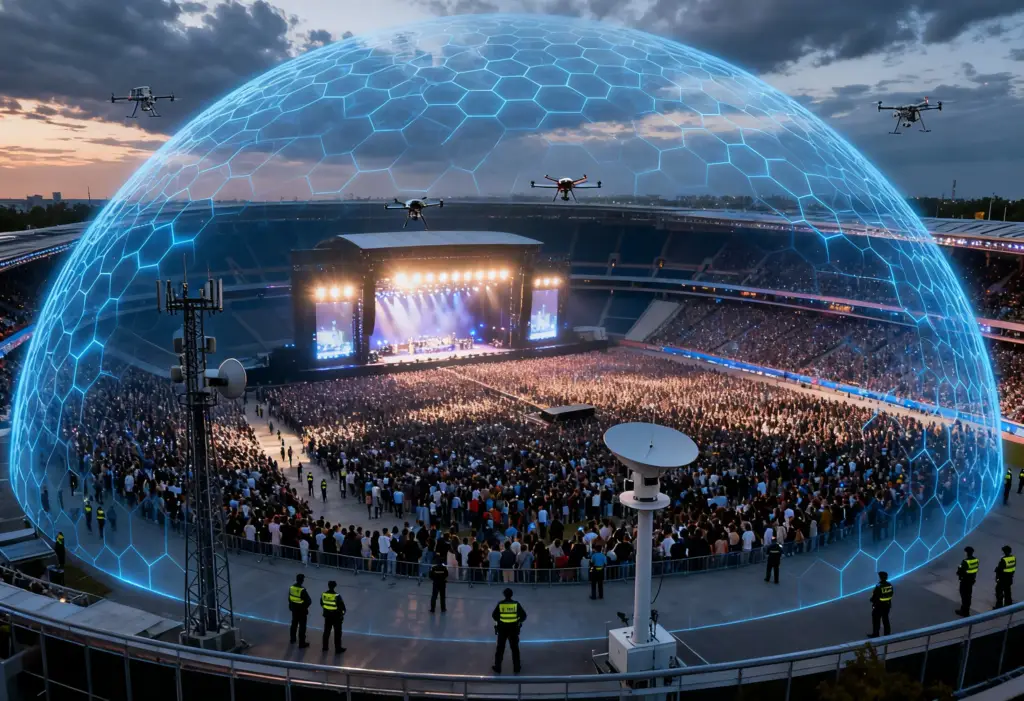
The Rising Airborne Threats
Drones have gained extensive attention, particularly given the current global geopolitical situation. Their versatility and accessibility have increased significantly. While drones offer numerous benefits in fields like photography, logistics, and surveillance, they also pose serious risks.
Drones can be misused for malicious purposes such as unauthorized surveillance, smuggling, and delivering explosive devices. This threat is very real, as evidenced by the frequent drone-related incidents reported in the news.
For instance, a few years ago, drones carrying explosives targeted Venezuelan President Nicolás Maduro during a military parade. Although he remained unharmed, the incident highlighted the vulnerability of high-profile public events to drone attacks.
For the technical foundation of how modern C-UAS platforms address this risk, see: Counter Drone Systems: Comprehensive Guide [2026]
Why Are Public Events a Popular Target?
Several factors make public events disproportionately attractive to malicious actors:
- Visibility and media reach. Public events attract large crowds and extensive media coverage. A successful attack at a high-profile event can spread an attacker’s message to a global audience almost instantly.
- Political leverage. Drone attacks at public events are often used to advance political agendas. Targeting gatherings that symbolize political power or dissent is intended to make a statement and shape public opinion – an effect amplified when political leaders or elections are involved.
- Symbolic and cultural significance. Cultural festivals, religious gatherings, and national celebrations carry deep symbolic weight. Attacking them strikes at a community’s cultural identity directly, spreading fear well beyond the immediate incident.
- Economic impact. Large-scale public events, sports tournaments, trade fairs – contribute significantly to local and national economies. A successful drone attack causes damage well beyond the event itself, deterring future events and tourism.
- Psychological impact. The sudden, unexpected nature of drone attacks generates outsized panic and fear relative to the physical damage caused, undermining public confidence in event safety more broadly.
- Accessibility. Drones are relatively easy to obtain and operate, and remote piloting lets attackers maintain anonymity and evade capture – a combination that lowers the barrier to entry for malicious actors considerably.
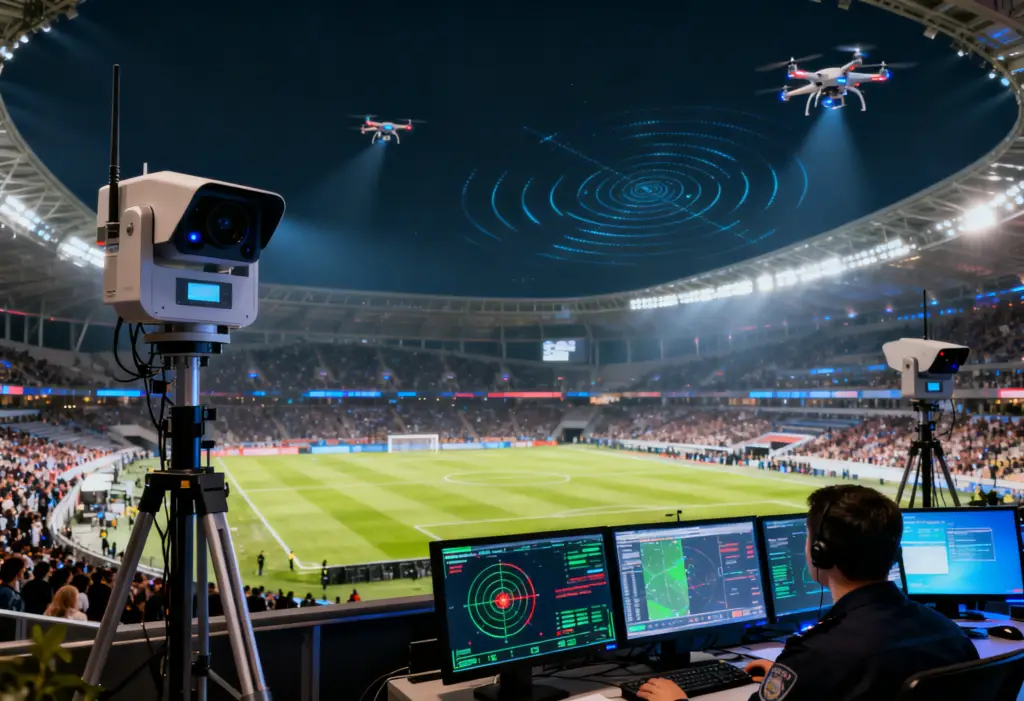
Benefits of Using Anti-Drone Systems in Public Gatherings
Deploying a system like Indrajaal™ at large public events delivers several concrete advantages:
- An additional, dedicated security layer. Anti-drone systems identify and mitigate drone threats specifically, giving both organizers and attendees genuine peace of mind that the event can proceed without aerial disruption.
- Early detection and rapid response. Early identification of potential threats lets security personnel respond swiftly, neutralizing drones before they can cause harm, a critical capability for preventing chaos and preserving event safety.
- Increased attendee confidence. When attendees know sophisticated anti-drone measures are in place, confidence in event safety rises, which can translate directly into higher attendance and a better overall experience.
- VIP protection. Public events frequently feature high-profile individuals, politicians, celebrities, other VIPs and anti-drone systems provide an essential additional layer of protection specifically for them.
- Long-run cost-effectiveness. Preventing a drone-related security breach avoids the substantial downstream costs of one: property damage, legal liability, and reputational harm to the event and its organizers.
Understanding Indrajaal™’s Approach to Event Security
Indrajaal, developed after 15 years of intensive research and development, is a comprehensive counter-drone system designed to address these very threats. It is the world’s first autonomous counter-unmanned aerial system (C-UAS) capable of protecting against all types of drones with minimal human intervention. The system integrates 12 modules of advanced technology, including radar, cameras, and other sensors, to create a seamless and efficient drone detection and neutralization network.
Applied specifically to event protection, Indrajaal delivers four coordinated capabilities:
- Continuous 360-degree surveillance. A network of sensors provides ongoing coverage of the event area, ensuring no drone — regardless of size or speed — can approach undetected.
- Real-time detection and tracking. Radar and optical systems detect and track drones as they appear, differentiating authorized from unauthorized activity so legitimate operations (media coverage drones, for instance) aren’t disrupted.
- Autonomous neutralization. Once an unauthorized drone is confirmed, Indrajaal can neutralize it autonomously — through communication jamming, control takeover, or kinetic measures, depending on the threat level.
- Integration with existing security protocols. Indrajaal’s Command & Control Centre coordinates directly with on-ground security personnel, feeding them real-time data and actionable intelligence rather than operating as a disconnected system.
Case Study: Safeguarding a Major Sporting Event
Consider a scenario where a major international sports event is being held in a large stadium. The event organizers have implemented stringent security measures, but the threat of drone attacks looms large. Here’s how Indrajaal ensures the event’s safety:
- Pre-Event Preparation: Indrajaal’s team works closely with event organizers to map out the area and identify potential drone entry points. A network of sensors and radars is strategically placed around the stadium.
- During the Event: As the event progresses, Indrajaal’s sensors continuously monitor the airspace. The Command & Control Centre, operated by trained personnel, keeps a vigilant eye on the radar feeds. Midway through the event, an unauthorized drone is detected approaching the stadium. Indrajaal’s system immediately alerts the operators, who activate the autonomous neutralization protocol. The drone’s communication signals are jammed, and it is safely brought down outside the stadium premises.
- Post-Event Analysis: After the event, Indrajaal’s team conducts a thorough analysis of the airspace activity. The data collected helps in refining the system and preparing for future events.
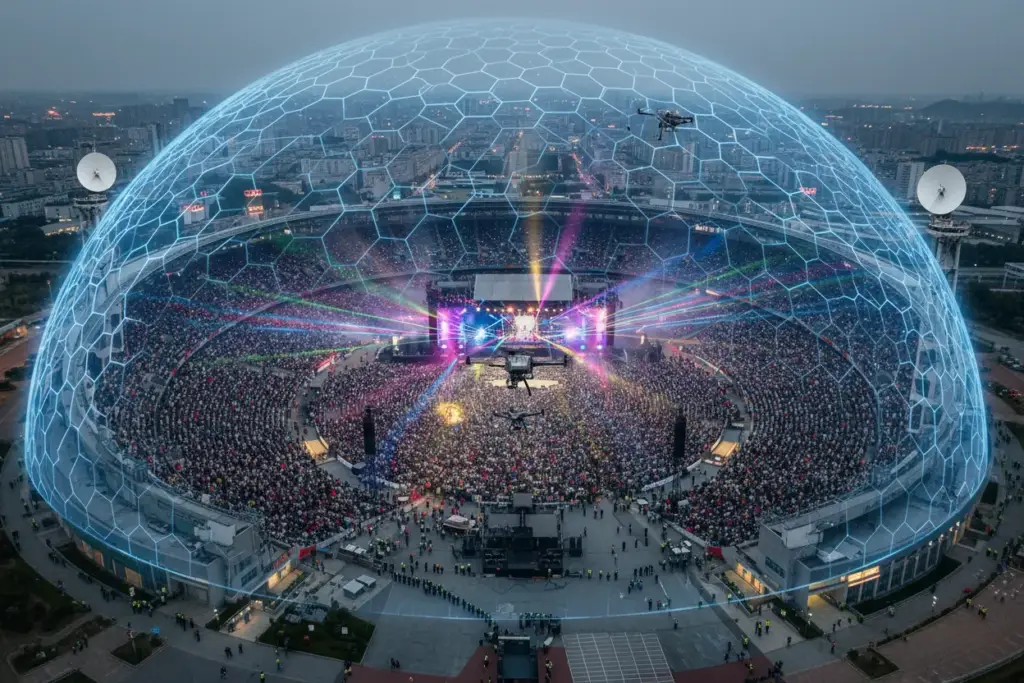
The Future of Public Event Security
As drone technology continues to evolve, so do the threats associated with it. Public events, by their very nature, will always be potential targets for malicious drone activities. This highlights the importance of adopting advanced counter-drone systems like Indrajaal.
Indrajaal is continuously evolving to keep pace with emerging threats. The system’s modular design allows for easy upgrades and integration of new technologies. This ensures that Indrajaal remains at the forefront of counter-drone solutions, capable of addressing the ever-changing security landscape.
Ready to safeguard your urban airspace? Connect with Indrajaal’s experts today.
Frequently Asked Questions
Public events combine high visibility, media coverage, symbolic or political significance, and large crowds — a combination that makes a successful attack disproportionately impactful for a malicious actor, both in terms of harm caused and message amplified.
Continuous 360-degree surveillance, real-time detection and tracking, autonomous neutralization, and integration with existing on-ground security protocols — removing any one weakens the overall response.
Yes, modern C-UAS platforms classify detected drones as friendly or hostile, allowing legitimate activity like media-coverage drones to continue operating without interference while unauthorized drones are flagged for response.
Typically through RF jamming to sever the drone’s communication link, forcing it to land or return to its origin point, with more advanced options like control takeover or kinetic interception available for confirmed high-severity threats.
A thorough post-event analysis of airspace activity data helps refine sensor placement, detection accuracy, and response protocols ahead of future events — deployment maturity comes from this kind of iteration, not a one-time setup.
Conclusion
Public events sit at a genuine intersection of high visibility and high vulnerability – exactly the combination that makes them attractive targets for drone-based threats. A structured approach, built around continuous surveillance, real-time response, and integration with existing security teams, is what turns a general awareness of drone risk into an actual protective capability. As real-world incidents continue to demonstrate this risk isn’t theoretical, event organizers and security leaders are increasingly treating dedicated counter-drone coverage as a standard part of event security planning, not an optional add-on.