

This piece looks at where military drone technology and counter-drone defense are both headed. It covers how the Russia-Ukraine war has already demonstrated asymmetric drone warfare in live combat, the key military drone trends (stealth, advanced sensing, Lethal Autonomous Weapons Systems), the legal and ethical questions advancing alongside the technology, and why counter-drone systems have to evolve continuously rather than being built for today’s threat alone.
Key takeaways
- The Ukraine-Russia war has demonstrated, in live combat, how low-cost drones can disable or destroy conventional military assets worth many times their cost, a shift with lasting implications for defense procurement priorities.
- Military drone technology is trending toward stealth, advanced multispectral and hyperspectral sensing, extended endurance, and increasingly – full autonomy, including early-stage Lethal Autonomous Weapons Systems (LAWS).
- The global military drone market is projected to grow from roughly $20.8 billion in 2026 to $30.9 billion by 2034, according to Fortune Business Insights, though estimates across research firms vary meaningfully depending on methodology.
- Legal and ethical questions – around autonomous lethal force, international law compliance, and privacy – are advancing in parallel with the technology itself, and will shape how these systems can actually be deployed.
- As offensive drone capability accelerates, counter-drone technology has to evolve in lockstep – a static defense system can’t keep pace with a rapidly advancing threat.
Table of Contents
- The Changing Face of Warfare
- Drones — The New Frontier of Military Capability
- Military Drone Trends Shaping the Future of Warfare
- Legal and Ethical Considerations
- The Need for Comprehensive Counter-Drone Technology
- Indrajaal — Built for an Evolving Threat
- Versatility, Scalability, and Deployment
- Frequently Asked Questions
- Conclusion
The Changing Face of Warfare
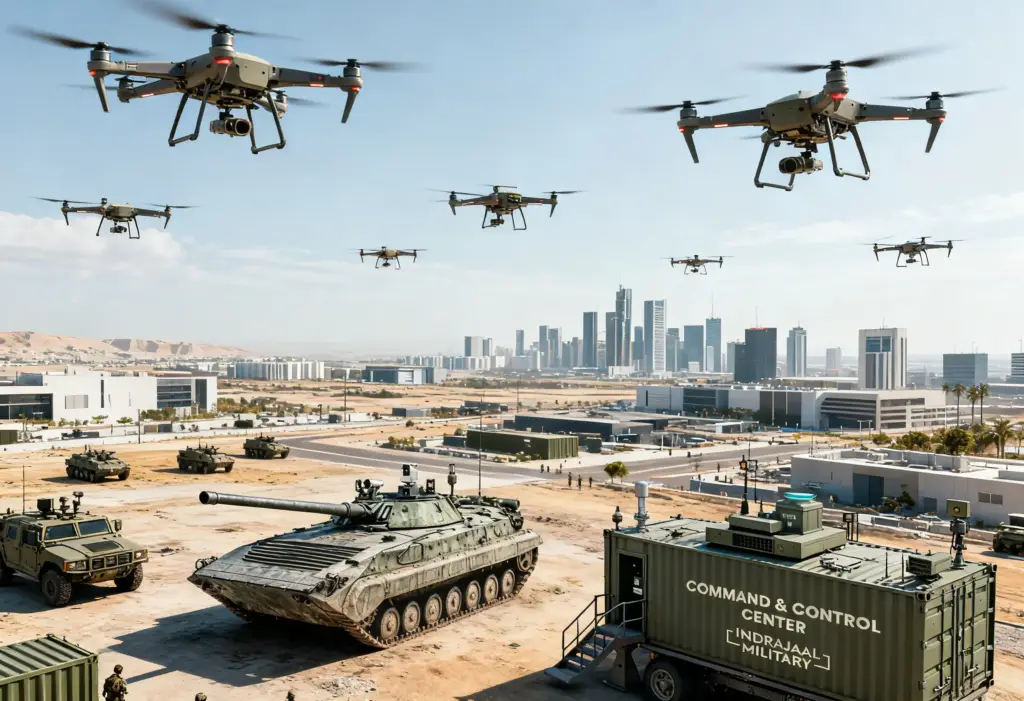
Warfare has shifted significantly in recent years. In the ongoing Russia-Ukraine war, Ukraine has repeatedly used inexpensive “suicide” drones to disable or destroy Russian tanks worth many times the drone’s cost – a stark demonstration of how asymmetric drone warfare is reshaping battlefield economics, not just tactics.
Drones now offer greater autonomy, more advanced capability, and genuinely 360-degree defense strategies, introducing tactics that simply didn’t exist a decade ago. Since their early development, drones have become integral to modern military operations, and the pace of advancement shows no sign of slowing — the global military drone market is projected to grow from roughly $20.8 billion in 2026 to $30.9 billion by 2034, according to Fortune Business Insights.
For foundational context on how counter-drone systems work, see: Counter Drone Systems: Comprehensive Guide [2026]
Drones — The New Frontier of Military Capability
The world is moving towards creating lighter, smarter, more cost-effective, and more heavily armed drones. With dependence on Artificial Intelligence (AI), “Intelligentized Warfare” is on the horizon.
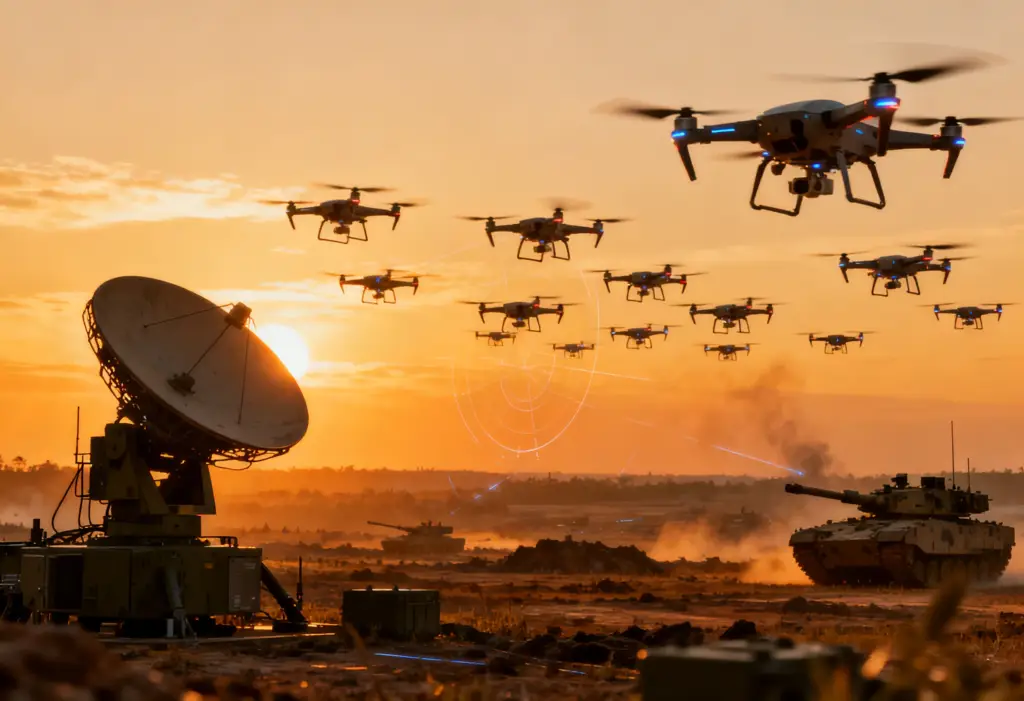
Numerous ongoing projects are poised to revolutionize the defence landscape. For example, future drones will likely operate in swarms equipped with electronic jamming devices to disrupt communications. A fleet of unmanned ships by the 2040s, along with smaller surface and underwater drones, all powered by AI, are currently under development.
A new generation of Lethal Autonomous Weapons Systems (LAWS) is emerging, capable of identifying, tracking, and attacking targets without human intervention.
In the long term, drones will benefit from advances in AI and computing. The commercial drone market is expected to feature deploy-and-forget drones capable of travelling at very high speeds, potentially hypersonic. Over the next decade, this technology will integrate with swarm capabilities and autonomy, creating highly effective military drones.
Military Drone Trends Shaping the Future of Warfare
Anticipated trends include:
Stealth and Low-Observable Drones
Operating in contested airspace with minimal risk of detection and interception, stealth drones enhance survivability in high-threat environments.
Advanced Sensor Capabilities
Upgraded sensors, such as multispectral imaging, hyperspectral sensors, and synthetic aperture radar, deliver detailed and comprehensive data for enhanced military operations.
Long-Endurance Surveillance
Military drones capable of extended flight durations are crucial for persistent surveillance and reconnaissance.
Enhanced Endurance Technologies
Research into mid-air refuelling and rapid battery recharging technologies aims to extend the range and operational endurance of military drones.
Legal and Ethical Considerations
Governments worldwide are grappling with how to regulate drone operations to protect citizens’ privacy while allowing beneficial applications like disaster response and infrastructure inspection.
Ethical Use of Lethal Force
The autonomous capabilities of future drones raise ethical questions about the use of lethal force and the potential for autonomous decision-making during combat.
International Laws and Treaties
Compliance with international laws, such as the Geneva Conventions and agreements on armed conflict, remains paramount.
Privacy and Surveillance
Balancing national security needs with individual privacy rights is an ongoing challenge, particularly in domestic and civilian contexts.
Transparency and Accountability
Maintaining transparency in drone operations and establishing accountability mechanisms is essential for upholding ethical standards.
The Need for Comprehensive Counter-Drone Technology
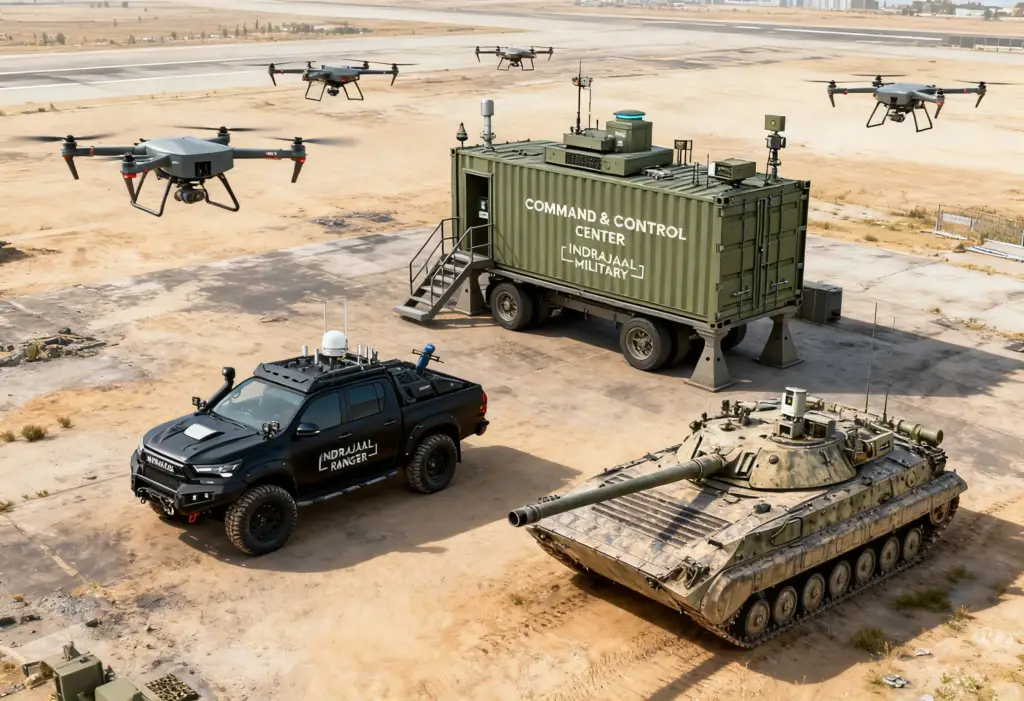
As offensive drone technology evolves, defensive technology has to keep pace — a static counter-drone system is a losing proposition against a rapidly advancing threat. Organizations worldwide are recognizing the importance of mitigating this risk through dedicated Counter-UAS systems.
A genuinely comprehensive counter-drone system needs to detect, track, and neutralize threats effectively and, critically, needs to be autonomous, continuously updated against the latest drone advancements, and adaptable to diverse threats in real time. A system built to counter today’s drones and nothing else is already falling behind.
Indrajaal — Built for an Evolving Threat
Indrajaal™ is the result of 15+ years of R&D in Autonomous Drone Security. The team brings extensive expertise in radar technology and airspace management.
The system autonomously safeguards against drones of all classifications, integrating 12 modules of advanced technology to provide comprehensive aerial security. Among these are patented HyperSensing™ and WeaponFusion™ technologies, which are pivotal in delivering a unified and highly efficient autonomous drone security system.
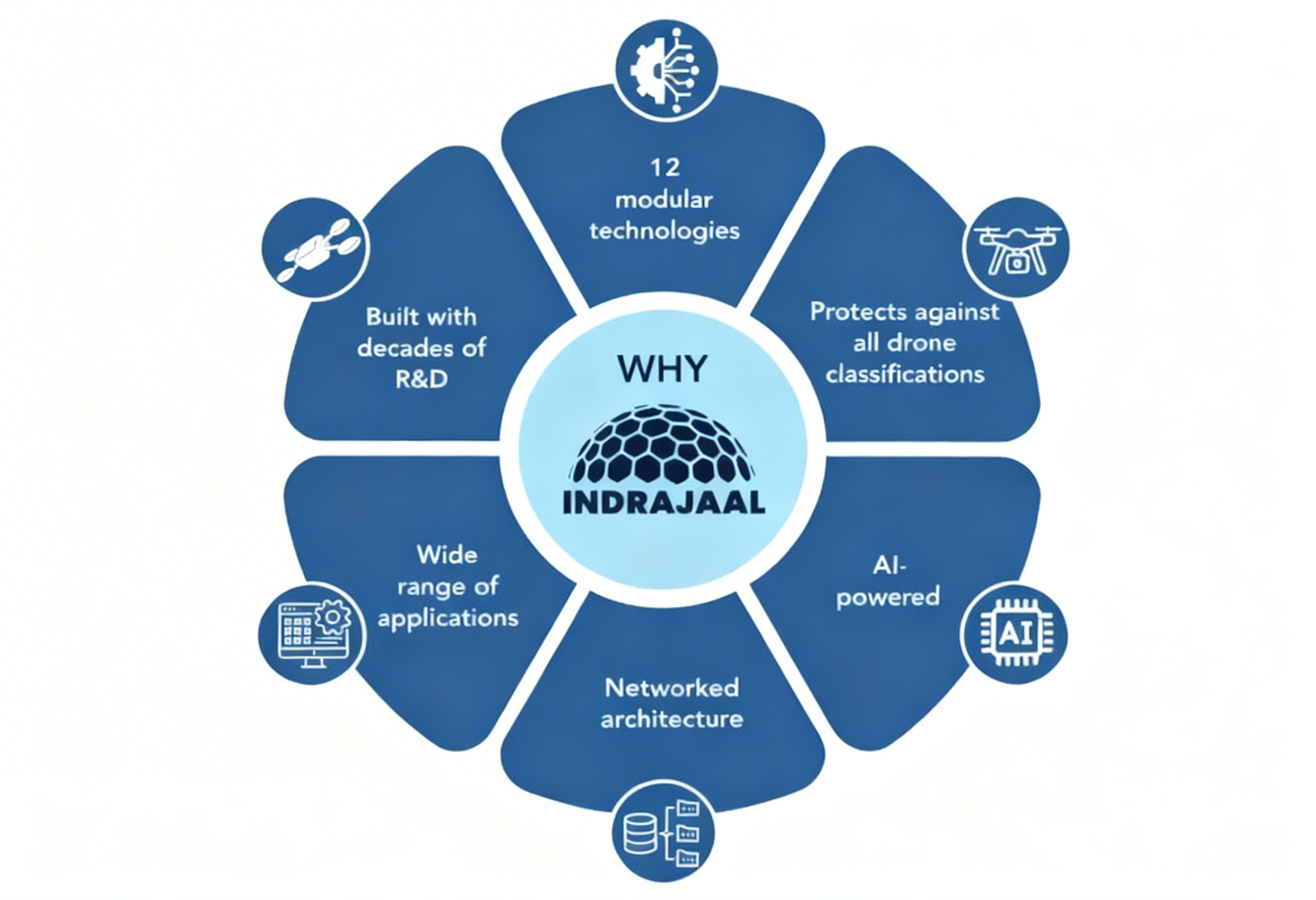
Moreover, Indrajaal™ consolidates data from radar, cameras, and other sensors using Multi-Sensor Fusion, enabling accurate differentiation between authorised and unauthorised aerial systems. A decentralized, mobile, and AI-enabled implementation can be achieved with multiple sensors and technologies connected to the Command & Control Centre through a secured mesh.
For the full technical breakdown of Indrajaal’s architecture, see: Decoding Autonomous Aerial Security Systems and How Indrajaal Is Revolutionizing Counter-Drone Security and Strengthening Military Intelligence: The Role of Counter-Drone Systems
Versatility, Scalability, and Deployment
Indrajaal offers versatility and scalability. Notably, its modular design allows for easy integration with existing security infrastructure, making it adaptable to various operational environments. As a result, the system can be deployed in diverse settings—from critical infrastructure protection to event security and military operations—safeguarding against evolving drone threats.
Furthermore, by consolidating data from radar, cameras, and other sensors, Indrajaal creates a comprehensive multi-dimensional overview. Powered by advanced AI algorithms, this technology analyzes real-time data to accurately differentiate between authorized and unauthorized aerial systems.
In addition, a decentralized, mobile, and AI-enabled implementation can be achieved through a wide array of sensors and technologies connected to the Command & Control Centre via a fully secured mesh. Unlike similar systems, Indrajaal doesn’t just detect—it reacts intelligently.
Frequently Asked Questions
Intelligentized warfare refers to the growing integration of artificial intelligence into military systems and decision-making, including autonomous drones, swarm coordination, and AI-driven target identification, a trend widely seen as defining the next phase of military technology development.
LAWS are weapons systems capable of identifying, tracking, and engaging targets with minimal or no human intervention. Their development raises significant, actively debated legal and ethical questions around accountability and compliance with international law.
Estimates vary by research firm, but Fortune Business Insights projects the global military drone market growing from roughly $20.8 billion in 2026 to $30.9 billion by 2034, at a CAGR of approximately 6.8%.
Because offensive drone technology is advancing rapidly toward stealth, swarm coordination, and greater autonomy a static counter-drone system falls behind quickly. Effective C-UAS platforms need modular, updatable architecture to keep pace with evolving threats.
The central debates concern the acceptable extent of autonomous decision-making in the use of lethal force, compliance with international law such as the Geneva Conventions, and balancing national security needs against civilian privacy rights.
Conclusion
The gap between offensive and defensive drone technology is closing in real time, and neither side of that equation is standing still. Stealth, swarm tactics, and increasing autonomy on the offensive side demand a counter-drone posture that’s just as adaptive – modular, continuously updated, and built to evolve rather than a fixed, one-time deployment. The legal and ethical questions raised by this shift aren’t a side issue; they’ll shape what’s actually deployable, which makes them as important to track as the technology itself.