

This guide gives airport security teams a practical framework for defending against drone threats. It covers what the Gatwick 2018 shutdown actually cost and why it remains the industry’s defining case study, the three pillars of effective airport drone defense, how to assess a drone’s intent rather than just its presence, and the airspace-integration constraints that make airport C-UAS fundamentally different from deployment anywhere else.
Airport drone defense rests on three pillars: multi-layered detection and tracking, trained personnel following clear SOPs, and automated autonomous response. What makes airports uniquely constrained is that mitigation must never interfere with legitimate aircraft systems or air traffic control, which rules out broad-spectrum jamming approaches available to other sectors.
Key takeaways
- The December 2018 Gatwick Airport drone incident, a 36-hour shutdown affecting roughly 140,000 passengers and 1,000 flights, remains the industry’s defining case study, with Gatwick’s own direct losses estimated at £1.4 million and combined airport-and-airline losses estimated at over £50 million.
- Airports face a distinct C-UAS challenge: mitigation must never risk interfering with legitimate aircraft systems or air traffic control, ruling out certain jamming approaches available to other sectors.
- Effective airport drone defense rests on three pillars: multi-layered detection and tracking, trained personnel following clear SOPs, and automated, autonomous threat response.
- Assessing a drone’s intent – not just its presence, is what separates a proportionate response from an operational overreaction; a delivery drone that’s drifted off course is a very different situation from one loitering over a restricted zone.
Table of Contents
- Understanding the Drone Threat Landscape at Airports
- Understanding the Threat of Drones
- Defence Against Drone Threats: A Three-Pillar Approach
- Identifying Drone Intent
- Neutralising Threats at an Airport
- Airport Drone Defence with Indrajaal™
- The Future of Airport Security
- Frequently Asked Questions
- Conclusion
Understanding the Drone Threat Landscape at Airports
Rapid advances in aerial technology have driven an exponential rise in airspace threats, and airports face a uniquely acute version of this challenge, a fact borne out by a string of high-profile incidents over the past several years.
Airport drone security first gained major public attention following the December 2018 Gatwick Airport disruption. Unauthorized drone activity forced a roughly 36-hour shutdown, grounding around 1,000 flights and affecting approximately 140,000 passengers during the peak holiday travel season. Gatwick’s own direct losses from the incident are estimated at £1.4 million, while combined losses across the airport and its airline partners, driven substantially by easyJet’s own disclosed £15 million impact, are estimated at over £50 million industry-wide.
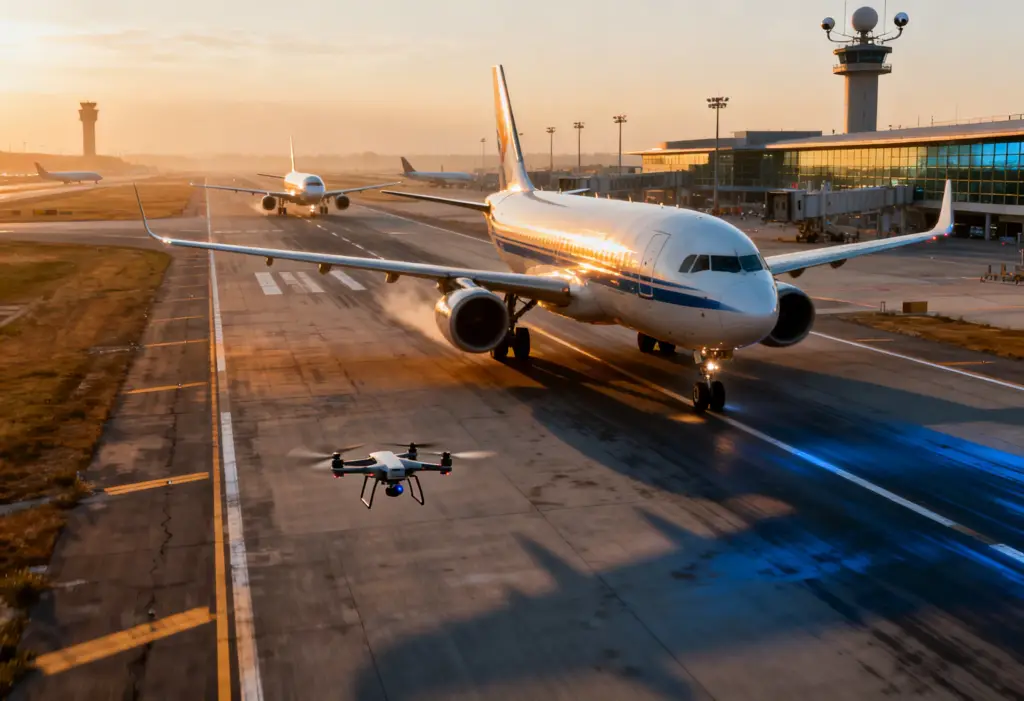
Gatwick wasn’t an isolated case. Airports worldwide have faced similar drone-related disruptions in the years since, including incidents at Madrid-Barajas, Edinburgh, Dublin, Palm Beach, Warsaw, Pittsburgh, and Frankfurt. The reputational and financial fallout from these events has made drone detection and mitigation infrastructure a standard, rather than optional, part of airport operations planning.
For the broader critical-infrastructure threat picture, see: Securing the Skies: Safeguarding Critical Infrastructure Against Drone Threats
Understanding the Threat of Drones
The popularity and affordability of drones have amplified risks at airports. Unauthorized drones can cause:
- Flight delays and cancellations
- Operational halts and structural damage
- Financial losses and reputational harm
- Unauthorized surveillance and espionage
Studies show drones can cause more damage to aircraft than birds of similar size and speed. In addition to safety risks, such incidents also lead to economic losses and passenger dissatisfaction.
Defence Against Drone Threats: A Three-Pillar Approach
To effectively counter drone threats, airports must employ multi-layered defences combining radar, electro-optical sensors, RF scanners, and AI-powered analytics.
Detection and Tracking
Advanced Counter-Drone Systems continuously monitor the airspace, distinguishing drones from birds and other airborne objects, even in adverse conditions.
Training and Response
Security teams must be trained to assess drone intent, track flight patterns, and respond swiftly with pre-defined Standard Operating Procedures (SOPs).
Automated Threat Response
Autonomous systems like Indrajaal™ can neutralize rogue drones in real time through signal disruption or kinetic interception, reducing manual intervention.
Identifying Drone Intent
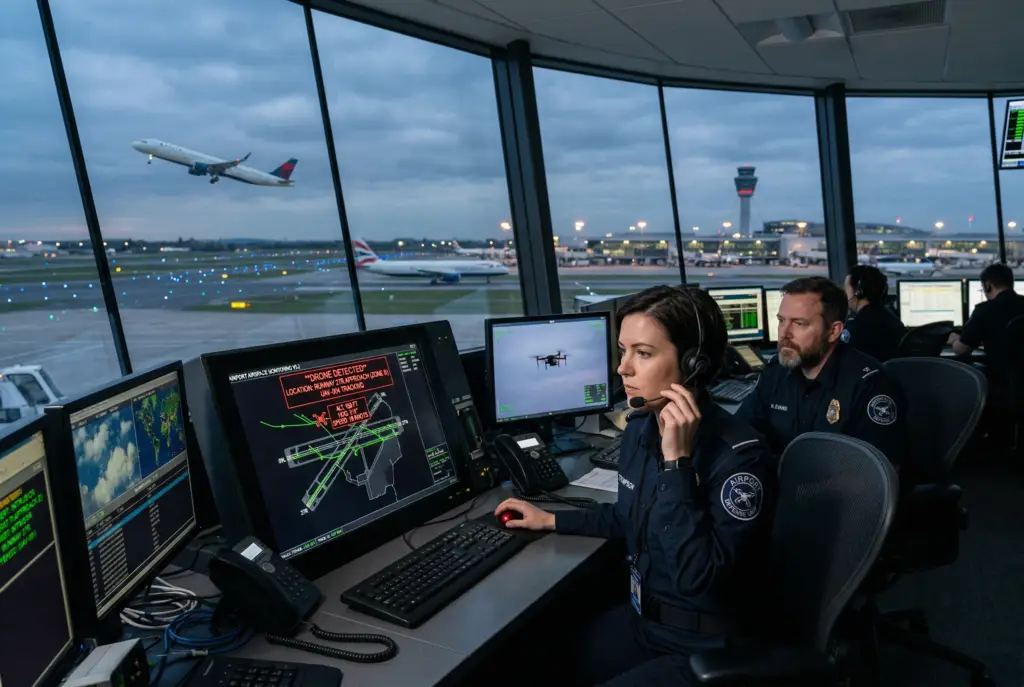
Understanding the intent behind a drone is essential for airport security. Drones can be used for various purposes, from commercial deliveries to recreational activities. Distinguishing between benign and potentially harmful drones involves analysing their behaviour, flight patterns, and location relative to the airport’s restricted airspace.
For instance, a delivery drone that has veered off course might be unintentionally disrupting operations, while a drone loitering in sensitive areas could indicate malicious intent. By rapidly assessing the drone’s behaviour and purpose, security teams can determine whether it poses a genuine threat. Early identification of malicious intent is essential, as it allows for timely intervention and appropriate response measures, reducing the risk of a serious incident.
Related reading: Counter Drone Systems: Comprehensive Guide [2026]
Neutralising Threats at an Airport
Once a drone threat has been identified and assessed, the next step is neutralisation. Effective drone defence systems must offer a range of tools to manage and mitigate risks. For instance, signal jamming can disrupt the communication between the drone and its operator, effectively neutralising its control. Alternatively, intercepting the drone might involve taking physical control of the aircraft or deploying measures to bring it down safely.
In more critical situations, it may be necessary to temporarily halt airport operations, such as suspending flights, to ensure the safety of passengers and aircraft. This decision is typically made in collaboration with air traffic control and other security personnel.
Airport Drone Defence with Indrajaal™
Modern airports need intelligent, AI-integrated Counter-Drone Systems capable of handling evolving threats. Indrajaal™, developed after 15 years of R&D, delivers exactly that. Its modular design is not just about current capabilities but is built with the future in mind. This allows for seamless upgrades and the integration of new technologies, ensuring that Indrajaal remains effective against both existing and emerging threats.
Developed through extensive R&D, Indrajaal seamlessly integrates 12 technologies to provide effective drone detection, tracking, and neutralisation. Let’s understand the features:
Comprehensive Surveillance
Indrajaal employs a network of sensors that provide continuous 360-degree visibility of the airport premises. This ensures that no drone can approach the airport undetected, regardless of the size or speed.
Accurate Threat Identification
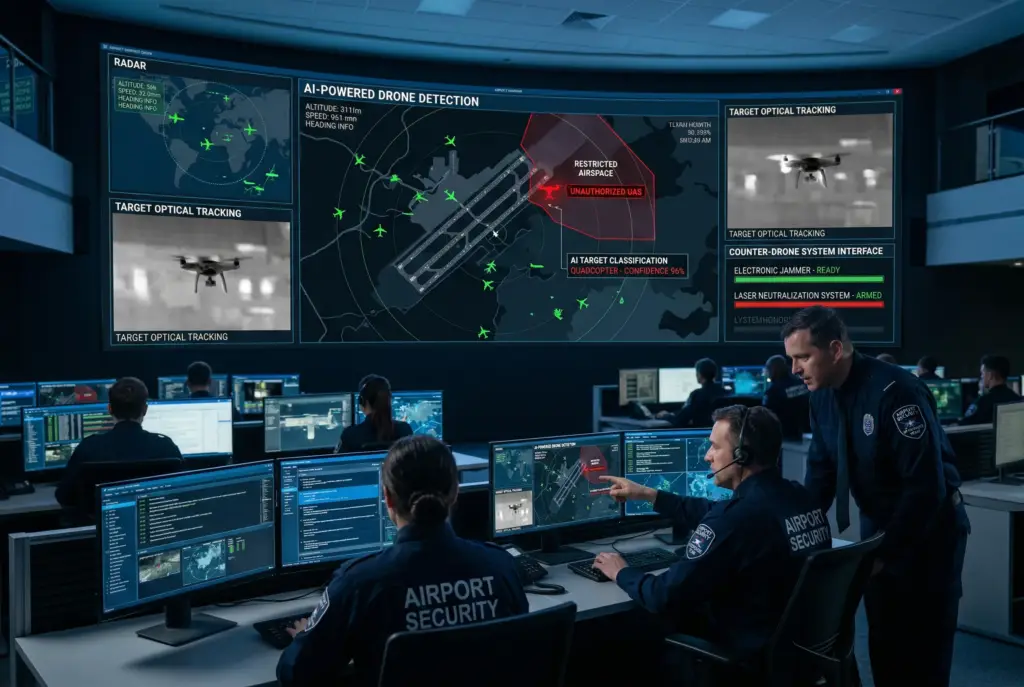
Utilising cutting-edge radar and optical systems combined with advanced AI algorithms, Indrajaal can differentiate between authorised and unauthorised drones. This prevents disruptions to legitimate drone activities, such as those conducted by the media.
Autonomous Neutralisation
Once an authorised drone is detected, Indrajaal can autonomously neutralise the threat. This can involve jamming the drone’s communication signals or taking control of the drone.
Seamless Integration
Indrajaal can easily integrate with existing airport security protocols. The system’s Command & Control Centre coordinates with on-ground security personnel, providing real-time data and actionable intelligence to enhance overall security.
By staying ahead of technological advancements, Indrajaal helps airports maintain a high level of readiness and resilience.
The Future of Airport Security
As drone technology continues to advance, so do the associated threats, presenting ongoing challenges for airport security. Airports are increasingly attractive targets for malicious drone activities, whether for disruptive purposes, espionage, or direct attacks. The evolving landscape of drone technology means that these threats are not static but are constantly adapting.
A proactive approach to airport security—one that anticipates future threats and adapts accordingly—is essential for mitigating risks and maintaining smooth operations. The time to act is now. By integrating advanced systems like Indrajaal into airport security protocols, we can fortify our defences against the growing array of drone threats. It is not just about responding to current risks but preparing for the future of airspace management.
Ready to strengthen your defense strategy? Contact Indrajaal’s experts today.
Frequently Asked Questions
In December 2018, unauthorized drone sightings forced a roughly 36-hour shutdown of Gatwick Airport, grounding around 1,000 flights and affecting approximately 140,000 passengers, with combined losses across the airport and airlines estimated at over £50 million.
RF jamming near an airport carries real risk of interfering with legitimate aircraft communication and navigation systems, which is why airport-grade C-UAS mitigation has to be precisely targeted rather than using broad-spectrum jamming
By analyzing the drone’s flight behavior, pattern, and proximity to restricted airspace, a drone that has drifted off a delivery route reads very differently from one deliberately loitering over a sensitive area, and assessing that distinction quickly is central to airport drone security.
Research indicates drones can cause more structural damage than birds of similar size and speed in a strike scenario, largely due to rigid components like motors and batteries, adding a distinct safety consideration beyond typical bird-strike risk models.
Response options range from RF jamming or control takeover to, in critical situations, a temporary halt of flight operations, a decision typically made jointly with air traffic control rather than by airport security alone.
Conclusion
The Gatwick incident made the cost of being unprepared for airport drone threats concrete and public, tens of millions of pounds in losses from a single, roughly day-and-a-half disruption. The airports handling this risk well today combine layered detection technology, trained personnel working from clear SOPs, and autonomous, precisely-calibrated response, because at an airport, unlike almost anywhere else a C-UAS gets deployed, the mitigation itself has to be engineered not to become its own safety risk.