

This guide covers how autonomous drone security protects industrial sites, from nuclear facilities to data centers. It explains the four core capabilities a comprehensive system needs & how Indrajaal’s multi-sensor fusion and open-systems architecture apply specifically to industrial environments.
Autonomous drone security for industrial sites combines detection, tracking, identification, and mitigation into one continuously monitoring system, protecting nuclear facilities, power plants, refineries, and data centers where perimeter-only security isn’t enough. Risk peaks during specific operational windows, equipment maneuvers, deliveries, and scheduled maintenance, when personnel and assets are most exposed.
Key takeaways
- Industrial sites face elevated aerial risk during specific operational windows, maneuvers, deliveries, and maintenance when personnel and assets are most exposed.
- A complete industrial C-UAS deployment rests on four capabilities: detection, tracking, identification, and mitigation – covered in full technical depth in our pillar C-UAS guide, and summarized briefly here.
- Facilities like nuclear sites, power plants, data centers, and refineries each need continuous, wide-area monitoring rather than perimeter-only security, since a single successful incursion can cascade into far larger operational or safety consequences.
- The ROI case for autonomous drone security rests on four categories: reduced manned-patrol costs, avoided incident/downtime costs, insurance and compliance benefits, and protected asset value, the actual dollar case depends entirely on your site’s specific baseline data.
Table of Contents
- Why Industrial Sites Need Autonomous Drone Security
- What a Comprehensive Industrial Drone Security System Does
- How Indrajaal Protects Industrial Sites Across Sectors
- SensonFusion AI – Indrajaal’s Multi-Sensor Fusion
- Achieving True Airspace Security with Integrated Counter-UAS Systems
- Potential Cost Savings and return on Investment (ROI)
- Frequently Asked Questions
- Conclusion
Why Industrial Sites Need Autonomous Drone Security
Industrial sites face near-constant aerial exposure, particularly during equipment maneuvers, material deliveries, and scheduled maintenance, the exact windows when personnel are most exposed and when unauthorized aerial activity is hardest to distinguish from routine site operations. A dedicated drone security system adds a layer of aerial coverage that traditional ground-based security was never designed to provide.
Autonomous drone security on industrial sites is a crucial investment to protect valuable assets and ensure the safety of infrastructure and employees. Counter drone systems equipped with advanced technology can provide real-time surveillance, monitor for potential threats, and swiftly respond to security incidents with precision and speed. Implementing comprehensive autonomous drone security will enhance the overall security posture of the industrial site, deter unauthorized access, and streamline security operations. In this blog, we explore how autonomous drone defence solutions like Indrajaal can be a game-changer for improving security industrial sites.
For the deeper threat picture across critical infrastructure sectors, see: Securing the Skies: Protecting Critical Infrastructure Against Drone Threats
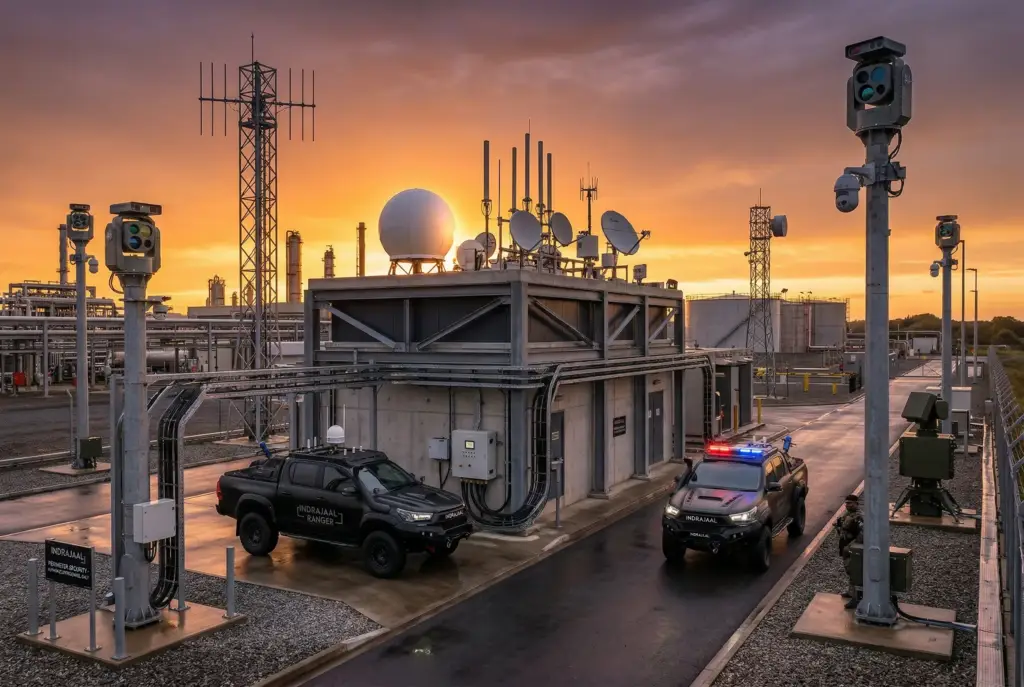
What a Comprehensive Industrial Drone Security System Does
As drones become more affordable, widespread, and regulated, organizations managing lower airspace face a genuinely new category of security challenge. A comprehensive aerial security solution needs to cover four capabilities:
- Detection — identifying unauthorized drones within a defined warning area, using radar, optical sensors, and acoustic detection, whether from a fixed or portable installation.
- Tracking — monitoring a detected drone’s trajectory and, where possible, the operator’s location, to give security teams real airspace situational awareness.
- Identification — classifying a drone as friendly or hostile so authorized drones (e.g., site inspection or delivery drones) can operate without interference, while flagging drone model, range, speed, and payload capacity for anything unauthorized.
- Mitigation — disabling or redirecting confirmed threats via jamming, interception, or directed-energy methods.
(For the full technical breakdown of each capability, including how modern AI-driven classification actually works, see the pillar C-UAS guide — this piece focuses on what these capabilities mean specifically for industrial sites.)
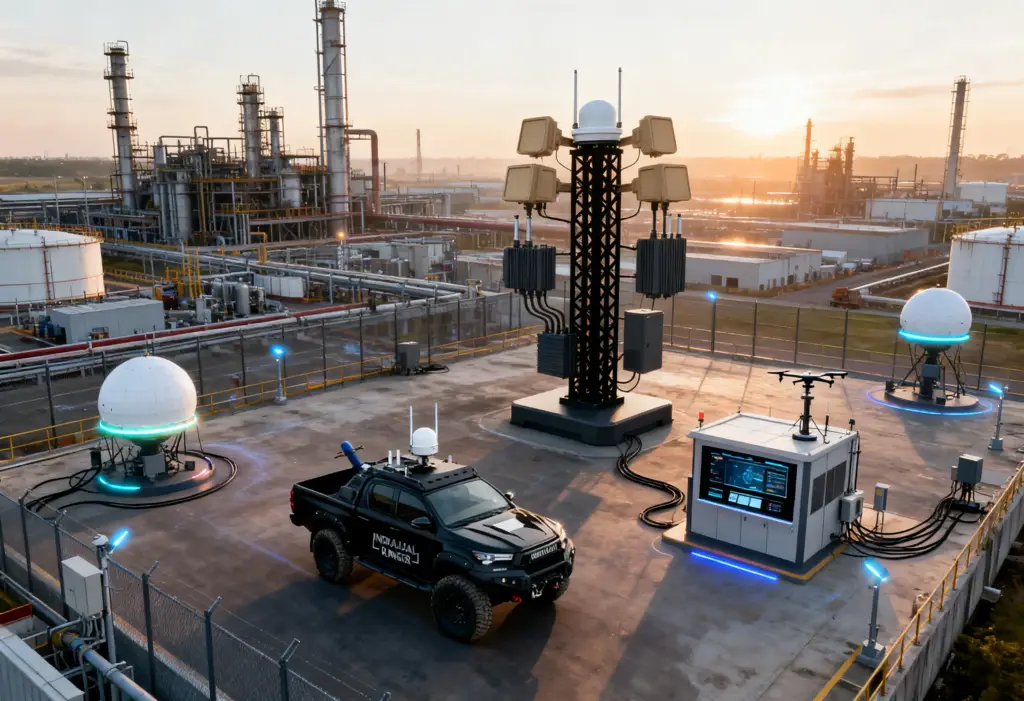
How Indrajaal Protects Industrial Sites Across Sectors
Drone security systems are indispensable tools for safeguarding restricted areas and preventing unauthorized intrusions. By arming them with cutting-edge surveillance technology, these systems can continuously monitor critical infrastructure sites like nuclear facilities, power plants, data centers, refineries, and other secure zones, swiftly identifying and alerting authorities to any unauthorized incursions.
Indrajaal’s cutting-edge drone security system effortlessly oversees extensive sensitive regions, effectively mitigating the threat of intrusions. Indrajaal offers instantaneous data and visuals, enabling security professionals to assess critical situations from a safe distance, minimizing potential dangers.
Indrajaal’s customized C2 system is the heart of the entire operation, providing users with a dependable tactical overview. With the ability to connect various sensors and effectors chosen specifically for each use case, Indrajaal’s 360-degree technology is equipped to handle threats from micro, mini, and large drones in a multitude of environments.
SensonFusion AI – Indrajaal’s Multi-Sensor Fusion
Indrajaal offers an open-systems architecture, providing customers with the flexibility to select the sensor technologies that best suit their needs. These various inputs are seamlessly integrated into Indrajaal’s AI/ML-driven multi-sensor fusion C2 system, allowing for the aggregation of data from a variety of sensor types, such as radar, PTZ cameras, acoustic sensors, and RF technology.
The system continuously identifies potential threats in the background, combining advanced RF-sensor technology with strong processing power to deliver a detailed, real-time overview of airspace conditions across an industrial site. (For the full technical definition of SensorFusion™ AI as part of Indrajaal’s 12-module architecture, Strengthening Military Intelligence: The Role of Counter-Drone Systems)
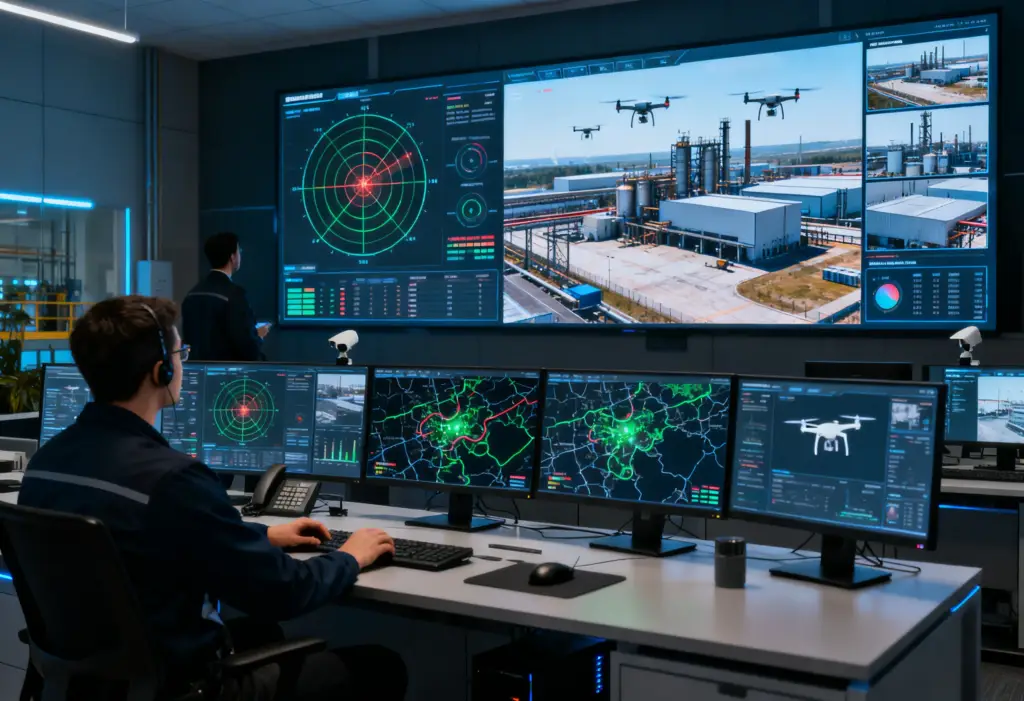
Achieving True Airspace Security with Integrated Counter-UAS Systems
Indrajaal’s integrated counter-UAS systems represent the optimal solution for ensuring comprehensive airspace security. Through the combination of diverse sensor technologies, these systems deliver instantaneous and accurate data regarding the presence and actions of drones, facilitating prompt threat detection. Additionally, the availability of multiple response mechanisms empowers security personnel to select the most suitable course of action.
Indrajaal elegantly solves the challenge of consolidating all sensor inputs into a unified operational interface that can be easily interpreted by operators, all while consistently evaluating emerging potential threats.
Potential Cost Savings and return on Investment (ROI)
By embracing a drone security system, your organization can unlock substantial cost savings through the reduction of manned patrols, the mitigation of security breaches, and the enhancement of overall security efficacy. This not only streamlines operations but also minimizes the financial burden associated with traditional security measures.
The return on investment of a drone security system is influenced by variables such as the site’s size, the desired level of security, and the frequency of security incidents. Investing in this advanced technology can yield significant returns over time, offering long-term benefits for your organization’s security strategy.
Frequently Asked Questions
Nuclear facilities, power plants, refineries, data centers, and other high-value or safety-critical industrial sites are the clearest candidates, since a successful drone incursion at any of these can cascade into safety, operational, or reputational consequences well beyond the immediate incident.
Primarily through reduced reliance on large manned-patrol teams, avoided incident and downtime costs from prevented incursions, and depending on the site and insurer potential insurance or compliance benefits. The specific savings depend on a site’s own baseline security spend and incident history.
SensorFusion™ AI is Indrajaal’s AI/ML-driven multi-sensor fusion system, aggregating data from radar, PTZ cameras, acoustic sensors, and RF technology into one real-time operational picture of airspace conditions.
Risk is elevated during specific operational windows – equipment maneuvers, deliveries, and scheduled maintenance, when personnel and assets are most exposed and unauthorized aerial activity is hardest to distinguish from routine site operations.
Yes, Indrajaal’s open-systems architecture lets sensor and effector selection be tailored per site, meaning one underlying platform can be configured differently for a refinery’s perimeter versus a data center’s more compact footprint, rather than requiring entirely separate systems.
Conclusion
Autonomous drone security has moved from a novel add-on to a core part of industrial site protection — particularly for nuclear facilities, power plants, refineries, and data centers where the cost of a successful incursion extends well past the immediate incident. The technology case is increasingly well established; the next step for most security leaders is building the specific ROI case using their own site’s data, not a generic industry benchmark.
Ready to protect your industrial site with world-class drone defense? Connect with Indrajaal’s experts to build a security and ROI case specific to your site.