

This guide explains how India can defend against a drone threat that’s moved from theoretical to real. It covers India’s direct experience, including the 2021 Jammu Air Force Station attack, the case for autonomous counter-drone technology in national defense, and a concrete five-step process, Detect, Identify, Track and Target, Deploy Countermeasures, Neutralize, showing exactly how a system like Indrajaal closes the loop from detection to defeat.
Key takeaways
- Drones have evolved from recreational devices into tools for reconnaissance, smuggling, and attacks — and India has direct, documented experience with this shift, including the June 2021 drone attack at the Jammu Air Force Station.
- Rogue drone activity in India has included smuggling of weapons, drugs, and ammunition across borders, making counter-drone capability a border-security issue as much as a military one.
- A fully autonomous counter-drone response follows five stages: Detect → Identify → Track and Target → Deploy Countermeasures → Neutralize — understanding this sequence is essential for evaluating whether a given C-UAS platform can actually close the loop end-to-end.
- Strengthening India’s drone defense requires both technology investment and regulatory maturity — stronger monitoring, formalized no-fly zones, and clear rules of engagement around strategic installations.
Table of Contents
- Understanding the Rising Drone Threat
- The Case for Counter-Drone Technology in National Defense
- Enter Indrajaal™ – A 360° Autonomous Aerial Security System
- How Indrajaal Protects a High-Value Installation: A 5-Step Autonomous Process
- Navigating India’s Unmanned Future
- Frequently Asked Questions
- Conclusion
Understanding the Rising Drone Threat
Drone attacks and incursions have become a recurring feature of the global security news cycle, not a rare, isolated event. As drones have evolved from recreational devices into tools for reconnaissance and attack, the threat to critical infrastructure has grown accordingly.
The growing accessibility of drones has heightened concern for law enforcement agencies worldwide, and in response, countries are investing heavily in both drone technology and the counter-drone systems needed to defend against it.
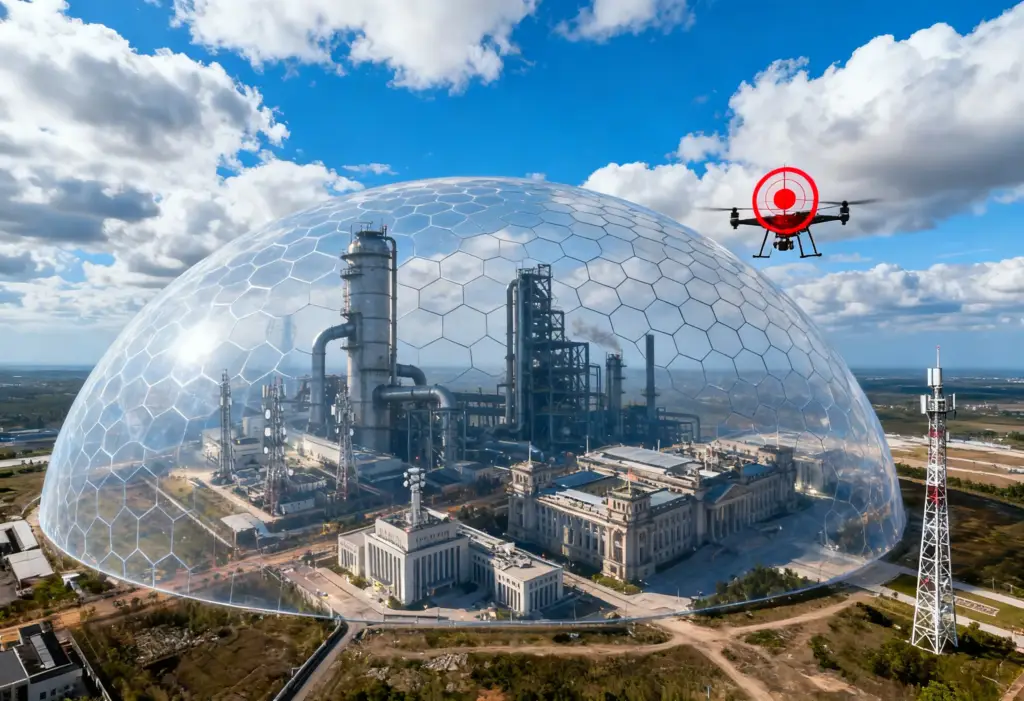
India has direct experience with this threat. The country has faced rogue drone activity used to smuggle weapons, drugs, and ammunition across its borders. The June 2021 drone attack at the Jammu Air Force Station marked a turning point – the first drone attack of its kind on Indian soil, and a stark reminder that this threat had moved from theoretical to real.
This raises an urgent, practical question: how can India effectively defend against drone threats originating from neighboring countries and non-state actors alike?
For the technical foundation behind these systems, see: Counter Drone Systems: Comprehensive Guide [2026]
The Case for Counter-Drone Technology in National Defense
Counter-drone systems equipped with autonomous technology can detect, track, and neutralize rogue drones in real-time, providing a proactive defence mechanism. These technologies are capable of handling a variety of threats, from single drones to coordinated swarm attacks, ensuring comprehensive protection. By securing airspace over sensitive areas, counter-drone technology prevents potential attacks on critical infrastructure, military bases, and civilian areas.
Furthermore, the deployment of counter-drone technology supports broader military operations. It enhances surveillance capabilities, ensuring continuous monitoring of borders and strategic locations. In conflict zones, these systems can protect troops from drone-borne threats, reducing risks to personnel and equipment. The ability to quickly respond to and neutralize drone threats also aids in maintaining the integrity of ongoing operations.
By integrating effective counter-drone systems, India can strengthen its defensive posture, safeguard its sovereignty, and ensure the safety of its citizens against evolving aerial threats.
Related reading: : A Guide to Counter-Unmanned Aerial Systems (C-UAS): Everything You Need to Know
Enter Indrajaal™ – A 360° Autonomous Aerial Security System
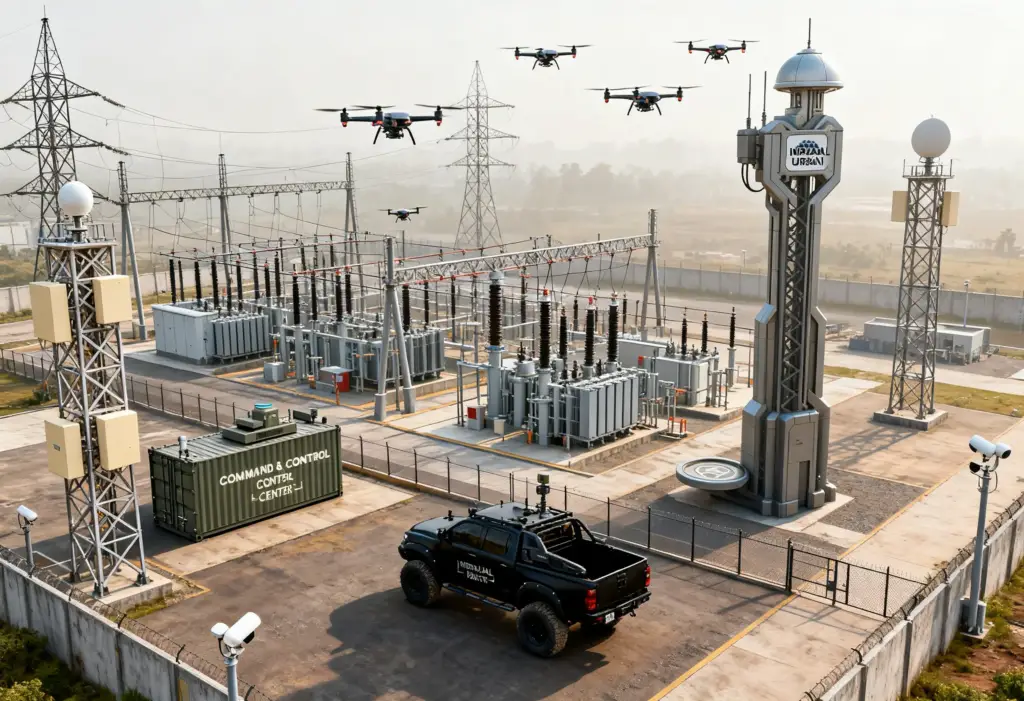
Indrajaal™, the world’s only anti-drone system capable of defending against all classifications and levels of autonomous drones, integrates 12 proprietary modular technologies. These can be used individually or combined to create a comprehensive Autonomous Drone Security solution.
The system is a major advancement in aerial security, defending against sophisticated drone attacks with precision. Its integrated approach ensures airspace security by swiftly neutralizing threats.
Its state-of-the-art drone security system effortlessly oversees extensive sensitive regions, effectively mitigating the threat of intrusions. It provides real-time data and visuals, allowing security professionals to assess critical situations from a safe distance and minimizing potential dangers.
At the heart of Indrajaal™ is its customized Command and Control (C2) system, which connects various sensors and effectors tailored for each use case. This ensures comprehensive 360-degree coverage and enables the system to handle threats from micro, mini, and large drones across diverse environments.
For the full technology breakdown, see: Strengthening Military Intelligence: The Role of Counter-Drone Systems
How Indrajaal Protects a High-Value Installation: A 5-Step Autonomous Process
Indrajaal™ employs a multi-layered approach, integrating radar systems, RF scanners, acoustic sensors, and visual cameras to detect drones across wide areas. These technologies identify and track drones, assessing their type and potential threat based on payload and flight patterns
The counter-drone system follows a 5-step fully autonomous process to protect the skies:
1. Detect
Wide-area detection is achieved using a radar-based counter-drone system deployed around the power plant. As drones enter the protected airspace, the radar system identifies them. Additionally, Radio Frequency (RF) sensors pick up signals from the drones, helping to pinpoint their precise location within the area.
2. Identify
Once the drones are detected, the system proceeds to identify the type of drone, whether commercial, custom-built, or otherwise. This identification process assesses the potential threat posed by each drone, taking into account their payload capabilities and flight patterns to determine the level of danger they represent.
3. Track and Target
After identification, the system tracks the movements of the detected drones. It continuously monitors their flight paths and positions, providing real-time data that is crucial for targeting. The system evaluates the best methods for targeting each drone based on its type and the assessed threat level.
4. Deploy Countermeasures
The next step involves deploying countermeasures to mitigate the threat. The counter-drone system uses RF jamming to disrupt the communication between the drones and their operators. This interference causes the drones to either land or return to their point of origin. In more advanced systems, directed energy weapons, such as lasers, are deployed to target and disable the drones’ critical components.
5. Neutralize Threat
The final stage is the neutralization of the drone threat. Disrupted drones are forced to land or return to their operators due to the loss of communication. When necessary, directed energy weapons are employed to disable the drones by targeting essential components like rotors or electronics, effectively neutralizing the threat and ensuring the safety of the protected area.
Navigating India’s Unmanned Future
The future is unmanned and India’s regulatory and defense posture needs to keep pace with that shift. Strengthening drone regulation, enhancing monitoring, and formalizing no-fly zones around strategic installations are all critical next steps. Effective counter-drone systems, built on advanced sensors, artificial intelligence, and genuine autonomous capability are essential to detecting, tracking, and neutralizing drone threats in real time, not after the fact.
Investing in these technologies gives India stronger defense capability, better-protected sensitive installations, and a real answer to an evolving category of threat to its citizens.
Looking to strengthen your national defense strategy? Connect with Indrajaal’s experts today.
Frequently Asked Questions
The June 2021 drone attack at the Jammu Air Force Station is widely regarded as India’s first drone attack of its kind, marking a turning point in the country’s approach to counter-drone defense.
Detect, Identify, Track and Target, Deploy Countermeasures, and Neutralize Threat — a fully autonomous system moves through all five stages in real time without requiring manual intervention at each step.
Rogue drones have been used to smuggle weapons, drugs, and ammunition across India’s borders, making counter-drone technology a border-security priority alongside its military applications.
Strengthening drone regulation, improving real-time monitoring, and formalizing no-fly zones around strategic installations are key next steps to match India’s technology investment with the regulatory maturity needed to enforce it.
Yes, modern autonomous C-UAS platforms are built to handle both single-drone incursions and coordinated swarm attacks, rather than being limited to one drone at a time.
Conclusion
India’s experience with rogue drone activity, from border smuggling to the 2021 Jammu attack has made the case for autonomous counter-drone defense a practical necessity rather than a theoretical one. A system that can move through detection, identification, tracking, countermeasure deployment, and neutralization autonomously, in real time, is what closes the gap between spotting a threat and actually stopping it. Pairing that technology investment with stronger regulation and formalized no-fly zones is what turns individual system deployments into a genuine national defense posture.