

This piece examines how autonomous anti-drone systems are reshaping what national sovereignty means in practice. It covers why modern aerial threats defeat conventional defences, what autonomy actually delivers in operational terms, how sovereignty itself has expanded beyond territorial control, and how Indrajaal’s autonomous ecosystem approaches the problem.
Autonomous anti-drone systems detect, evaluate, and neutralise aerial threats without requiring human intervention at each decision point. They matter for national sovereignty because modern drone threats, small, fast, cheap, and often deployed in swarms, escalate faster than manual interception can respond, making machine-speed autonomy a requirement rather than an upgrade.
Key takeaways
- Sovereignty has expanded well beyond territorial control. It now depends on the uninterrupted functioning of power plants, airports, financial institutions, and government networks, all of which are exposed to aerial threats.
- Drones represent an asymmetric threat class: small, inexpensive, and easily deployed, they give non-state actors and adversarial forces capability disproportionate to their cost.
- Conventional radar and manual interception were built for large-scale weapons and struggle against swarms moving with speed and unpredictability.
- Autonomous defence delivers four things manual systems cannot at scale: response speed measured in milliseconds, scalability across sprawling assets, precision in distinguishing friend from foe, and resilience that isn’t subject to fatigue.
- Autonomy is not a replacement for human judgment. It exists to give defenders the time and information to exercise that judgment meaningfully.
Table of Contents
Securing Sovereignty: Shaping the Autonomous Future with Anti-Drone Defense
For centuries, sovereignty has been safeguarded by courage, strategy, and strength. From fortresses that protected kingdoms to radars that secured modern borders, the definition of defense has evolved with every era.
Today, the battlefield has shifted once again — to the skies above us, where threats are invisible, fast, and unmanned. In this new era, the ability to secure sovereignty does not rest solely on the size of an army or the strength of an arsenal, but on how swiftly and intelligently a nation can respond with autonomous anti-drone systems to unseen threats.
The New Frontier of Security
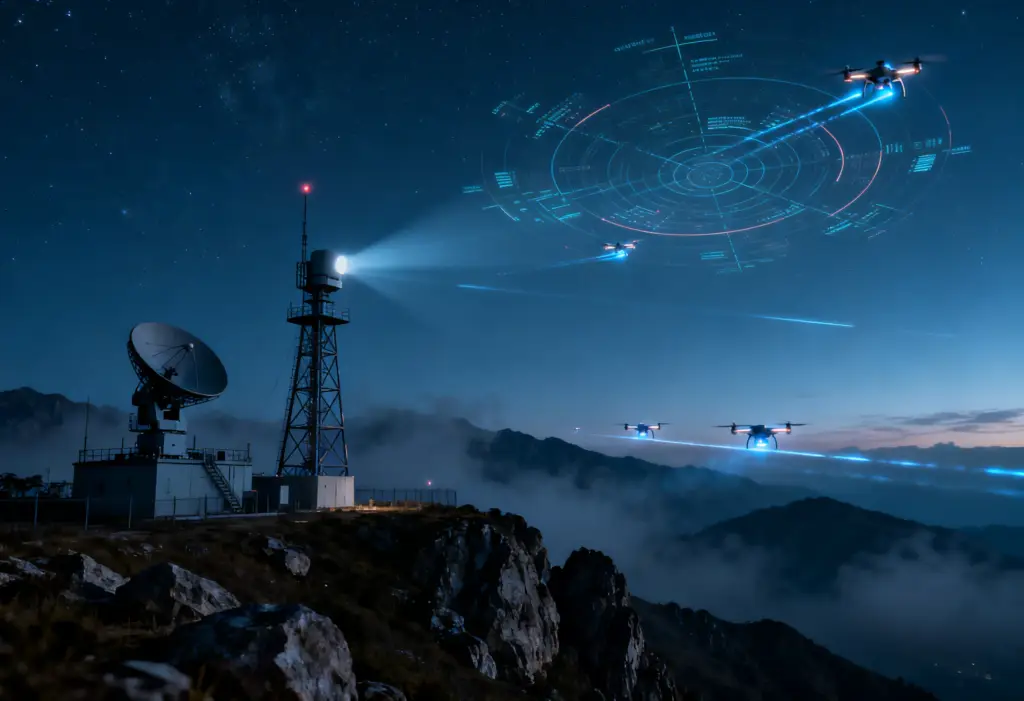
The rise of drones and unmanned aerial systems has redefined modern warfare and security. Once celebrated as symbols of innovation, drones have also become instruments of disruption.
From surveillance to precision strikes, from critical infrastructure attacks to destabilizing psychological warfare, they represent a class of asymmetric threats that are difficult to predict — and even harder to counter with conventional defenses. Small, inexpensive, and easily deployed, these airborne threats have leveled the playing field. They give non-state actors, terror groups, and adversarial forces an outsized advantage.
Traditional radar systems and manual interception methods, designed for large-scale weapons, often fail to detect or neutralize swarms of drones moving with speed and unpredictability. This shift demands more than vigilance. It demands autonomy.
Also Read: Counter Drone Systems: Comprehensive Guide [2025]
Autonomous Anti-Drone Systems: The New Defender
The challenge of modern threats lies in their immediacy. As we have seen in recent events, a drone intrusion can take mere seconds to escalate into a catastrophe. Human reflexes and manual systems are no longer enough.
Autonomous defense ensures:
- Speed of Response: Reaction times measured in milliseconds, not minutes.
- Scalability: Protecting sprawling borders, critical assets, and urban hubs.
- Precision: Differentiating friend from foe with unmatched accuracy.
- Resilience: Always vigilant – immune to fatigue and hesitation.
Here, autonomy is not about replacing human judgment. It’s about empowering it. It gives defenders the time and information to anticipate, to act, and to neutralise before harm unfolds, rather than forcing split-second decisions under incomplete information.
Related reading: Autonomous Counter-Drone Systems Explained
Sovereignty in the 21st Century
Sovereignty is no longer just about territorial control. In today’s interconnected world, it is about ensuring the uninterrupted flow of life – from power plants to airports, financial institutions to government networks. A breach in any of these is not only a security risk but a disruption of national confidence and stability.
By securing the skies, autonomous defense systems safeguard trust. Citizens can live and work without fear, industries can operate without disruption, and governments can function with the assurance that invisible threats are being met with invisible shields.
This is sovereignty redefined: not reactive, but proactive; not dependent on walls, but on intelligence.
Just as the advent of nuclear deterrence changed the course of the 20th century, autonomous defense will define the security architecture of the 21st.
Related reading: How Indrajaal shields your city from the growing drone menace
Building the Shield with Indrajaal Anti-Drone Systems
The story of defense has always been the story of adaptation. Just as fortresses gave way to firepower, and radars gave way to satellites, the age of autonomy is upon us. The question is no longer if nations will adopt autonomous defense, but how quickly they can build, integrate, and deploy it. In the autonomous future of defense, nations will not only secure their skies; they will secure their destiny.
This is where Indrajaal, India’s first autonomous AI-powered anti-drone ecosystem, is positioned.
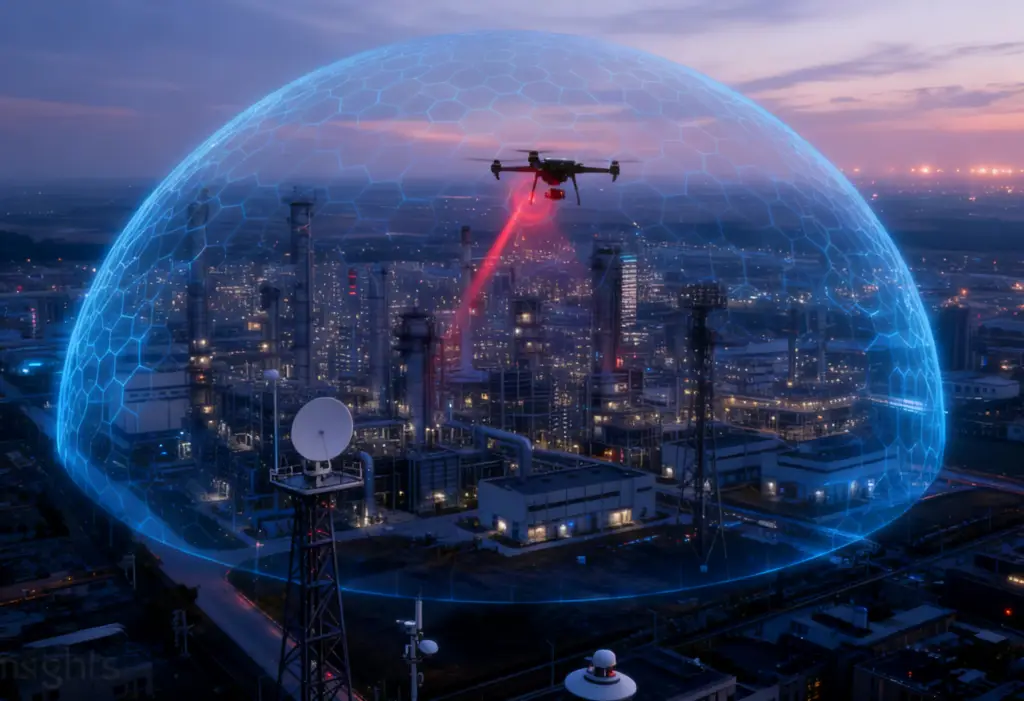
Designed as the world’s first autonomous counter-drone system of its kind, Indrajaal embodies the philosophy of proactive, invisible, and intelligent defense. It is an ecosystem — a shield that can monitor, detect, evaluate, and neutralize threats before you see them. From lone drones to swarms, from asymmetric intrusions to coordinated aerial offensives, Indrajaal’s anti-drone system can adapt faster than adversaries can innovate.
Built on the pillars of AI, machine learning, and modular scalability, Indrajaal protects not just borders but entire nations, cities, critical infrastructure, and strategic assets. It is a defense that never sleeps, never hesitates and never fails to respond.
Most importantly, Indrajaal represents more than technology. It represents sovereignty in action. By ensuring that every threat is met with certainty, it allows nations to grow, citizens to live securely, and industries to operate without fear.
With Indrajaal, the autonomous anti-drone system, the path is clear. The skies are secure. The future is sovereign.
Take control of your sovereignty. Speak with Indrajaal’s specialists to understand how autonomous anti-drone systems can protect your nation’s critical assets.
Frequently Asked Questions
An autonomous anti-drone system detects, evaluates, and neutralises aerial threats without requiring human intervention at each decision point, using AI-driven sensor fusion and automated countermeasure selection to respond at machine speed.
Conventional radar was designed to detect large-scale aerial weapons like aircraft and missiles. Small drones present low radar cross-sections, fly at low altitudes, and move unpredictably, particularly in swarms, which conventional systems were never built to track or engage at scale.
No. Autonomy handles the speed-critical portions of the response, detection, classification, and countermeasure selection, while human operators retain oversight and authority over escalation. The purpose is to give defenders better information and more time, not to remove them.
Modern sovereignty depends on the uninterrupted functioning of critical systems: power, aviation, finance, and government networks. Because drones can disrupt any of these without crossing a physical border, protecting airspace has become inseparable from protecting sovereignty itself.
Because their cost is wildly disproportionate to the disruption they can cause. A drone costing a few hundred dollars can force an airport closure, surveil a strategic facility, or damage infrastructure worth millions, giving smaller actors capability that once required state-level resources.
Conclusion
The history of defence is a history of adaptation, and the current shift is toward autonomy because the threat itself has become faster than manual response can manage. What’s genuinely new isn’t the existence of aerial threats, but their cost, accessibility, and speed. Sovereignty in this era depends less on the scale of a nation’s arsenal and more on how quickly and intelligently it can meet an unseen threat, which is exactly what autonomous anti-drone systems are built to deliver.