

This piece examines how drone warfare has changed maritime security, and what defending against it actually requires. It covers the real-world port and naval attacks already reshaping the threat picture, why maritime environments demand purpose-built rather than repurposed land systems, and how Indrajaal Maritime’s multi-domain approach protects above, on, and beyond the waterline.
A maritime counter-drone system protects ports, naval vessels, and offshore assets against aerial and surface unmanned threats: UAVs and FPV drones above the waterline, and unmanned surface vessels (USVs) on it. Unlike land-based C-UAS, maritime systems must also withstand salt corrosion, constant motion, and sustained all-weather exposure, which is why purpose-built marine engineering matters as much as the detection technology itself.
Key takeaways
- Maritime drone threats are already operational, not hypothetical. Russian drone strikes have damaged Ukrainian port facilities, and in May 2025 a sustained drone campaign against Port Sudan struck the Flamingo Bay naval base, fuel depots, and port infrastructure across five consecutive days.
- Those Port Sudan strikes had strategic consequences well beyond the immediate damage: Russia has since abandoned its long-planned Red Sea naval base at the site.
- Maritime threats span three domains: aerial (UAVs, FPVs, loitering munitions), surface (hostile USVs), and cyber (signal and GNSS manipulation). Defending only one leaves the others open.
- Marine environments destroy equipment not built for them. Salt, spray, constant motion, and sustained exposure mean repurposed land-based systems degrade quickly, making purpose-built marine engineering a functional requirement rather than a premium feature.
- A single drone incident at a major port can halt container movement, delay fuel supplies, and produce economic effects far beyond the port itself.
Table of Contents
A New Age of Maritime Threats
The sea has always been a battlefield. From the Battle of Salamis that safeguarded Greece way back in the 5th century BCE to the naval blockades of World War II, control of ports and sea lanes has decided the fate of nations.
In this new era, these same gateways face a new kind of siege: one led by drones. Swarming FPVs, DIY UAVs, and USVs now pose the biggest maritime threats. They can surveil, disrupt, and even destroy with a fraction of the cost of conventional weapons

This isn’t tomorrow’s threat. It’s already happening. Russian drone strikes have crippled port facilities in Ukraine. And in May 2025, a sustained drone campaign attributed to Sudan’s Rapid Support Forces struck Port Sudan across five consecutive days, hitting the Flamingo Bay naval base, strategic fuel depots, the port’s converter station, and its airbase. (Verified by the Centre for Information Resilience, which confirmed damage to six sites between 4 and 7 May using satellite imagery and verified footage.)
One hostile drone can cripple a ship. A swarm can overwhelm a port. And unlike traditional attacks, they arrive without a declaration of war.
That’s why Indrajaal Maritime, India’s most effective counter-drone system, exists.
Related reading: Securing Sovereignty: Shaping the Autonomous Future with Anti-Drone Defense
Multi-Domain Protection, One Integrated Shield
Indrajaal Maritime is a modular, autonomous counter-drone system built specifically for maritime environments. It protects both naval vessels and port assets against threats from above and on the surface, with an AI-powered engine that fuses detection, classification, and neutralisation into one continuous loop.
From hijacking hostile signals to jamming FPV swarms and spoofing GPS guidance, Indrajaal Maritime responds at machine speed, before human operators can even register the threat.
- Above the waterline: Neutralizes UAVs, FPVs, and loitering munitions.
- On the surface: Detects and disables hostile USVs before they can breach perimeters.
- Cyber layer: Cuts the enemy off at the source with signal takeovers and GNSS spoofing.
For the technical foundation behind these methods, see: A Guide to Counter-Unmanned Aerial Systems (C-UAS): Everything You Need to Know
Built for the Sea, Ready for Operation
The ocean is unforgiving. Salt, spray, constant motion, and sustained operational stress degrade anything not specifically hardened against them.
Indrajaal Maritime is engineered for that environment, with:
- Rugged, corrosion-resistant housings
- Sealed, all-weather electronics
- Mast-mounted, wide-coverage sensors
- Continuous autonomous operation
This is not repurposed land defence. It’s purpose-built maritime security technology, and that distinction matters more than it might sound: a land system deployed at sea doesn’t fail dramatically on day one, it degrades quietly over months until it’s no longer reliable when it matters.
Why Maritime Needs Indrajaal Now
Ports: Gateways of Global Trade
One drone incident can halt container movement, delay fuel supplies, and disrupt economies. Indrajaal Maritime protects these lifelines.
Naval Vessels: Assets & Targets
On open seas, ships are exposed and isolated. Indrajaal creates a protective autonomous defence dome.
Offshore Critical Infrastructure
Oil rigs, undersea cable landing points, refineries, and LNG terminals are all vulnerable to aerial and surface approach, frequently in locations far from any rapid-response support.
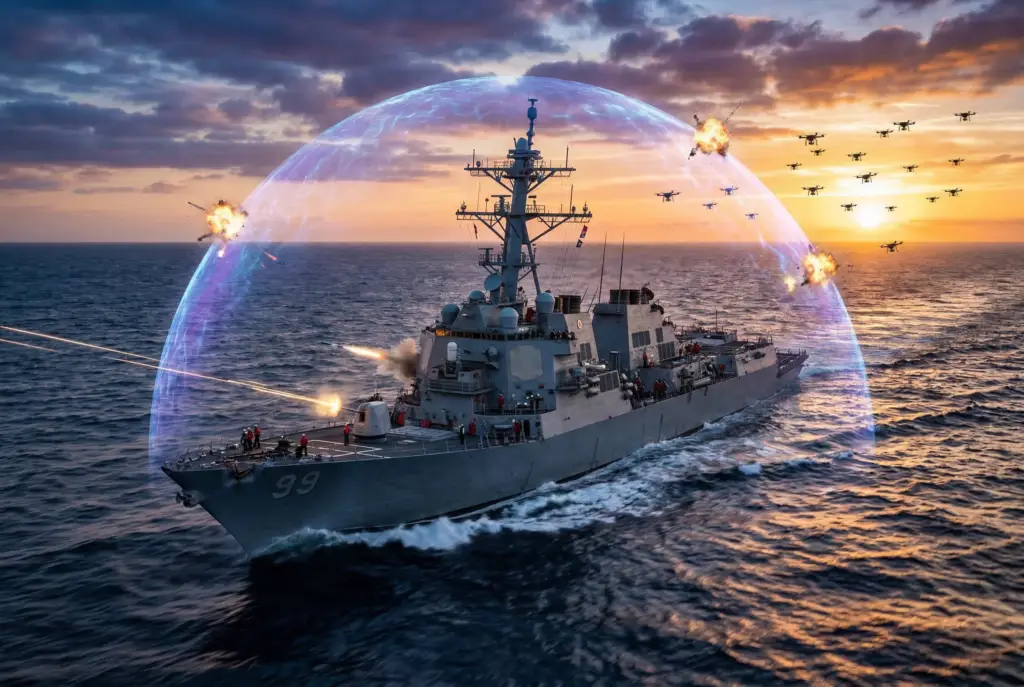
The Indrajaal Maritime Advantage
- Autonomous Intelligence: Acts at machine speed, without delay
- Multi-Domain Coverage: Air and sea, integrated into one defense loop
- Rugged Engineering: Tested and proven in extreme marine environments
- Scalable Deployment: From a single vessel to an entire naval fleet or port complex
Control of the seas has always meant control of the future. But in an era of invisible, asymmetric threats, dominance is no longer about who has the biggest fleet. It’s about who can secure their fleet against the unseen.
ndrajaal Maritime ensures ports remain open, vessels remain secure, and nations remain connected, no matter what rises above the horizon or skims below the waves.
The next maritime war won’t be fought with cannons and carriers alone. It will be fought with drones. And only those wired for this new battlefield will prevail.
Also Read: Counter Drone Systems: Comprehensive Guide [2026]
Frequently Asked Questions
A maritime counter-drone system protects ports, naval vessels, and offshore assets against unmanned threats across multiple domains: aerial UAVs and FPV drones, unmanned surface vessels (USVs), and signal-based attacks. It differs from land-based C-UAS in requiring corrosion-resistant, all-weather engineering for sustained marine deployment.
Marine environments degrade equipment not built for them. Salt corrosion, constant vessel motion, spray, and sustained exposure cause land-rated systems to deteriorate over time, often quietly, until reliability is compromised. Purpose-built maritime systems use sealed electronics, corrosion-resistant housings, and mounting designed for a moving platform.
Unmanned surface vessels are uncrewed boats that can be used for surveillance or attack. They matter because port defences focused solely on aerial threats leave the surface approach open, and a USV can carry a significantly larger payload than most aerial drones.
Yes. Russian drone strikes have damaged Ukrainian port facilities, and in May 2025 a sustained drone campaign struck Port Sudan across five consecutive days, hitting a naval base, fuel depots, and port infrastructure, with strategic consequences including Russia’s subsequent abandonment of planned naval base facilities at the site.
Offshore oil rigs, LNG terminals, refineries, undersea cable landing points, and anchored fleet assets all face aerial and surface unmanned threats, often in remote locations far from rapid-response support.
Conclusion
The next contest for maritime control won’t be decided by cannons and carriers alone. Port Sudan demonstrated something that should concern any port authority or naval planner: a paramilitary group with commercially available drones disrupted a facility significantly enough that a major power walked away from a strategic naval project there. That’s the asymmetry defining maritime security now, and meeting it requires defence purpose-built for the environment it operates in, across every domain a threat can arrive from.