

This guide examines how nano and micro drones are changing airspace security. It covers what makes them nearly undetectable to legacy systems, the three capabilities they excel at (stealth reconnaissance, swarm disruption, and precision micro-payload delivery), real fielded examples including China’s mosquito-sized surveillance drone and the Black Hornet, and what a counter-drone system needs to close this specific blind spot.
A nano drone is an extremely small unmanned aerial vehicle, in some cases just 1 to 2 centimeters long and weighing under a gram, built for covert surveillance, reconnaissance, or precision tactical operations. Their size and low radar cross-section let them slip past detection thresholds that work reliably against normal-sized drones, creating a genuine blind spot in conventional airspace security.
Key takeaways
- Nano drones have moved from experimental concept to fielded reality. China’s National University of Defense Technology publicly unveiled a mosquito-sized surveillance drone in June 2025, roughly 1 to 2 centimeters long and weighing about 0.3 grams.
- The original Black Hornet Nano, already in active military use, weighs just 18 grams and can capture high-definition video and thermal imagery while remaining extremely difficult to detect visually or acoustically.
- Nano drones excel at stealth reconnaissance, coordinated swarm disruption, and precision micro-payload delivery, three capabilities that traditional security infrastructure was never built to counter at this scale.
- Legacy detection systems lack the sensitivity to reliably identify drones this small, creating a genuine and growing blind spot in national security protocols worldwide.
- Countering nano drones requires the same layered approach used against larger threats (radar, RF, and AI fusion), tuned specifically for extremely small, low-signature targets.
Table of Contents
A New Scale of Threat
Most conversations about drone security still picture something roughly the size of a large bird, a quadcopter with visible rotors and a recognizable silhouette on radar. That picture is already out of date. A new generation of nano and micro drones, some smaller than a human fingernail, is changing what “detectable” even means in airspace security.
These aren’t hobbyist toys. They’re purpose-built reconnaissance and tactical tools, developed by defense research institutions and increasingly available in commercial and semi-commercial form. This piece looks at how nano drones are reshaping warfare, why they’re so difficult to detect with conventional systems, and why advanced, autonomous counter-drone platforms like Indrajaal are becoming essential to closing this specific gap in national security.
You’re already late if you saw me.
That’s the silent message today’s nano drones deliver as they slip through restricted airspace, peer through windows, or hover undetected in crowded urban zones. In June 2025, China’s National University of Defense Technology publicly unveiled a drone engineered to mimic a mosquito, complete with leaf-shaped wings, thin legs, and a body barely visible to the naked eye. At roughly 1 to 2 centimeters long and about 0.3 grams, with wings beating up to 500 times per second, the device is genuinely difficult to spot by sight or sound, and its size alone lets it evade conventional radar.

And security forces are already behind.
Once a fringe innovation, nano drones are now critical tactical assets and rising threats. They bypass radar, infiltrate blind spots, and operate where humans and larger machines cannot. For every operational advantage they bring, there is a mirror risk. Surveillance becomes espionage. Strategy becomes sabotage. Defence turns into vulnerability.
For the technical foundation on how modern C-UAS platforms handle this range of threats, see: What is CUAS? Counter Unmanned Aircraft System Explained (2026 Guide)
How Small, Smart, Strategic Nano Drones Are Shaping the Future of War
Stealth Reconnaissance
Nano drones are designed for silent infiltration. They can enter enemy territory unnoticed, stream live video, and collect real-time intelligence. Ideal for urban combat, hostage scenarios, or bunker-based surveillance, they provide eyes where boots cannot go. Their agility allows them to fly through narrow alleys, broken structures, or even ventilation shafts, offering critical tactical data without physical presence. This makes them a vital part of modern drone detection systems and counter-intelligence operations.
Swarm Capability and Disruption
When used in groups, nano drones become a disruptive force. Swarm formations powered by AI can coordinate in real time, confusing anti-drone defense systems, jamming enemy communications, and executing simultaneous objectives. Even if a portion of the swarm is intercepted, others continue. This decentralised disruption is fast becoming a core tactic in next-generation warfare, pushing the demand for autonomous counter UAV solutions and UAV threat mitigation technologies.
Micro Payloads With Precision Impact
Despite their size, nano drones can carry impactful payloads. Some are equipped with micro-explosives, signal jammers, or chemical dispersal agents. These are not designed for mass destruction but for precise, high-value targeting. From disabling radars to striking key personnel, nano drones are the ultimate scalpel in a world full of hammers.
Related reading: Drone Swarms: The Invisible Threat Lurking in Urban Skies

Decoding the Real Threat
Nano drones are difficult to detect and even harder to track. Traditional security infrastructure generally lacks the sensitivity to identify drones at this scale, creating a genuine, emerging blind spot across many national security protocols.
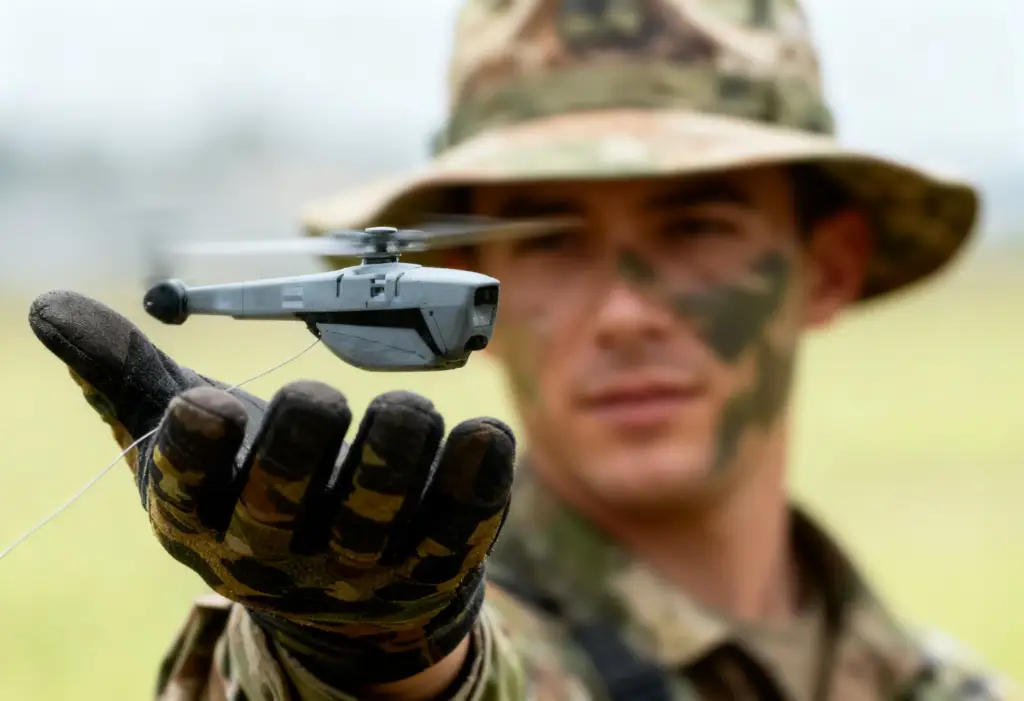
Consider the Black Hornet Nano, one of the most widely deployed micro-reconnaissance drones in active military use. The original Black Hornet weighs just 18 grams, barely the size of a human palm, and can silently capture high-definition video and thermal imagery, transmitting real-time intelligence without alerting the area under observation. (Source: Teledyne FLIR) Newer generations in the same product line have grown somewhat larger for added capability (the current Black Hornet 4 weighs around 70 grams), but even at that size, it remains genuinely difficult to detect with legacy systems.
As commercial and defense-grade nano drones become smaller, smarter, and more widely accessible, security frameworks need to evolve specifically to counter these functionally invisible threats. Such drones can realistically target fuel lines, power relays, and command centers, potentially disabling key infrastructure with minimal trace. These scenarios are no longer theoretical. In dense urban zones, particularly in active conflict areas, nano drones pose a genuine risk to transport systems, communication towers, and civilian safety alike.
The global availability of commercial nano drones, combined with open-source AI navigation software, has also meaningfully lowered the barrier to entry for non-state actors. The ability to modify off-the-shelf drones into surveillance or attack tools has grown quickly, and capability that was cutting-edge military technology a decade ago is increasingly accessible well beyond state militaries.
Detect, Defend, Neutralise
Nano drones represent a genuinely new category of threat: small enough to be functionally invisible to legacy systems, but capable of espionage, sabotage, surveillance, and precision strikes all the same. The implications span from tactical battlefield use to civilian infrastructure risk, and they’re immediate rather than distant.
As this threat category matures, layered anti-drone technology that integrates radar detection, RF and electronic warfare methods, and kinetic interception is what’s needed to close the gap, not any single detection method in isolation. Indrajaal is built around exactly this kind of integrated approach, designed to detect, track, and neutralize threats across this range of scale in real time.
The operating environment has genuinely changed. Traditional perimeter security assumptions are increasingly obsolete against threats that arrive in silence, in coordinated groups, and within seconds. Effective prevention and neutralization now needs to be autonomous, real-time, and persistent, because at nano scale, if a threat is visible to the naked eye, the response window has likely already closed.
Protect your site from nano-scale incursions. Schedule a technical briefing with Indrajaal’s team to evaluate your specific vulnerabilities and design a tailored detection-and-neutralization plan.
Also Read: Why your border security strategy is incomplete without drone defence
Frequently Asked Questions
A nano drone is an extremely small unmanned aerial vehicle, in some cases just 1 to 2 centimeters long, built for covert surveillance, reconnaissance, or precision tactical operations. Their small size makes them very difficult to detect with radar and other legacy security systems.
China’s National University of Defense Technology unveiled a mosquito-mimicking drone in June 2025 measuring roughly 1 to 2 centimeters long and weighing approximately 0.3 grams, with wings that beat up to 500 times per second.
The Black Hornet is a palm-sized military reconnaissance drone used for real-time tactical surveillance. The original version weighs 18 grams and can capture high-definition video and thermal imagery silently, giving ground troops situational awareness without exposing their position.
Legacy radar and surveillance systems were built to detect objects far larger than a nano drone. Their extremely small physical size and low radar cross-section let them slip past detection thresholds that work reliably against normal-sized commercial or military drones.
Yes. AI-coordinated nano drone swarms can confuse anti-drone defenses, jam communications, and carry out simultaneous objectives across multiple points, and because the swarm is decentralized, intercepting some units doesn’t stop the rest from continuing their mission.
Conclusion
Nano drones mark a genuine shift in scale for airspace security, from a threat category built around a visible object to one where the entire premise of visual or radar-based detection can quietly fail. The response has to match that shift: layered radar, RF, and AI-driven detection, tuned specifically for extremely small, low-signature targets, and built to act at machine speed rather than waiting for a threat to become visible to the human eye. By the time it’s seen, at this scale, it’s very likely already too late.