

This guide explains what makes drone swarms a fundamentally different threat from a single rogue drone. It covers how swarms coordinate without a central leader, why cities offer them specific tactical advantages, why legacy radar and jamming approaches fail against them, and what a defense system needs to counter a threat operating at machine speed.
A drone swarm is a synchronized network of autonomous UAVs operating as a single collective system, with no central leader. Individual units communicate, adapt, dodge obstacles, and recalculate formation in milliseconds. Countering one requires a system operating at the same machine speed, since human-paced detection and response is structurally too slow against dozens of simultaneous, adaptive targets.
Key takeaways
- A drone swarm is a synchronized network of autonomous UAVs operating as a single collective system, with no central leader, communicating, adapting, and recalculating formation in milliseconds.
- On March 11, 2025, Russian air defenses reported intercepting 337 Ukrainian drones across 10 regions in a single night, at the time the largest drone attack on Russian territory in three years, illustrating the scale coordinated drone attacks can now reach.
- Legacy defenses struggle specifically against swarms: radar was built to detect large, single, loud threats, and jammers that work against one drone become far less effective against a swarm that reroutes and reconfigures in real time.
- Countering a swarm requires a system operating at machine speed, since by the time a human-led team detects, assesses, and responds to one drone in a swarm, the swarm as a whole may have already completed its mission.
Table of Contents
The Rise of Drone Swarms and a New Kind of Aerial Threat
The skies above our cities are getting smarter and more dangerous. Once hailed as marvels of modern convenience, drones have become the eyes, hands, and wings of the future. But today, they aren’t flying solo. They’re flying together: thinking, manoeuvring, and executing as one.
Welcome to the age of drone swarms: an invisible, intelligent threat silently infiltrating the airspace over our homes, offices, and critical infrastructure.
And unlike missiles or tanks, they don’t roar in—they whisper.
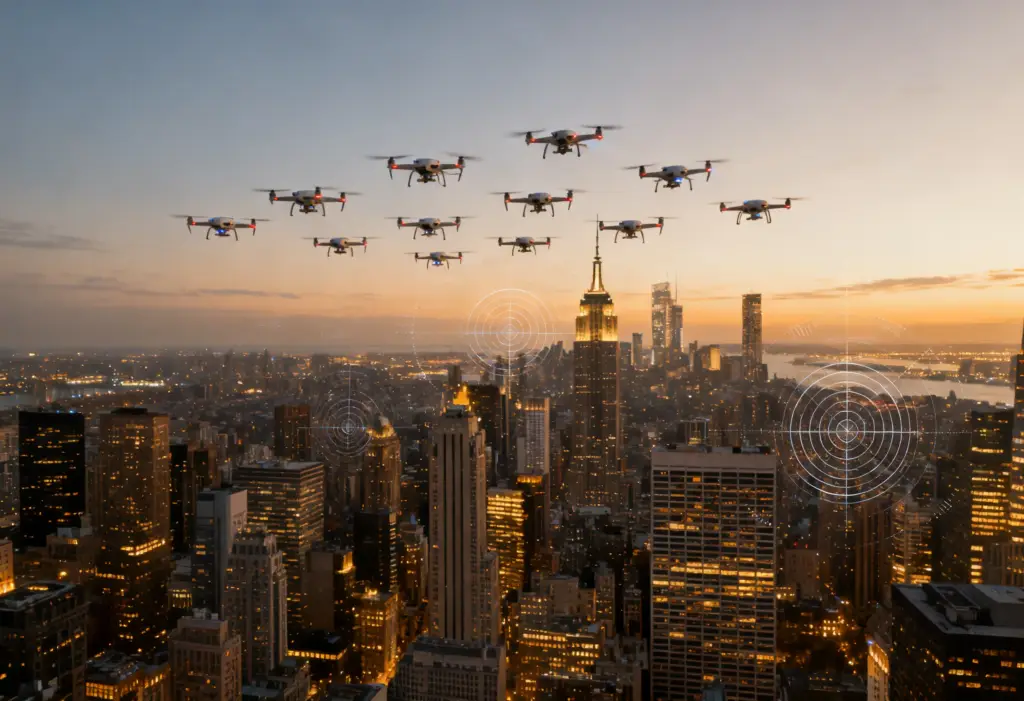
Swarm Warfare: Intelligence in Formation
The skies above cities are getting smarter, and more dangerous. Once seen mainly as tools of convenience, drones have become the eyes, hands, and wings of modern infrastructure and modern conflict alike. Increasingly, they aren’t operating solo. They’re operating together: thinking, maneuvering, and executing as a coordinated whole.
A drone swarm is a synchronized network of autonomous flyers operating as a single, collective system. There’s no central leader controlling the group; the swarm’s coordination logic itself functions as the leader. Individual units communicate, adapt, dodge obstacles, shift formation, and recalculate their approach in milliseconds, without waiting for a human operator to direct each one.
The scale this can reach is no longer theoretical. On March 11, 2025, Russian air defenses reported intercepting 337 Ukrainian drones across 10 regions in a single overnight attack, at the time the largest drone assault on Russian territory in three years, coordinated with the kind of speed and precision that legacy point-defense systems were never built to handle.
For the technical foundation on how counter-drone systems work generally, see: A Guide to Counter-Unmanned Aerial Systems (C-UAS): Everything You Need to Know
Why Cities Are the Perfect Target
Urban airspace is a paradox. It’s densely packed, digitally connected, and constantly in motion, yet remains surprisingly underprotected relative to the value concentrated within it. Skyscrapers cluster tightly, communication networks run through every corner, and millions of people move through crowded transit hubs and public spaces daily.
That combination makes cities an genuinely attractive target. Add the widespread availability of off-the-shelf drone kits, open-source swarm coordination software, and a regulatory framework still playing catch-up, and the result is close to a blueprint for orchestrated disruption.
For a swarm specifically, cities offer real tactical advantages: tight alleys to weave through, radar shadow zones created by dense structures, and GPS jamming zones that can be exploited rather than avoided. Small individual unit size lets a swarm blend into ambient background noise, and speed lets it strike before it’s even noticed. The threat isn’t limited to passive hovering either: swarms are capable of intercepting communications, conducting reconnaissance, disrupting digital infrastructure, and in the most severe scenarios, delivering weaponized payloads with real precision.
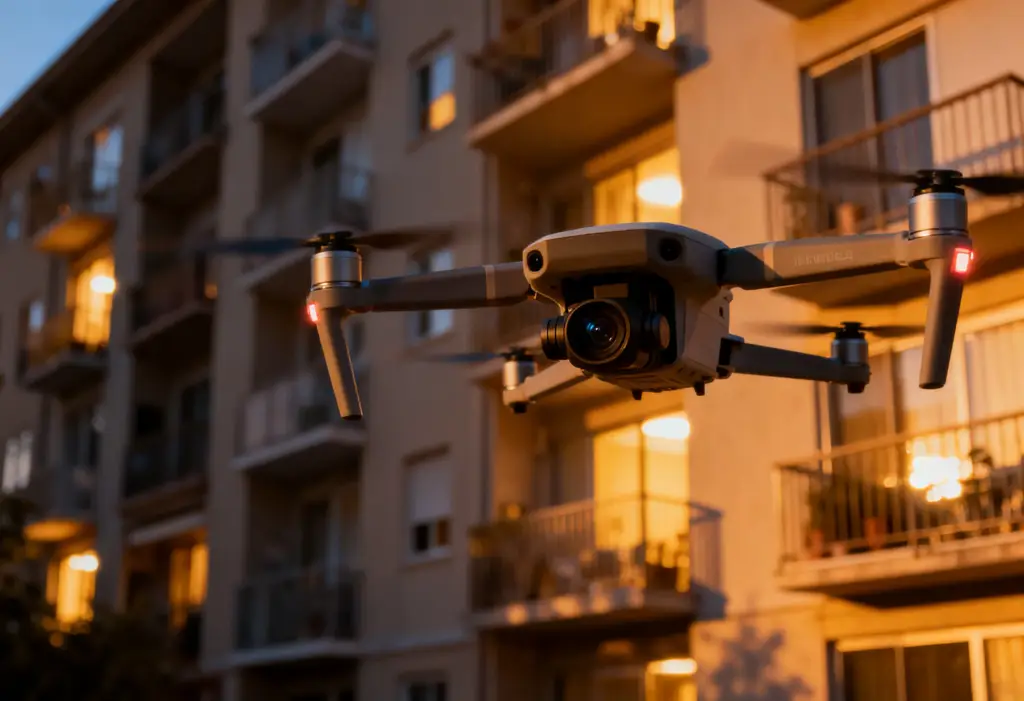
Old Defences, New Problems
Radar systems were designed for a different era, one where threats were large, loud, and easier to detect. While they can spot aircraft and missiles, a swarm of compact drones presents a completely different challenge. These machines are small enough to slip through detection nets and smart enough to avoid traditional countermeasures.
Jammers face similar limitations. What works against a single drone becomes ineffective against a swarm that’s constantly adapting, rerouting, and reconfiguring in real time. With decentralised communication, autonomous movements, and unpredictable tactics, swarms are difficult to control using conventional methods.
Even human-led response teams, no matter how well-trained, are simply outpaced. By the time a threat is detected, assessed, and acted upon, a swarm could have already completed its mission—whether it’s surveillance, sabotage, or something far more dangerous.
The bottom line is simple: when drone swarms strike, there’s no time for manual decisions. You need systems that are as fast, intelligent, and coordinated as the threat itself.
Also Read: Counter Drone Systems: Comprehensive Guide [2026]
Indrajaal: Built for Swarm-Scale Threats
Indrajaal is an autonomous wide-area drone defence dome, designed to counter the most complex threats of our time: drone swarms. But unlike traditional systems that react, Indrajaal anticipates. It doesn’t just detect incoming drones, it understands their intent.
Powered by advanced AI decision engines, real-time sensor fusion, and constant 24/7 surveillance, Indrajaal can secure up to 4,000 square kilometres of airspace without a single manual command. Indrajaal can integrate all kinds of equipment such as jammers, spoofers, cyber takeover systems, radars, kamikaze drones and edge processing systems into its umbrella to provide a single, highly effective system capable of handling all kinds of threats.
This is not a one-trick jammer or a handheld drone gun. It’s an end-to-end aerial defence ecosystem. One that monitors, analyses, classifies, and neutralises hostile drones in milliseconds. From national borders and oil refineries to airports, metro hubs, and industrial zones, the system wraps an invisible fortress around everything that matters.
In a world where threats don’t wait, neither does Indrajaal. Drone swarms won’t issue warnings. They won’t give you time. They’ll arrive with precision, coordination, and silence.
At Indrajaal, we believe the only way to fight intelligence is with intelligence.
Warfare has evolved. So must our defenses.
Frequently Asked Questions
A drone swarm is a synchronized network of autonomous UAVs operating as a single collective system, with no central leader, capable of communicating, adapting, and shifting formation in real time based on the swarm’s own coordination logic.
Real-world examples already reach hundreds of coordinated drones in a single attack. On March 11, 2025, Russian air defenses reported intercepting 337 Ukrainian drones across 10 regions in a single overnight attack.
Radar was designed to detect large, single, loud threats like aircraft and missiles, not clusters of small, low-signature drones. Jammers that disable a single drone’s communication become far less effective against a swarm that reroutes and reconfigures its communication pathways in real time across multiple units.
Dense urban structures create radar shadow zones and GPS jamming opportunities, tight spaces let small drones maneuver undetected, and background noise and activity let swarms blend in until they’re already close to their target.
Indrajaal combines AI-driven threat anticipation, real-time multi-sensor fusion, and a coordinated response layer, integrating jamming, spoofing, cyber takeover, radar, and interceptor drones, all operating autonomously across up to 4,000 square kilometers without requiring manual command at each step.
Conclusion
Drone swarms represent a genuinely different category of threat from a single rogue drone: decentralized, adaptive, and fast enough that manual, human-paced response is structurally too slow. Countering that requires a system built on the same principles the threat itself uses: autonomy, real-time coordination, and machine-speed decision-making, across an area wide enough to matter. As drone swarm capability continues to mature in active conflicts and beyond, the defenses built to counter them have to mature at the same pace, not lag behind it.