

This piece examines how India’s integrated air defence grid, including autonomous counter-drone systems like Indrajaal, held during one of the most significant coordinated drone offensives faced by any country to date. It covers what happened during Operation Sindoor’s drone counter-offensive phase, why autonomous systems specifically made the difference, and what the operation demonstrated about indigenous defense technology.
Operation Sindoor, India’s May 2025 military response to the Pahalgam terror attack, included a large-scale coordinated drone and missile counter-offensive from Pakistan, which India’s layered air defence grid, combining legacy systems with autonomous counter-UAS platforms, were credited by Indian defence officials. The operation is widely cited as a real-world demonstration that autonomous, indigenous counter-drone capability is now operationally decisive, not theoretical.
Key takeaways
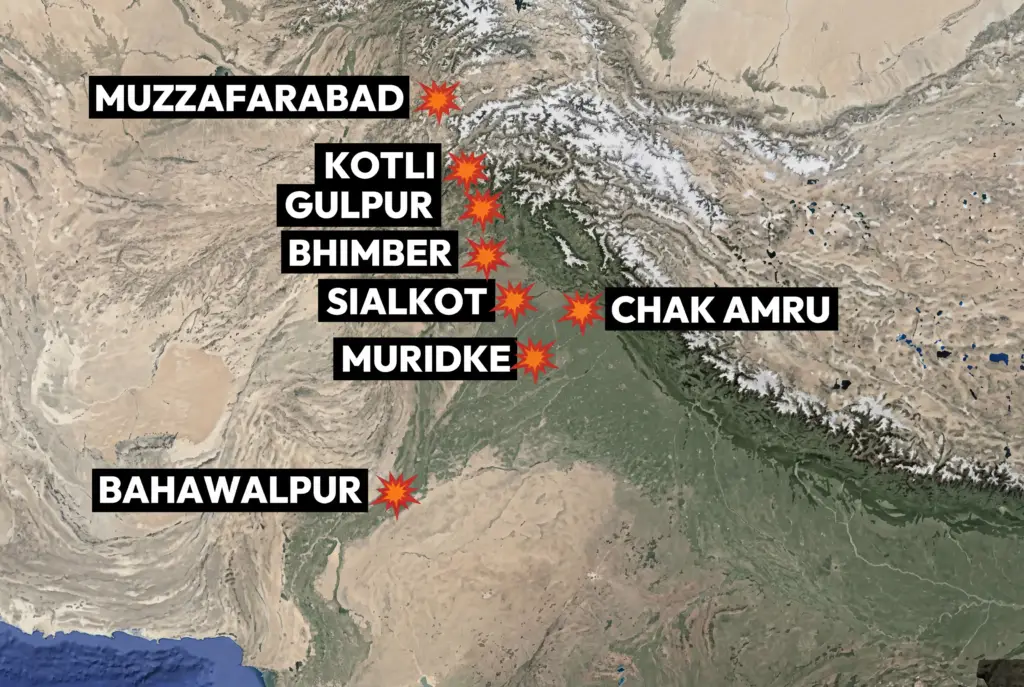
- Operation Sindoor was launched on May 7, 2025, in response to the April 22 terror attack in Pahalgam, which killed 26 civilians. India struck nine terror camps in Pakistan and Pakistan-occupied Kashmir before Pakistan launched a large-scale counter-offensive.
- India’s official account, per Air Marshal A.K. Bharti and DGMO Lt. Gen. Rajiv Ghai’s press briefings, states that Pakistan attempted drone and missile intrusions at 36 locations along the western front, involving roughly 300 to 400 drones, and that Indian air defence intercepted them.
- Indrajaal’s counter-drone system was deployed at the Western Naval Command during the operation, a deployment independently confirmed by multiple defense and business publications, not just Indrajaal’s own materials.
- The operation is widely cited in Indian defense and startup media as evidence that indigenous, autonomous counter-UAS technology can perform at real operational scale, not just in demonstrations.
Table of Contents
When Danger Arrived Unannounced
Vinay Na Manat Jaladhi Jad, Bhaye Teen Din Beet,
Bole Ram Sakop Tab, Bhay Binu Hoi Na Preet.
These lines from the Ramcharitmanas were reportedly invoked by Air Marshal A.K. Bharti, Director General of Air Operations, IAF, while addressing journalists on May 12, 2025. (Air Marshal Bharti’s briefings that week were widely covered; see India Sentinels’ profile of the operation’s planning.) The verse recounts Lord Ram’s patience with the Sea God, and how, when persuasion failed, strength had to speak.
In the early hours of May 7, 2025, following the April 22 terror attack in Pahalgam that killed 26 civilians, India launched Operation Sindoor: a tri-service operation targeting nine terror camps in Pakistan and Pakistan-occupied Kashmir. The strikes destroyed militant infrastructure without Indian troops crossing the Line of Control or the International Boundary.
India anticipated retaliation. As the operation continued, a new front opened, this time in the sky.

An Invisible Swarm
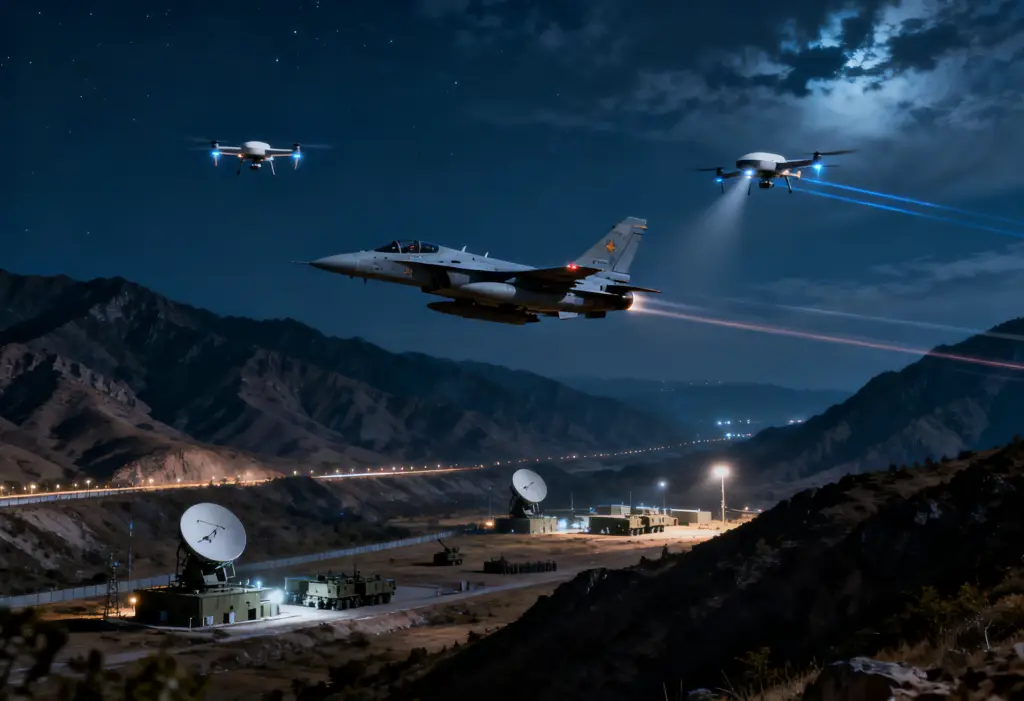
Pakistan’s counter-offensive followed quickly. According to India’s official account, drones, loitering munitions, and rocket systems were launched across India’s western front in a coordinated wave. India’s Ministry of Defence and Indian Air Force stated that Pakistan attempted intrusions at 36 locations from Leh to Sir Creek, involving roughly 300 to 400 drones, an account corroborated by independent defense-tracking sources. The stated targets included military airfields, radar stations, and critical infrastructure spanning from the Himalayas to Gujarat.
Such UAV threats pose an unprecedented challenge. Nano drones and swarm attacks evade traditional radars. Without modern drone detection systems and autonomous counter-UAV systems, these threats could have crippled national critical infrastructure, compromised airfields, or endangered civilian lives.
For the technical foundation behind these systems, see: Counter Drone Systems: Comprehensive Guide [2026]
A Defence That Didn’t Blink
In its official briefings, India’s Ministry of Defence stated that its integrated air defence grid held through this phase. Combining legacy platforms like the OSA-AK and Pechora missile systems with upgraded drone-radar detection and real-time electronic warfare, India’s forces deployed a multi-layered counter-drone response, according to Air Marshal Bharti and DGMO Lt. Gen. Rajiv Ghai’s press briefings on May 11 and 12, 2025.
Autonomous anti-drone systems played a central role in this layer of defence. Unlike legacy air defence reliant on continuous human operator input, these systems are built to detect, track, and neutralize multiple drones simultaneously and autonomously, compressing a response that would otherwise require multiple human operators into a single automated decision loop. According to India’s official account, Indian air defence intercepted the drones and loitering munitions launched during the operation before they could reach their intended targets.
Indrajaal: Guarding the Western Coastline
One of the regions under threat during Operation Sindoor was the Western Naval Command. Intelligence had flagged the possibility of incoming drone and loitering munition attacks on coastal assets and naval installations.
Indrajaal’s counter-drone system, using autonomous 360-degree surveillance, threat classification, and countermeasure deployment, was deployed to help protect this sector. This deployment is independently corroborated:business publication Inc42 reported that “Indrajaal’s anti-drone system was deployed at the Western Naval Command during Operation Sindoor” and defense publication IDRW separately reported the Indrajaal Infra variant went operational at a Gujarat naval port during the operation.
Its AI‑driven capabilities ensured:.
- Instant threat identification
- Autonomous response
- Zero human‑delay in action
Related reading: Autonomous Counter-Drone Systems Explained
Beyond Tactical Brilliance
Operation Sindoor is being cited, across Indian defense and startup media, as a demonstration of indigenous technological capability, not just a military operation. A June 2025 report in Organiser magazine on Indian startups’ role in the operation described Indrajaal as “an AI-based anti-drone system that neutralized multiple aerial threats during Sindoor,” alongside other Indian defense-tech startups whose products were used during the operation.
India has historically relied heavily on imported defense systems. Indigenous platforms like Indrajaal’s Counter-UAS architecture are now being pointed to, by multiple independent outlets, as evidence that domestically developed technology can operate at real operational scale under live conditions, not only in controlled demonstrations.
The Future of Defence Is Autonomous
Chief of Defence Staff, General Anil Chauhan, recently said that drones can “shift tactical balance disproportionately,” making self-reliance in UAVs and Counter-UAS a “strategic imperative” for India. Operation Sindoor validated this perspective. From nano drones to hypersonic missiles, the battlefield is evolving, and so must our defences.
Related reading: How Indrajaal Maritime Defends Ports and Naval Assets Against Drone Warfare
Protecting Freedom, Every Day
At Indrajaal™, our mission is simple:
To build autonomous counter‑UAV systems that secure India’s skies and protect national assets — every single day.
Because the battle is not just against drones… but against fear itself.
And in that battle, autonomous defence is India’s strongest shield.
Want to see how autonomous C-UAS applies to high-risk zones and mission-critical assets? Request a defense-grade briefing with Indrajaal’s team today.
Frequently Asked Questions
Operation Sindoor was a tri-service Indian military operation launched on May 7, 2025, in response to the April 22 terror attack in Pahalgam that killed 26 civilians. It began with strikes on nine terror camps in Pakistan and Pakistan-occupied Kashmir and was followed by a large-scale Pakistani drone and missile counter-offensive that India’s air defence grid was credited with repelling.
According to India’s official account, Pakistan attempted drone and missile intrusions at 36 locations along the western front, involving roughly 300 to 400 drones, targeting military airfields, radar stations, and infrastructure from the Himalayas to Gujarat.
Yes. Indrajaal’s counter-drone system was deployed at the Western Naval Command during the operation, a deployment independently reported by multiple publications beyond Indrajaal’s own materials, including Inc42 and IDRW.
Because the scale and coordination of the drone threat, dozens of simultaneous intrusions, exceeded what manual, human-operator-dependent air defence can reliably manage in real time. Autonomous systems compress detection, classification, and response into a single automated loop rather than requiring sequential human decisions for each threat.
Multiple independent defense and business publications have cited the operation as evidence that Indian-developed counter-drone platforms, including Indrajaal, can perform at real operational scale under live conditions, not just in demonstrations, supporting India’s broader push toward defense self-reliance.
Conclusion
Operation Sindoor is one of the most concrete real-world tests any country’s counter-drone capability has faced to date, and it’s being cited across Indian defense and technology media as evidence that indigenous, autonomous systems can perform under genuine operational pressure. Indrajaal’s deployment at the Western Naval Command during the operation, independently corroborated beyond the company’s own materials, is a meaningful data point in that case. As drone-based threats continue to scale in speed and coordination, the operation reinforces a broader argument this cluster makes throughout: autonomy isn’t a future upgrade to counter-drone defense, it’s what’s already required to keep pace with the threat as it exists today.