

This guide explains why border security without dedicated counter-drone capability leaves a real gap. It covers the global pattern of drone use at borders and in conflict, from NATO’s drone wall initiative to India’s escalating cross-border smuggling problem, why traditional border security methods fall short against small low-flying aerial threats, and what an effective border C-UAS strategy actually requires across hard-kill and soft-kill capability, terrain scalability, and multi-agency integration.
Border security drone defense requires capabilities that traditional border infrastructure was never designed for: detecting small, low-flying drones across remote terrain, distinguishing them from other airborne objects, and neutralizing them without collateral damage or communication disruption. Effective border C-UAS supports both hard-kill and soft-kill mitigation and integrates into broader multi-agency security frameworks.
Key takeaways
- In May 2024, six NATO members bordering Russia – Lithuania, Latvia, Estonia, Poland, Finland, and Norway, agreed to build a “drone wall” combining surveillance drones and anti-drone systems along their shared border, a direct response to escalating drone-based threats.
- Drones have been used in border and conflict contexts for smuggling, surveillance, and direct attacks, including a July 2024 assassination attempt against Sudanese military leader General Abdel Fattah al-Burhan and the well-documented 2020 drone strike that killed Iranian General Qasem Soleimani.
- India’s Border Security Force reported intercepting around 100 drones from Pakistan in 2023 alone, primarily used to smuggle narcotics, arms, and ammunition, a figure that had grown to 255 by 2025, reflecting a clear escalation trend.
- Effective border C-UAS must support both hard-kill and soft-kill mitigation, remain scalable across large and often remote terrain, and integrate into broader, multi-agency security frameworks rather than operating as an isolated system.
Table of Contents
Rising Drone Threats Along Global Borders
In May this year, six NATO allies—Lithuania, Latvia, Estonia, Poland, Finland, and Norway—announced plans to construct a “drone wall” along their shared border with Russia. This initiative involves deploying unmanned aerial vehicles (UAVs) to conduct surveillance, deter potential threats, and enhance border security.
The increased frequency of drone attacks over the past year has highlighted the dual nature of drone technology. While drones have advanced industries like agriculture and filmmaking, they also pose new security challenges, particularly at national borders. Drones are now used for warfare, surveillance, and even attempted assassinations, forcing a reassessment of modern security strategies.
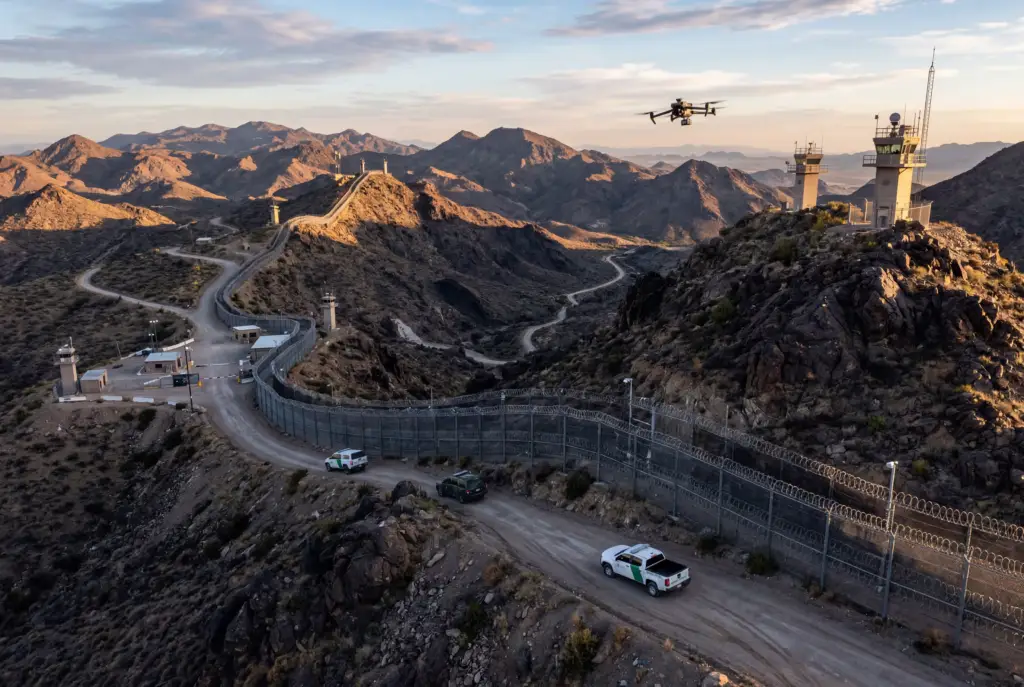
The availability of commercial drones, often at low costs, has made it easier for malicious actors to conduct illegal activities without risking human operatives. The growing use of drones highlights the need for effective C-UAS to strengthen border security and surveillance.
For the technical foundation behind these systems, see: Counter Drone Systems: Comprehensive Guide [2026]
The Rising Threat of Drones: A Global Pattern
Drone-based security incidents have become a recurring feature of conflicts and border tensions worldwide. Hezbollah has been reported using drones against Israel amid the ongoing conflict in the region. Russian drone strikes on Kyiv and other Ukrainian cities have escalated sharply since the start of the full-scale invasion in February 2022, with attack scale varying from dozens to several hundred drones in a single wave depending on the period. In Sudan, General Abdel Fattah al-Burhan, the country’s de facto military leader, survived a drone-based assassination attempt on July 30, 2024, when strikes hit a military graduation ceremony in Jebeit, Red Sea State, killing five people.
India has faced this threat directly. In June 2021, low-flying drones dropped IEDs on the Jammu Air Force Station, one penetrating a building roof, another exploding on the tarmac near a parked helicopter. The incident demonstrated, concretely, how drones can be weaponized for terrorist activity. Cross-border drone intrusions have surged since: India’s Border Security Force reported intercepting around 100 drones from Pakistan in 2023 alone, primarily used to smuggle narcotics, arms, and ammunition – a figure that had grown to 255 by 2025.
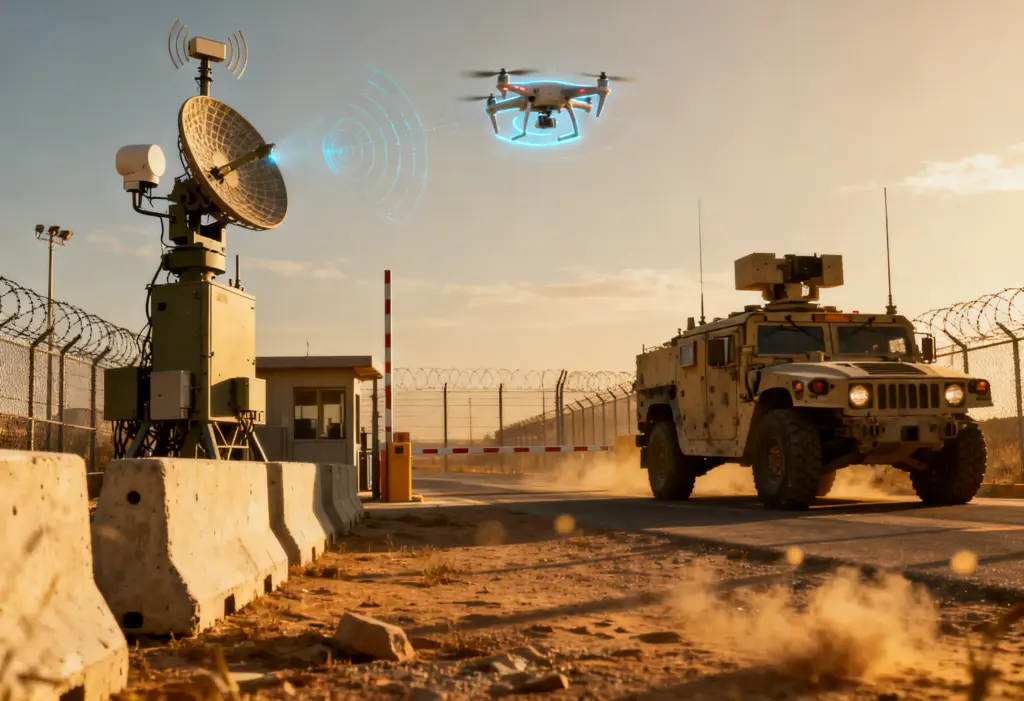
Today, drones pose a genuinely multi-faceted border threat: smuggling, surveillance, facilitating illegal crossings, and direct attacks on personnel. The 2020 drone strike that killed Iranian General Qasem Soleimani remains one of the starkest demonstrations of the lethal potential of this technology. As the technology matures further, the shift from human-piloted drones toward AI-powered autonomous systems capable of real-time decision-making without human intervention is accelerating, raising the stakes for border security agencies still relying on legacy detection methods.
The Need for Advanced C-UAS at Borders
Traditional methods of border security are inadequate in detecting and neutralising drone threats. The challenges include distinguishing small drones from other airborne objects, minimizing false positives, and avoiding collateral damage in densely populated or urban border areas. Moreover, using jammers, a common countermeasure, can disrupt essential communications.
Effective C-UAS systems must be capable of both “hard kill” and “soft kill” strategies. They must also be scalable and adaptable to evolving threats, capable of being integrated into broader security frameworks.
Border Security & Surveillance With IndrajaalTM
Indrajaal is an advanced C-UAS platform that offers a comprehensive solution to the challenges posed by traditional systems. By integrating 12 AI technologies, including Zombee Drone™, Repulsor™, and HyperSensing™, the system can be used separately or in combination with each other to form an autonomous drone security solution. Moreover, its capabilities are not limited to merely detecting drones, it also assesses threats, tracks their movements, and neutralises them autonomously.
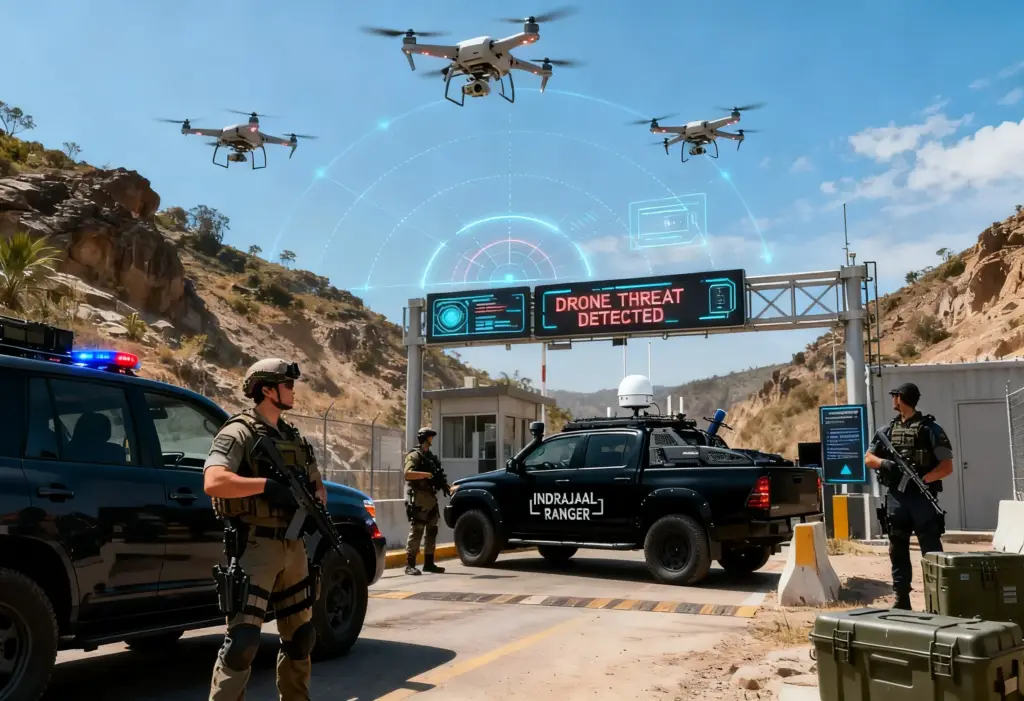
The system also features a Command & Control Center (C2) that can easily integrate with existing security infrastructures, providing real-time data and actionable intelligence. This level of integration is crucial to maintaining situational awareness and responding swiftly to threats. It also plays a crucial role in coordinating with on-ground security personnel by providing actionable intelligence, including real-time tracking and predictive analytics about the drone’s potential flight path. Indrajaal can differentiate between drones and other objects, reducing false positives and ensuring that security personnel can focus on genuine threats.
In addition to counter-drone operations, Indrajaal significantly enhances surveillance capabilities along borders. The system’s sensor network provides continuous 360-degree monitoring, making it difficult for any aerial or ground threat to go undetected. This constant vigilance is particularly valuable in regions where terrain or other factors may make traditional surveillance methods less effective.
Also Read: A Guide to Counter-Unmanned Aerial Systems (C-UAS): Everything You Need to Know
Implementing an Effective Border C-UAS Strategy
- Begin with a risk assessment by engaging a C-UAS company to identify unique vulnerabilities and hazards in your area, aiding in efficient resource management and prioritization.
- Choose the appropriate technologies for identification and detection based on precision, line of sight constraints, detection range, and integration potential, with guidance from your C-UAS provider.
- Establish detailed Standard Operating Procedures for responding to unauthorized or hostile drones, including threat assessment, communication protocols, and necessary actions.
- While autonomous C-UAS technologies like Indrajaal are user-friendly, ensure all relevant teams understand the technology through thorough training, and keep them prepared with ongoing updates.
- Foster cooperation with law enforcement, government agencies, and other stakeholders to enhance the effectiveness of counter-UAS strategies.
- Finally, conduct post-action evaluations to assess the success of operations, learn from the experience, and refine protocols as needed.
Way Forward for India
With drone sightings becoming increasingly common, the Indian government is giving the drone ecosystem in India a very high priority. However, India must promote more research and development in drones and unmanned systems to remain globally competitive and relevant. As the country becomes drone-friendly, there is a need to evolve air defence procedures and create an anti-drone force.
Drones are here to stay and India must take a proactive approach to prepare for them. Get in touch with our experts at Indrajaal to understand how our comprehensive counter-drone system is protecting the skies.
Ready to safeguard your border airspace? Connect with Indrajaal’s experts today.
Frequently Asked Questions
Traditional methods struggle to distinguish small drones from other airborne objects across remote terrain, generate false positives across long border stretches, and risk collateral damage or communication disruption from countermeasures like jamming if not precisely targeted.
Hard-kill methods physically disable a drone (interceptors, kinetic strikes), while soft-kill methods use jamming, spoofing, or protocol takeover to neutralize a threat without physical destruction – effective border C-UAS needs both options available.
The BSF reported intercepting around 100 drones from Pakistan in 2023, a figure that grew to approximately 255 by 2025, reflecting a clear year-over-year escalation in cross-border drone activity, primarily used for smuggling narcotics, arms, and ammunition.
Announced in May 2024, it’s a joint border-defense initiative by Lithuania, Latvia, Estonia, Poland, Finland, and Norway to deploy surveillance drones and anti-drone systems along their shared border with Russia, aimed at deterrence, surveillance, and smuggling prevention.
Yes, this has been documented in multiple real incidents, including the 2020 drone strike that killed Iranian General Qasem Soleimani and the July 2024 drone attack targeting Sudanese military leader General Abdel Fattah al-Burhan, who survived.
Conclusion
Border security built without dedicated drone defense is, at this point, an incomplete strategy, not a hypothetical gap. From NATO’s drone wall to India’s escalating cross-border smuggling problem, the pattern is consistent worldwide: legacy border security methods weren’t designed for small, fast, low-flying aerial threats, and retrofitting them isn’t sufficient. A genuinely effective border C-UAS strategy needs both hard-kill and soft-kill capability, the scalability to cover difficult and often remote terrain, and tight integration with the broader security and law-enforcement ecosystem already in place.