

National infrastructure has always protected what keeps a country running—power, transport, communication, and defence assets. Today, however, that responsibility extends upward. As a result of drones becoming cheaper, autonomous, and increasingly difficult to detect, airspace has evolved into a critical vulnerability. Consequently, defending it is no longer optional. In this new reality, drone defence has emerged as essential national infrastructure, safeguarding everything from airports and ports to military bases and civilian life across India.
Table of Contents
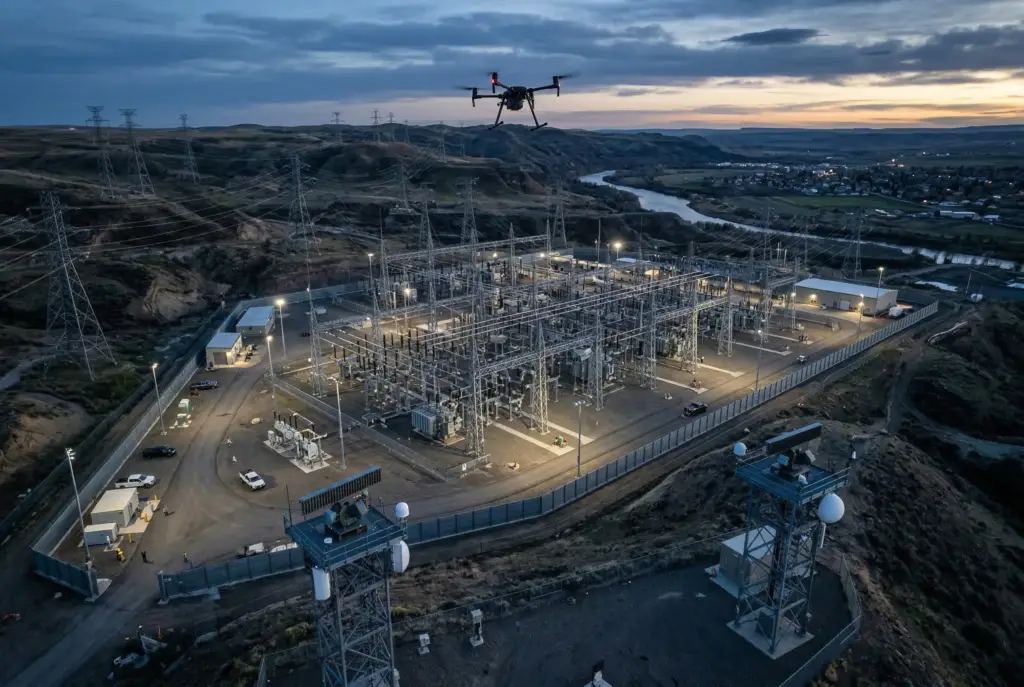
For decades, national infrastructure has meant the obvious: roads and railways, power grids, ports, airports, telecom networks. What they all share is simple: if they fail, the nation grinds to a halt. This includes national security infrastructure such as army bases, ammunition depots, and naval bases. But what about the airspace above? Air defense grids that protect a country from high-altitude threats such as warplanes and missiles are no longer enough. And that’s where drone defence is fast becoming non-negotiable infrastructure.
As drones become cheaper, autonomous, and harder to detect, they’ve shifted from hobbyist tools to real-world threats—used for surveillance, smuggling, sabotage, and targeted attacks. This has turned C-UAS from a tactical afterthought into a core national security requirement. Protecting critical assets now means defending not just land and sea, but the invisible aerial layer in between. In this new reality, drone defence isn’t just protection – it’s infrastructure.
The Evolving Threat Landscape
Recent incidents around the globe illustrate the urgency of this shift. In conflict zones and border regions, operators use drones for reconnaissance, payload delivery, and as instruments of disruption. The Russia–Ukraine war and, more recently, the India–Pakistan conflict have highlighted this changing reality. But the threat doesn’t exist only during wartime. According to a report in the online news portal Bhaskar English, Pakistan has sent more than 800 drones into Indian airspace since Operation Sindoor.
Industrial sites, ports, airports, and large events have reported unauthorised drones breaching restricted airspace, challenging traditional security mechanisms. For example, temporary airspace closures near major global airports due to rogue drone sightings have caused significant disruptions.

According to a report in The Indian Express on Feb 6, 2026, drone sightings at Amritsar Airport disrupted operations for an entire hour. At that time, authorities diverted two international flights. In September 2025, authorities shut down Copenhagen Airport for nearly four hours due to drone sightings. In fact, this was one among many such disruptions that happened in the span of a few months at various airports in Denmark, Germany, Norway, Belgium, and Spain. Belgian Defence Minister Theo Francken stated that these were deliberate attempts “to spy, to see where the F-16s are, where the ammunition is…”. These events highlight that even seemingly innocuous drones can pose a material risk to aviation safety and operational continuity. The stakes are high when unmanned systems are exploited without appropriate safeguards.
Moreover, the rise of AI-enabled drones capable of autonomous navigation and complex mission execution has outpaced the evolution of conventional detection systems. This asymmetry underscores the need for a dedicated, resilient defense infrastructure that can function in real time across varied terrains and conditions.
Airspace Is Infrastructure
National infrastructure is defined by its critical role in maintaining the security, stability, and functioning of society. Roads, power grids, communication networks, and ports form the backbone of modern life. In the twenty-first century, airspace must be regarded in the same light.
Airspace is not an abstract concept. It is a physical domain that must be protected, monitored, and regulated. As drones multiply and capabilities diversify, the potential for misuse grows alongside legitimate utility. Unauthorised access to restricted airspace can endanger human life, disrupt commerce, and compromise strategic sites.
Protecting this domain, therefore, requires infrastructure that is continuous, responsive, and interoperable with existing security frameworks. This infrastructure must include advanced detection systems, automated response mechanisms, and situational awareness tools that operate seamlessly across cities, borders, and critical facilities.
Indrajaal’s Role in Shaping Defense Infrastructure
At Indrajaal, we have been at the forefront of developing autonomous anti-drone solutions that address these very challenges. Our systems go beyond simple detection. They are designed for real-time classification, tracking, and response, ensuring that emerging threats are identified and mitigated before they impact operations.
Earlier this year, Indrajaal secured significant contracts from the Ministry of Defense, affirming the strategic importance of indigenous counter-drone capabilities. These contracts reflect a national recognition that airspace defense must be deeply integrated into the broader security ecosystem. It must be reliable, scalable, and capable of operating without interruption in diverse conditions.
Our solutions are engineered with this principle in mind. They incorporate advanced sensor fusion and autonomous engagement options that enable defenders to maintain airspace integrity across a wide range of scenarios. This capability is critical for protecting strategic assets, infrastructure nodes, and high-density urban environments.
Building an Integrated Defense Fabric
National infrastructure functions effectively when its components are interconnected, resilient, and future-ready. Drone defense must be woven into the broader tapestry of border security, aviation safety, critical infrastructure protection, and emergency response. This means interoperable systems, continual data flows, and coordinated response protocols that extend from local facilities to national command centres.
An effective infrastructure approach also requires investment in research and development, cross-agency collaboration, and clear regulatory frameworks that support both innovation and public safety. Governments, private enterprises, and industry partners must work together to build a defense fabric that can anticipate, adapt, and respond to evolving aerial threats.
The Path Forward
Drones will continue to revolutionise industries and enhance operational capabilities across sectors. Their potential is vast and will continue to grow. At the same time, the misuse of aerial systems presents real and persistent risk.
The solution is not to slow progress. The solution is to ensure that progress is underpinned by robust, layered, and intelligent defense infrastructure. Airspace must be treated as a domain that requires the same level of protection and governance as terrestrial and maritime spaces.
Indrajaal is committed to advancing this vision. Through cutting-edge anti-drone infrastructure, deep technological expertise, and partnerships with national stakeholders, we are helping build secure skies that enable innovation while safeguarding safety and stability.
Drone defense is no longer a specialised capability. It has become an indispensable component of national infrastructure. Recognising this is the first step toward a safer, more resilient future.
Conclusion
When airspace fails, disruption inevitably follows—grounded flights, exposed assets, and compromised security. Therefore, treating drone defence as national infrastructure is no longer a strategic choice; it is an operational necessity. Looking ahead, a resilient future demands autonomous, interoperable, and always-on aerial protection woven directly into the nation’s security fabric. In this context, indigenous platforms like Indrajaal represent decisive progress toward securing national airspace and enabling safe, uninterrupted growth in an increasingly unmanned world.