

This article traces how counter-drone technology evolved from single-tool detection into today’s AI-fused, autonomous airspace security systems, and where it’s heading next. It covers why early approaches like RF jamming alone stopped working, how sensor fusion and AI closed the resulting gap, how layered response systems performed in recent real-world conflicts, and the emerging challenges, fiber-optic drones and distributed swarm AI, that will define the next generation of the technology.
Counter-drone technology has evolved from single-sensor detection paired with signal jamming into layered, AI-fused, autonomous systems that combine radar, RF, electro-optical, and thermal sensing with software-defined response. The shift was driven by adversaries adapting faster than single-tool defenses could keep up: autonomous drones, frequency-hopping, and coordinated swarms all defeated the RF-jamming-only approach that worked well just a few years ago.
Key takeaways
- Early counter-drone systems assumed a drone threat presented a detectable RF signal that, once disrupted, ended the threat. Autonomous, waypoint-guided drones and frequency-agile platforms broke that assumption.
- Modern systems combine radar, RF sensing, electro-optical, thermal imaging, and direction-finding into one fused picture, because no single sensor catches every drone type in every condition.
- AI became a functional requirement, not a convenience. The volume of data from a multi-sensor network exceeds what human operators can process in real time, especially during multi-target, fast-moving scenarios.
- The next set of challenges, fiber-optic drones immune to RF jamming and swarms coordinated by distributed rather than centralized AI, will demand engagement approaches current soft-kill systems weren’t built for.
Table of contents
A Fast-Moving Threat Drove a Fast-Moving Response
Five years ago, protecting a military base or critical infrastructure from an unmanned aerial threat usually meant identifying a single drone and disrupting its communication link.
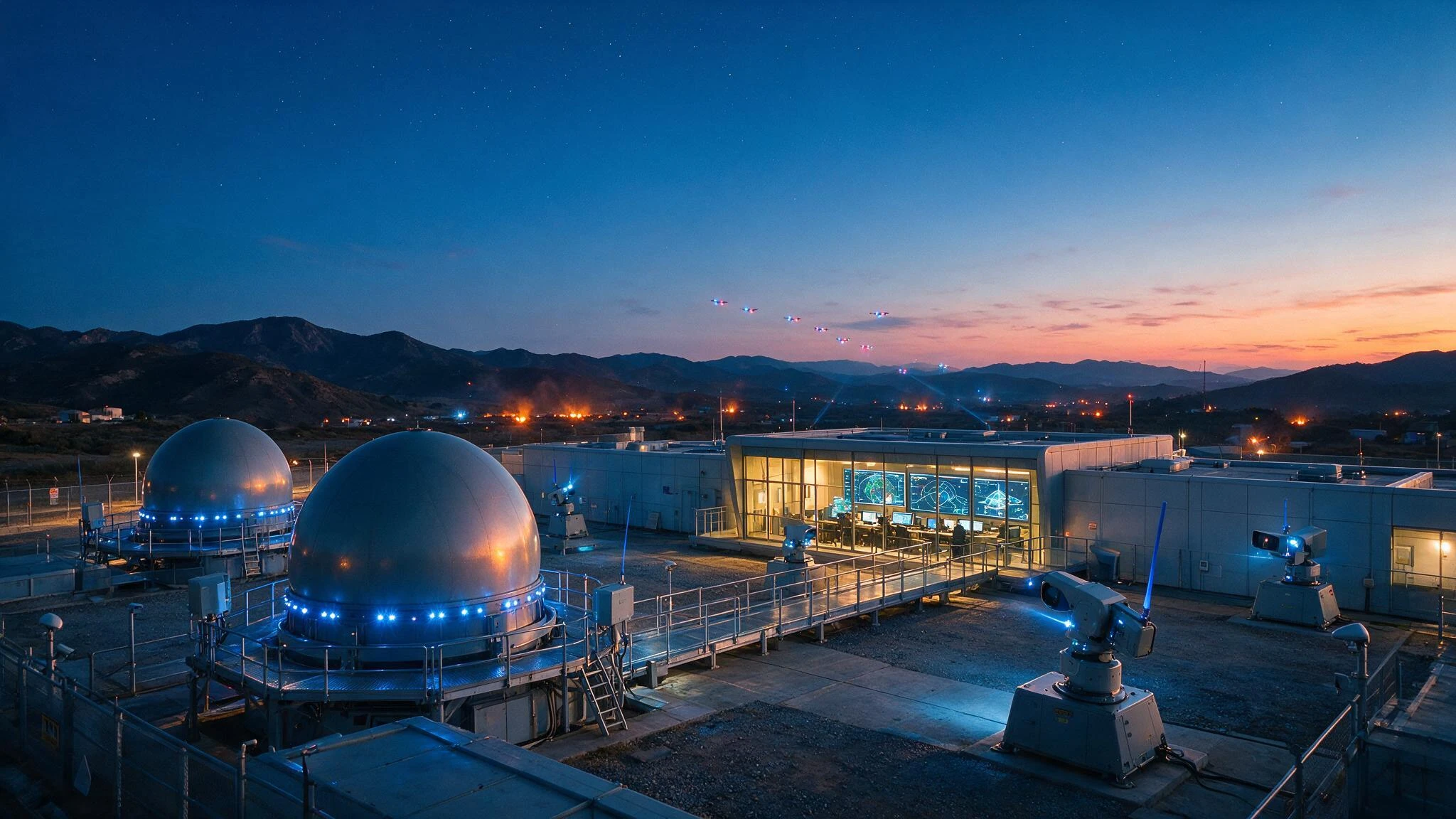
Today, security planners prepare for autonomous drones, coordinated swarms, GPS-denied navigation and attacks that unfold in seconds rather than minutes. Counter-drone technology has evolved accordingly, shifting from isolated detection tools to intelligent, autonomous airspace security ecosystems.
What drove that shift was the speed at which the threat changed. In Ukraine, low-cost FPV drones costing a few hundred dollars each have disrupted armoured vehicles and supply lines worth millions. In the Red Sea, Houthi drone and missile campaigns forced the rerouting of commercial shipping and demonstrated that asymmetric aerial threats can impose costs far exceeding their own. Across the Middle East, drone swarms have been used to saturate air defences, targeting infrastructure and military assets with a level of operational persistence that traditional defence architectures were never designed to absorb.
The global counter-drone market reflects this urgency, growing from around $18-21 billion in 2025 to a projected $79-94 billion by 2035.
The platforms being built to address this are a different category of technology from the jammers that preceded them. At Indrajaal, we have approached the problem as a systems architecture challenge rather than a hardware one, combining AI, layered sensors, autonomous command and modular deployment to create airspace security that can match the speed and variety of modern drone threats. This article traces how counter-drone technology reached this point, and where it is heading next.
For the technical foundation behind modern C-UAS platforms, see: A Guide to Counter-Unmanned Aerial Systems (C-UAS): Everything You Need to Know
Why single tool responses stopped working
Early counter-drone systems were built around a reasonable assumption: that a drone threat would present a detectable signal, and that disrupting that signal would end the threat. RF jamming worked by flooding a drone’s control frequencies until it lost its connection to the operator, typically causing it to return home or land. For commercial quadcopters operating on standard frequencies, this approach was often effective.
The problem emerged as drone manufacturers and adversarial operators adapted. Platforms designed to navigate autonomously using pre-programmed waypoints do not rely on a live RF link to complete their mission, which means jamming their communication does not stop them. Others switched between frequencies or operated with reduced RF signatures specifically to avoid the detection systems deployed against them. Swarm attacks added a further dimension: a system designed to track and engage one drone faces a fundamentally different problem when confronted with thirty simultaneously.
False alarms compounded the challenge. Birds, civilian aircraft and environmental interference regularly generated alerts that demanded manual verification, placing unsustainable load on operators and eroding confidence in automated systems. Effective counter-drone capability required moving beyond single-sensor detection toward something that could understand a threat, not just flag one.
Building a complete picture
Radar remains effective for early warning, but small drones often present low radar cross-sections and operate at altitudes where terrain and urban clutter complicate tracking. Modern systems combine radar with RF sensors, electro-optical payloads, thermal imaging and direction-finding to build a more complete and reliable picture of the airspace.
Radar remains effective for early warning, but small drones often present low radar cross-sections and operate at altitudes where terrain and urban clutter complicate tracking. Modern systems combine radar with RF sensors, electro-optical payloads, thermal imaging and direction-finding to build a more complete and reliable picture of the airspace.
The combination of these sensor layers is what enables modern systems to understand a threat rather than simply detect one. A drone operating in silent autonomous mode with no active RF link requires a different response from a commercial platform broadcasting on standard frequencies, and sensor fusion is what makes that distinction possible at operational speed.
Related reading: Drone Detection Technologies: Radar vs RF vs AI
How AI changed everything
The volume of data generated by a multi-sensor detection network exceeds what human operators can process in real time, particularly during a fast-moving multi-target scenario. AI became a functional requirement, not a convenience: without machine-speed processing, the detection capability of modern systems cannot translate into effective response.
Machine learning enables threat classification at a speed and scale that rule-based systems cannot approach. Rather than matching signals against a fixed list of known drone types, AI-native systems learn from operational data and can distinguish a commercial reconnaissance platform from a hardened FPV build, filter environmental false positives, predict flight paths and prioritise the most dangerous target in a crowded airspace simultaneously. Recent conflicts have demonstrated how AI-assisted command systems allow operators to manage multiple simultaneous engagements that would previously have exceeded human decision-making capacity, compressing a process that once required several operators and several minutes into seconds.
The slowest part of any counter-drone engagement used to be the human decision loop. AI moved that bottleneck out of the kill chain entirely, compressing detection, classification and response selection into seconds.
Indrajaal’s SkyOS™ platform is built around this principle, fusing inputs from radar, RF sensors, cameras, jammers and direction finders into a single autonomous control layer that classifies threats, predicts trajectories and selects proportionate responses without requiring operator intervention for each engagement. Soft-kill methods are assessed first; kinetic options are available when required. The escalation logic is embedded in the system rather than dependent on individual operator judgement under pressure.
Related reading: Autonomous Counter-Drone Systems Explained
Layered Response: Matching the Countermeasure to the Threat
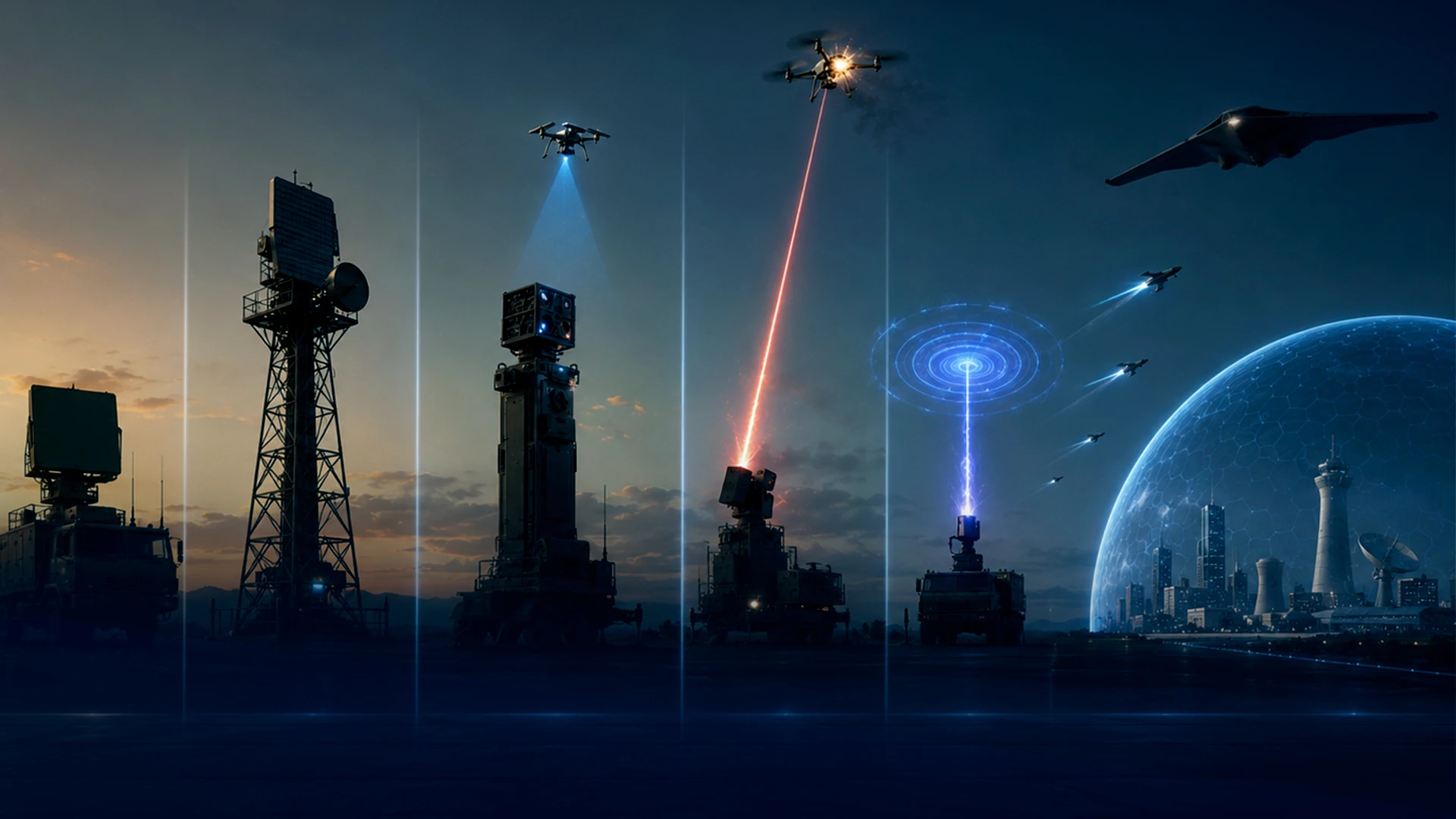
Soft-Kill: Jamming, Spoofing and Cyber Takeover
Soft-kill techniques became the preferred first response layer because they neutralise threats without the risks of physical destruction in populated or sensitive areas. RF jamming disrupts the control link, causing the drone to return home or land. GNSS spoofing feeds false location data, allowing operators to redirect a hostile drone to a designated safe zone. Cyber takeover goes further by assuming direct control, landing the platform safely and preserving it as intelligence without any secondary impact from an uncontrolled fall.
Related reading: Soft Kill vs Hard Kill Anti-Drone: Which Is Better?
Layered architecture in operation
Operation Sindoor in May 2025 demonstrated many of the principles that modern counter-drone systems are designed around. Layered detection, electronic warfare, integrated command networks and coordinated interception operated together to manage a large-scale aerial threat. Rather than relying on any single technology, the operation highlighted the value of an architecture in which sensors, AI and multiple response layers function as one system, each compensating for the limitations of the others and responding at a speed that a human-operated system could not have matched.
What the operation illustrated more broadly is that the measure of a counter-drone architecture is not how it performs against a single known threat type, but how it holds against the kind of simultaneous, varied and high-tempo attack that an adversary will deliberately design to find the gaps. The layered autonomous response closed those gaps faster than they could be exploited, which is the operational standard the technology has been built toward.
What comes next
The next generation of counter-drone challenges is already taking shape. Fibre-optic drones, communicating through physical cables rather than radio links, are immune to RF jamming and require engagement approaches that current soft-kill systems cannot provide. Swarms controlled by distributed AI, with no single platform acting as coordinator, require different prioritisation strategies from those designed for centralised swarm architectures. Directed energy weapons entering operational service offer high-rate hard-kill capability without reload constraints, but require integration with existing command architecture to be effective in practice.
The manufacturers that will define the next decade are building modular, software-defined architectures that integrate new sensors, weapons and AI models without requiring infrastructure replacement. Adaptability, more than any fixed hardware specification, is what determines whether a counter-drone system remains effective as the threat continues to evolve.
Counter-drone technology has entered a phase where software, artificial intelligence and systems integration are becoming as important as the hardware itself. The platforms that define the next decade will be those capable of evolving continuously as threats evolve. That is the philosophy shaping the next generation of autonomous airspace security, and the direction in which platforms such as Indrajaal continue to develop.
Frequently Asked Questions (FAQs)
Counter-drone technology detects, identifies, tracks and neutralises unmanned aerial threats using layered sensors, AI and multiple response mechanisms.
Modern drones can operate autonomously, use GPS-denied navigation and attack in coordinated swarms. Single-tool approaches such as RF jamming cannot address every type of threat.
AI enables systems to fuse data from multiple sensors, classify threats, filter false alarms, predict trajectories and prioritise responses in real time, helping manage complex multi-drone scenarios faster and more effectively.
Fiber-optic drones communicate through a physical cable rather than a radio link, which makes them immune to RF jamming and GNSS spoofing entirely, since there’s no wireless signal to disrupt. Countering them requires different detection and engagement approaches than conventional soft-kill methods.
Conclusion
Counter-drone technology has entered a phase where software, artificial intelligence, and systems integration matter as much as the hardware itself. The platforms that define the next decade will be those capable of evolving continuously as threats evolve, not those with the most impressive spec sheet at launch. That’s the philosophy shaping the next generation of autonomous airspace security, and the direction platforms like Indrajaal continue to develop toward.