

This deep dive explains how RF sensors actually work inside a counter-drone system: what signal characteristics they analyze, how direction finding locates both a drone and its operator, and how RF detection feeds into an autonomous response chain, from electronic countermeasures through cyber takeover to kinetic interception. It closes with where RF sensing technology is headed next, including wideband receivers, AI-driven signature recognition, and tip-and-cue integration with radar and optical sensors.
RF sensors passively monitor the radio-frequency transmissions between drones and their controllers to detect, classify, and locate potential drone threats, without emitting any signal of their own. Because most commercial and military drones maintain a continuous radio link carrying control commands, telemetry, and often live video, RF sensing can often identify a rogue drone before radar, cameras, or any other system has registered a threat.
Key takeaways
- Most commercial and military drones maintain a continuous radio link with their operator, control commands, telemetry, and often live video, which means an unauthorized drone is, in effect, broadcasting its presence in the RF spectrum the entire time it’s operating.
- RF sensors are passive: they emit no signal of their own, letting them monitor continuously and discreetly while identifying drone type, estimating distance, and performing direction finding.
- Direction finding is what turns RF sensing into actionable intelligence. Multiple RF sensors working together can locate both the drone and its operator, and identifying the operator often delivers more operational value than tracking the drone alone.
- RF detection feeds a layered, largely autonomous response chain: electronic countermeasures (jamming, spoofing) first, cyber takeover where precision matters, and kinetic interception as the final layer against drones with no active RF link to exploit.
- RF sensing’s core limitation is exactly that dependency: autonomous drones with no active communication link, including fiber-optic drones, can be effectively invisible to RF sensors alone, which is why it’s deployed as one layer within a multi-sensor architecture, not a standalone solution.
Table of contents
Understanding the Threat RF Sensing Was Built to Address
The airspace above critical infrastructure has changed dramatically over the past decade. Drones that were once viewed primarily as commercial tools for photography, surveying and logistics now occupy a far more complex role in the security landscape. They are increasingly used for unauthorised surveillance, cross-border smuggling, disruption of critical infrastructure and, in modern conflicts, as precision strike platforms capable of carrying out missions at a fraction of the cost of conventional systems.
This shift has transformed how governments, defence organisations and infrastructure operators think about airspace security. Detecting a rogue drone early, understanding its intent and responding before it reaches a protected asset have become central to modern counter-drone strategies. At the heart of that capability lies one of the most effective yet often underappreciated technologies in the counter-UAS ecosystem: Radio Frequency sensing. While radar, electro-optical cameras and thermal imaging each contribute valuable information, RF sensors provide a unique ability to identify drones by analysing the signals they exchange with their controllers, often before any other system has registered a threat.
Understand the threat RF sensing was built to address
The challenge posed by rogue drones extends well beyond the drone itself. Modern unmanned aerial systems are becoming smaller, quieter and increasingly autonomous, allowing them to operate in environments where traditional surveillance methods face real limitations. Critical infrastructure such as airports, military installations, power plants and border crossings presents attractive targets because even a brief disruption can carry significant operational and economic consequences.
Recent conflicts have demonstrated how inexpensive commercial platforms, adapted for reconnaissance, electronic warfare and precision attack, have changed the economics of aerial threats. Their accessibility has made comprehensive airspace awareness a necessity rather than an operational advantage.
What makes drone threats particularly difficult to address through conventional means is this: most commercial and military drones maintain a continuous radio link with their operators. This link carries control commands, telemetry data and, in many cases, a live video feed. The ITU designates 2.4 GHz and 5.8 GHz as the primary frequency bands for drone control links, and the vast majority of commercial platforms operate within these ranges. A drone conducting unauthorised surveillance over a naval base is, in effect, broadcasting its presence in the radio spectrum the entire time. RF detection was developed to exploit precisely this characteristic.
For the broader detection-technology comparison, see: Drone Detection Technologies: Radar vs RF vs AI
What RF sensors are
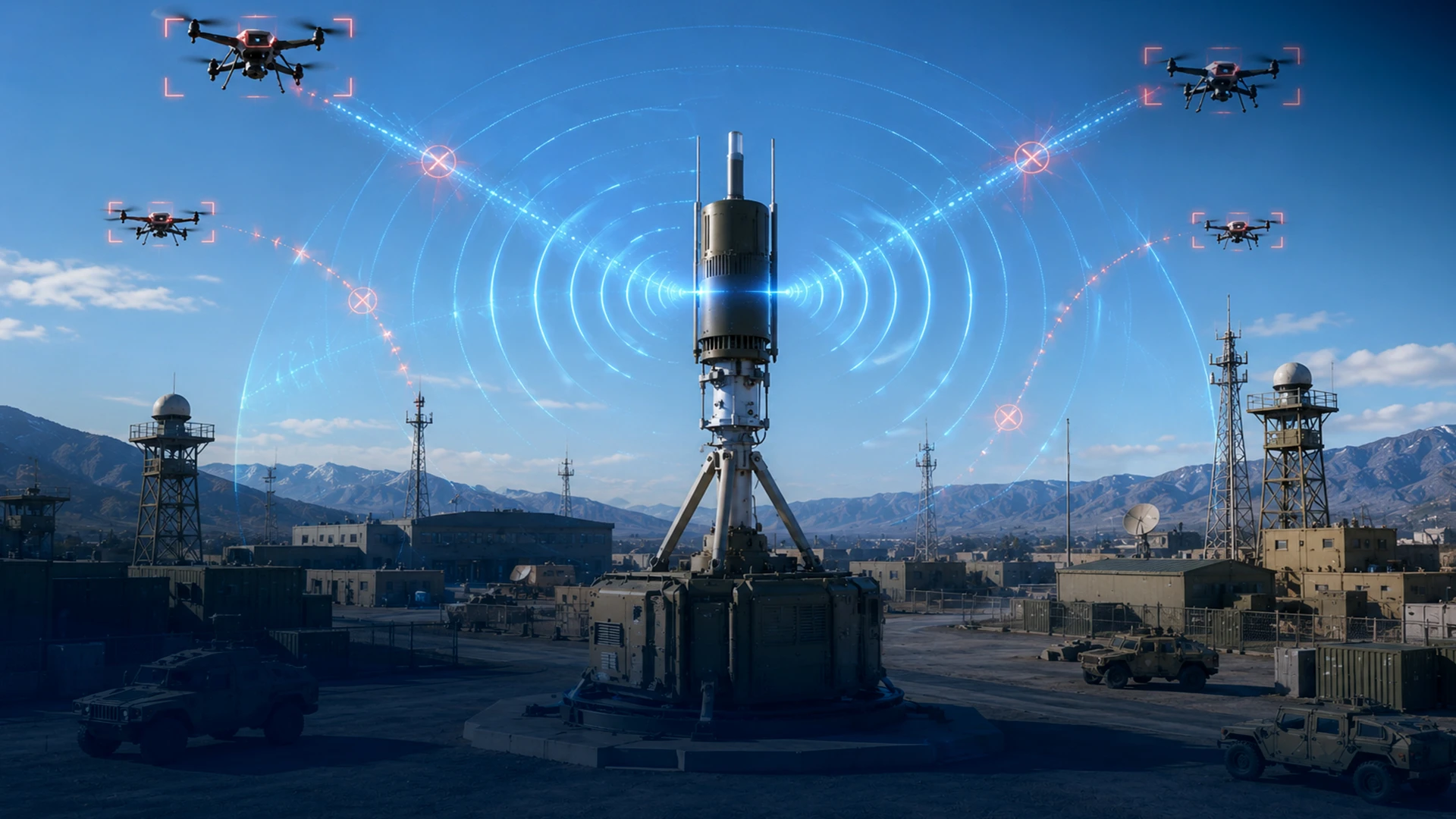
Every active communication between a drone and its controller generates a unique RF signature. By passively monitoring the electromagnetic spectrum, RF sensors analyse these transmissions to identify the type of drone, estimate its location, determine the position of the operator and assess its activity. Unlike active sensors, RF systems emit no signals of their own, allowing them to operate discreetly while continuously monitoring the airspace. This passive approach enables early threat detection while providing the intelligence required for timely counter-drone operations.
How RF sensors work
When an RF sensor intercepts a transmission, it performs several analytical operations simultaneously. It matches the signal’s characteristics, including frequency patterns, modulation schemes and timing behaviour, against a continuously updated library of known drone communication signatures. It measures signal strength to estimate distance. It performs direction finding, using the differential arrival time of signals at multiple antenna elements to calculate the bearing of the transmission source.
Direction finding transforms RF sensing from simple detection into actionable intelligence. By comparing how a signal reaches multiple antennas, the system estimates the direction of the transmission. When several RF sensors work together, they can accurately locate both the drone and its operator. For security agencies, identifying the operator often delivers greater operational value than tracking the drone alone, enabling follow-on action to prevent repeated incursions.
Modern AI-driven classification extends this capability beyond known drone models. Instead of relying solely on predefined signature libraries, the system analyses transmission behaviour to recognise modified, custom-built or previously unseen platforms. Distinguishing these weak drone signals from dense electromagnetic activity demands both highly sensitive hardware and sophisticated signal processing.
Related reading: Autonomous Counter-Drone Systems Explained
RF sensors in the counter-drone response chain
Detection by itself accomplishes nothing without a clear path to response. In a well-designed counter-drone architecture, that path is short and largely autonomous: the sensor data enters a centralised command layer, threat classification happens within the system, and the appropriate countermeasure is activated without requiring an operator decision for each engagement.
- Electronic Countermeasures: Once a drone has been classified and its communication protocol identified, the command layer can apply targeted electronic countermeasures. RF jamming disrupts the control link between the drone and its operator, typically triggering a fail-safe response in which the drone returns to its launch point or executes a controlled landing. GNSS spoofing feeds false position data to the drone’s navigation system, allowing the defending force to redirect it to a designated safe zone rather than simply causing it to fall unpredictably. These soft-kill methods are preferred where physical destruction would create secondary risks in populated or operationally sensitive areas.
- Cyber Takeover: Cyber takeover extends this further by assuming direct control of the drone’s flight systems. Rather than disrupting the communication link, the system identifies the drone’s communication protocol and injects commands that override the operator’s control, landing the drone safely and preserving it for forensic analysis. This approach is particularly valuable in urban environments and public venues where the uncontrolled descent of a jammed drone would create unacceptable risk.
- Kinetic Interception: When a drone operates without an active RF link, as pre-programmed autonomous platforms do, or when soft-kill methods prove insufficient against a hardened target, kinetic interception through an autonomous interceptor drone provides the final layer of response. The Indrajaal Zombee interceptor illustrates this capability: an autonomous platform that locks onto and engages a target without requiring operator input for each intercept, capable of responding to the fast-moving and jam-resistant threats that electronic countermeasures cannot reliably address.
The entire sequence, from RF detection through classification, countermeasure selection and engagement, is managed by Indrajaal’s SkyOS command platform. SkyOS treats RF sensor data as one input among several in a unified operational picture, escalating through the response chain autonomously and ensuring that each countermeasure is proportionate to the assessed threat before the situation advances to the next level.
Related reading: Soft Kill vs Hard Kill Anti-Drone: Which Is Better?
The next phase of RF sensors
The evolution of RF sensing is being driven by two parallel developments: the increasing sophistication of drone threats and the growing capability of AI-driven signal processing.
Wideband receiver arrays are extending frequency coverage to capture a broader range of military, custom and encrypted platforms. Machine learning models trained on behavioural signal characteristics are improving detection of modified platforms that evade fixed signature matching. Edge computing integration is reducing processing latency, bringing classification closer to the sensor rather than dependent on centralised infrastructure, which matters in forward-deployed or bandwidth-limited environments.
RF sensors are also evolving into what the industry calls tip-and-cue: the RF detection triggers radar and optical sensors to focus on a specific location, reducing processing load on higher-power systems and improving the efficiency of the overall detection chain. As platforms become more deeply integrated into national command-and-control structures, RF sensors will contribute continuous spectrum intelligence that feeds predictive threat analysis rather than intermittent detection alerts.
RF sensing remains the most operationally valuable single technology in counter-drone defence because it delivers intelligence, not just detection. The systems that use it most effectively are those that have built it into a broader architecture, where the speed and precision of RF detection feeds an autonomous response chain capable of acting on that intelligence before the threat reaches its target.
Want to see RF sensing as part of a complete counter-drone architecture? Talk to Indrajaal’s experts today.
Frequently Asked Questions (FAQs)
An RF sensor passively monitors radio-frequency transmissions between drones and their controllers to detect, classify and locate potential drone threats.
RF sensors analyse signal characteristics such as frequency, modulation and timing patterns, while direction-finding capabilities can help estimate the location of both the drone and its operator.
No. Autonomous drones operating without an active RF link, including fibre-optic drones, may be invisible to RF sensors. Effective counter-drone systems therefore combine RF sensing with radar, electro-optical, thermal and other sensor technologies.
Because it enables follow-on action, whether law enforcement, prosecution, or targeting a repeat source of incursions, rather than only neutralizing a single flight and leaving the operator free to launch another drone.
Tip-and-cue is where RF detection triggers radar and optical sensors to focus on a specific location, reducing processing load on higher-power systems and improving the overall efficiency and speed of the detection chain.
Conclusion
RF sensing occupies a distinctive position in counter-drone defense: it’s often the earliest signal a system receives, and the only one that can reliably point back at the operator, not just the drone. Its core limitation, dependency on an active radio link, is exactly why it belongs in a layered architecture rather than standing alone. The systems that get the most value from RF sensing are the ones that treat it as one input feeding a fast, largely autonomous response chain, not a standalone alert system waiting on a human to act.