

For years, the perimeter was just a line on the ground. Fences, cameras and guard gates were built around one philosophy: any threat that wants to get in, will come overground.
Drones have changed this perspective completely, and the threat now can be easily contained within a backpack.
Small UAS (Unmanned Aerial Systems) are capable of crossing borders, approaching targets and staying undetected until they reach optimal proximity. The increased use of drones in recent wars has proven one thing: protecting the ground is not enough anymore; airspace is equally important.
This is where CUAS (Counter Unmanned Aerial Systems) come into play.
Modern CUAS combines layers of detection, identification, tracking and response, bringing security into the three-dimensional space all around. The change is big. Traditionally, dangers usually came by foot or on wheels, making them visible to humans and cameras that watched. However, a small drone can come from a different direction, skip over electrified fences, hover above a sensitive place, all while remaining hidden.
Relying on humans as the first responders is no longer justified. CUAS infrastructure protection has now become the baseline for protecting critical infrastructure against drone threats.
Table of contents
The 3D Security Gap: Understanding the Drone Threat
How Drones Bypass Traditional Physical Security
Let’s start with an example: a client had invested heavily in a top-tier ground security setup, including AI-driven optical gates, but the system failed during a site vulnerability assessment. A commercially available quadcopter bypassed the entire area in under 40 seconds, flying 200 feet above the fence line. The ground sensors never detected it.
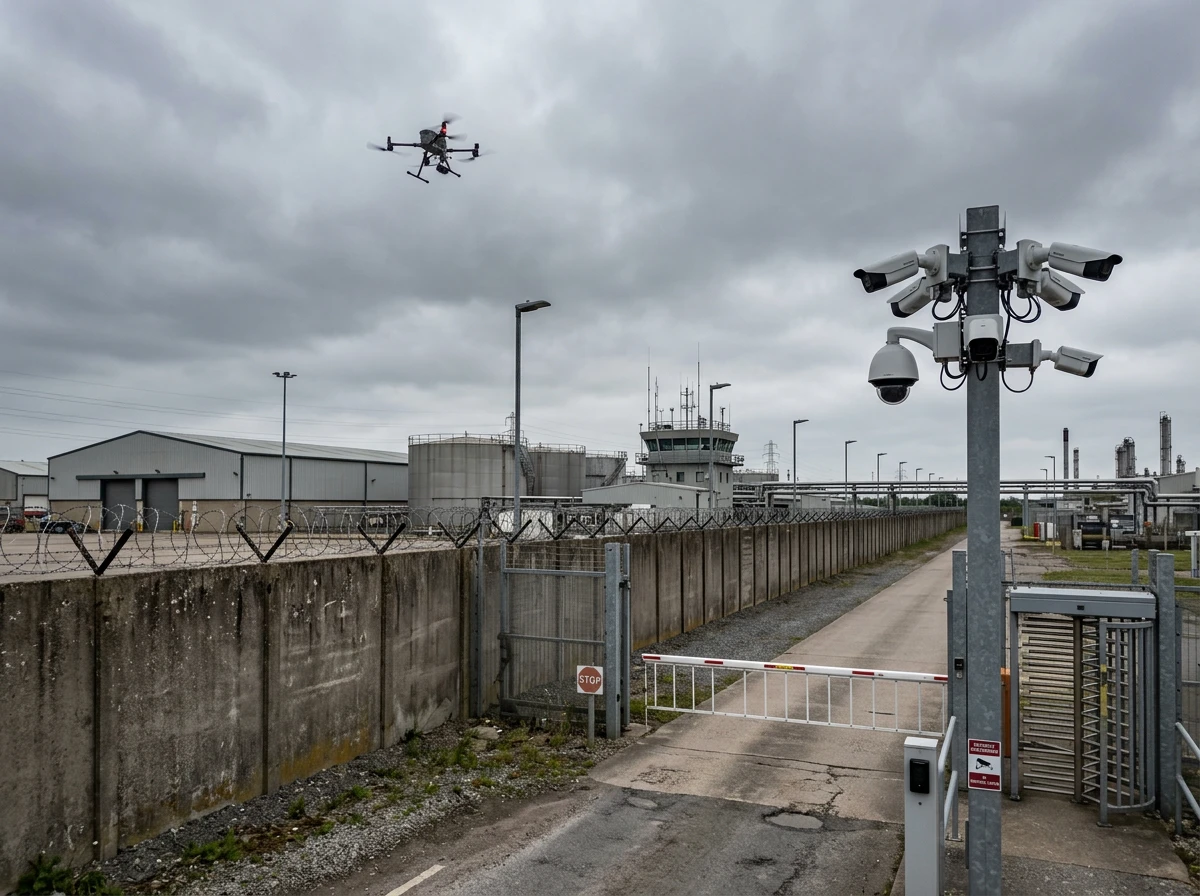
Now imagine if this had been a real-world breach. A UAV could have dropped a payload, conducted surveillance or simply hovered over a high-security zone, effectively bypassing a million-dollar security architecture. The vulnerability wasn’t necessarily in the technology itself, but in the way the site had been secured: the planners had fallen victim to the “two-dimensional perimeter” illusion.
Kinetic Payloads and the Financial Reality of Operational Outages
The real financial hit from an airspace breach usually comes from the disruption it causes.
Even a small drone incident can throw a business into chaos. A suspected payload or a near-miss can be enough to set off alarms. Critical systems may have to be shut down, operations can grind to a halt, and emergency teams may need to investigate before the facility can resume normal activity.
All of this adds up. Industry reports suggest that an unplanned shutdown can cost between $100,000 and $1 million per incident, depending on the scale and duration.
The impact isn’t just about lost time. It can also mean lost trust. When a vulnerability is exposed, companies have to act. They may need to update their procedures, invest in stronger defenses and rebuild confidence in their security infrastructure. That’s why CUAS spending needs to be part of the financial conversation.
In many cases, protecting the airspace around critical infrastructure can be a far more sensible investment than dealing with the operational and financial fallout of an incident.
Core Technologies Powering Modern CUAS Solutions
Multi-Sensor Detection: Radar, RF, Acoustic, and Optical Fusion
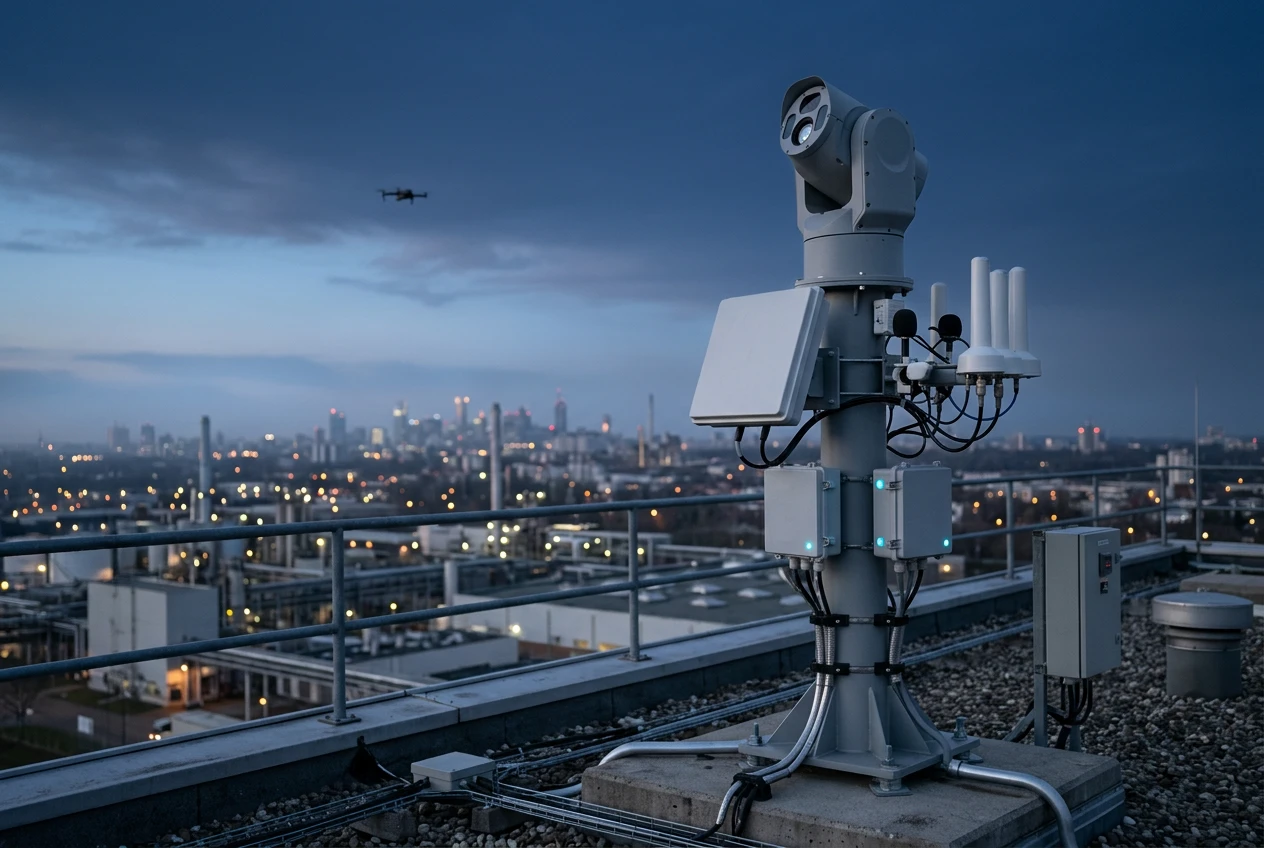
CUAS adopts a layered approach for comprehensive airspace awareness. This includes:
- RF (Radio Frequency): Monitors scientific and medical (ISM) bands to recognise uplink and downlink signatures. Advanced systems can identify the drone type and read its information in real time
- Micro-Doppler 3D Radar: Important for detecting dark drones that operate without active radio signals. These drones follow programmed GPS directions. The radar provides data on the range, how high and how fast the drone is moving, regardless of RF emissions
- EO/IR (Electro-Optical/Infrared) Movement: Automated PTZ optics slew to provide visual classification, payload verification and record evidence for use
- Acoustic Arrays: Help to double-check the target in cities/urban environments where radar ground clutter may reduce clarity
The Critical Shift to Autonomous Airspace Infrastructure
The biggest weakness in drone defense is human reaction time. Closing the gap between detection and response is essential for keeping security teams effective.
A multirotor flying at 25 meters per second can travel 500 meters in 20 seconds. An operator watching on camera feeds cannot process an alarm, confirm the shape, coordinate a response and start mitigation fast enough. The delay is what causes harm.
The Latency Gap:
- Manual Tracking (45-90 Seconds): Sensor Alert ➔ Operator Triage ➔ Visual Search ➔ Manual Track ➔ Delayed Reaction ➔ Perimeter Breach
- Autonomous Infrastructure (< 3 Seconds): Multi-Sensor Ingestion ➔ AI Threat Classification ➔ Automated Tracking ➔ Coordinated Countermeasure ➔ Threat Mitigated
Autonomous airspace defense removes latency by using real-time systems such as:
- Algorithmic Correlation: Machine learning models analyse radio frequency signals and radar data. This helps eliminate alarms caused by birds, weather or normal traffic
- Autonomous Threat Escalation: Systems like Indrajaal’s SkyOSTM instantly rate threats based on direction, speed, height and proximity to critical assets
- Speed-of-Flight Engagement: Command-and-control software activates security protocols the moment an unauthorised drone crosses a defined boundary. This ensures response before a threat can do real damage
Defeat Mechanisms: Soft-Kill vs. Hard-Kill Mitigation
Any neutralisation strategy needs to find the balance between defeating a target and keeping operations safe, while reducing collateral damage.
You can view examples of such interception methods in Indrajaal’s whitepapers:
- Soft-Kill (Software attack): This method uses focused and strategic radio frequency disruption across control and satellite navigation bands. It causes the drone’s software to enter failsafe modes, such as hovering, returning home or controlled landing
- Hard-Kill (Kinetic and Interceptor systems): In areas with high security, autonomous drone interceptors such as the Indrajaal Zombee AI-Powered Interceptor are used. The Zombee uses kinetic impact to stop drones that cannot be jammed or that are part of a swarm. It takes these drones out of the sky before they can reach their target.
Navigating the Legal Landscape
Passive Spectrum Analysis vs. Communication Interception
Deploying counter-drone technology requires a clear legal distinction. Passive detection systems are permissible for business because they do not emit any signals or transmissions.
- Radio Spectrum Surveying: RF sensors monitor the electromagnetic spectrum to find signal presence and frequency bands to spot small unmanned aircraft systems
- Privacy Statute Compliance: Unlike devices that can invade privacy, passive detection finds the physical presence of an RF signal without decoding or saving any private communication content
Authorisation Thresholds for Active Mitigation
Active countermeasures such as disruption, protocol takeover or physical interception face strict regulatory barriers.
In most places, electronic jamming and kinetic takedowns are only allowed for military, law enforcement or national security authorities, as it could interfere with aviation and public telecommunications.
Defense operation experts, while discussing cross-border security and infrastructure defense, often highlight that,
The challenge is not just detection, but navigating the complex civilian airspace regulations that prevent immediate kinetic mitigation. You need a system that offers awareness without violating federal telecommunications laws.
Enterprise operators address this by:
- Establishing real‑time data handoffs and joint response protocols with defense agencies
- Deploying non‑transmitting mitigation assets where civil aviation regulations permit
- Using detection telemetry to run automated ground‑level protection steps
4 Steps to Integrating CUAS into Existing Security Operations
- Conduct a 3D Airspace Vulnerability Assessment: Security groups need to look past the walls and draw a map of the airspace. This means studying the surrounding terrain, line-of-sight from high roofs and other elevated spaces. The goal is to find places where sensors might not work before they become blind spots.
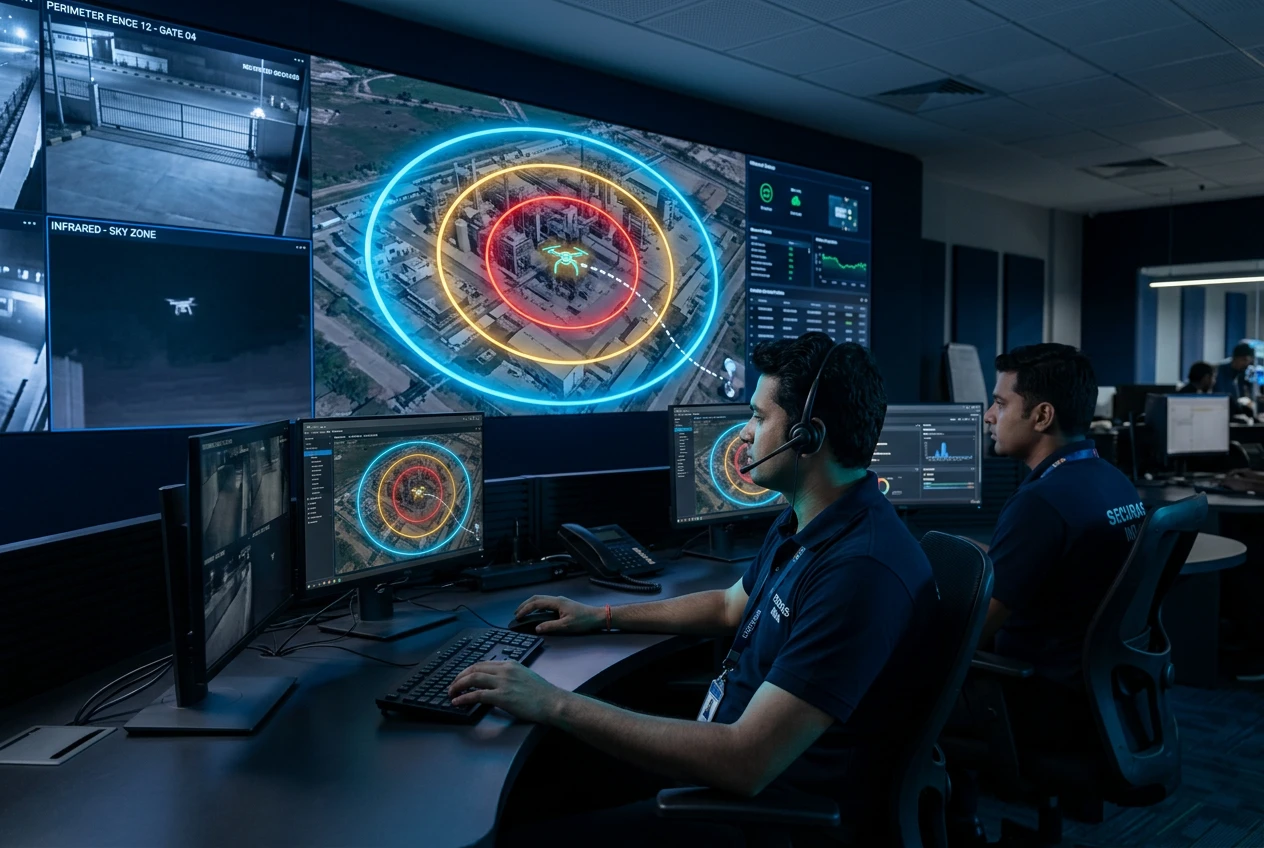
- Bring Airspace into Command & Control (C2): A robust CUAS system should not be standalone. Sensors should connect with control systems like the main Video Management System or the Physical Security Information Management platform. Drone movements, warnings and other air activity should show up with security alerts, giving one clear view.
- Geolocate the Pilot: Stopping a drone solves the problem, but finding the person flying it adds another way to respond. High-tech radio systems can help find where the controller is, so people on the ground can investigate the remote location and act accordingly.
- Establish proper SOPs (Standard Operating Procedures): Detection is useful when the next steps are properly aligned. A clear set of rules and protocols can cut down on delays and ensure the action matches the danger. For example:
- Advisory Alert (1,500m): The system spots a drone and starts tracking it with cameras
- Critical Perimeter Alert (500m): The drone moves into the limit, sending a warning and directing ground teams to the area
- Terminal Perimeter Breach (150m): The target enters the defined exclusion zone, triggering the appropriate site protection measures, including escalation to facility security and protection of high-value personnel
The goal is to ensure that detection leads to a working plan with every part of the security system acting from the same picture of the threat.
Frequently Asked Questions (FAQ)
Modern CUAS architectures use whitelisting. Authorised enterprise drones send registered IDs, MAC addresses and authorised pilot credentials. The system checks these against scheduled flight logs, quickly telling approved operations apart from unauthorised platforms.
Detection is situational awareness: using radar, RF scanners and cameras to spot and track an aircraft and its pilot.
Mitigation is engagement/action: using electronic disruption, protocol manipulation or kinetic interceptors to change the flight path or shut down the platform.
Relying on one type of sensor creates risks, which is why modern CUAS use multi-sensor fusion. Even though heavy rain or fog can hurt cameras, micro-Doppler radar and RF detection arrays work through tough weather, keeping the perimeter secure.
A single sensor can confuse birds, weather or other flying objects with a drone. Modern CUAS systems use sensor correlation, mixing data from radar, RF detection and electro-optical or infrared cameras to confirm a target before sending an alert. This helps security teams tell drone activity from normal activity and focus their actions where needed.
Securing Your Skies Before the Next Breach
Assessing your security posture only through gates, walls and ground cameras overlooks the main operational risk faced by modern critical infrastructure.
Enterprise resilience now demands vertical perimeter control. Waiting for an intrusion to validate such a threat is an operational and financial gamble no organisation can afford.
The shift to 3D security has become an immediate necessity. Indrajaal provides the airspace infrastructure that can fit smoothly within your current systems to detect, track and neutralise threats before they become a casualty.
Stop leaving your critical assets exposed from above. Contact our team today to arrange a 3D airspace vulnerability assessment and learn how our counter-drone technologies can permanently close your security gap.