

Ask a defence planner what is hardest to defend against right now and a cheap drone often tops the list. It costs a few thousand dollars, turns up in numbers, and trying to intercept it leaves your budgets depleted. Interceptor drones have become the most practical answer to that problem in 2026, and this guide covers how they work, what types exist and where the market is heading.
Table of contents
- What is an Interceptor Drone? (Definition & Purpose)
- The Role of Interceptor Drones in C-UAS (Counter-Unmanned Aerial Systems)
- Interceptor Drones vs. Swarm Drones vs. Loitering Munitions
- How Do Interceptor Drones Work? The Aerial Kill Chain
- Core Types of Interceptor Drones & Defeat Mechanisms
- Key Use Cases & Deployment Environments
- Interceptor Drone Market Trends & The Cost-Exchange Advantage
- The Cat and Mouse Game: Drone Countermeasures
- Frequently Asked Questions
- Secure Your Airspace with Next-Generation C-UAS
What is an Interceptor Drone? (Definition & Purpose)
An interceptor drone is a fast, purpose-built unmanned aircraft that finds, tracks and neutralizes hostile or unauthorized drones in mid-air. Where passive ground systems wait for a threat to arrive, it flies out to meet the target and defeats it physically before it reaches whatever it was sent to hit.
The Role of Interceptor Drones in C-UAS (Counter-Unmanned Aerial Systems)
Most traditional defences sit in one place. A radar site, a missile battery or a fixed jammer covers the ground around it and little else. An interceptor drone leaves the ground. It launches on a cue from the sensors, closes on the threat and settles the matter well away from the asset being protected. That distance matters, because every extra second of warning gives defenders room to react.
Interceptor Drones vs. Swarm Drones vs. Loitering Munitions
Here’s the difference betrween the three. Loitering munitions are built to circle for a long time and then strike something on the ground. Swarms overwhelm a defence through sheer numbers. Interceptors exist to catch other aircraft, and speed is the design priority.
| Feature | Interceptor Drones | Swarm Drones | Loitering Munitions |
|---|---|---|---|
| Primary Purpose | Air-to-air threat neutralization | Overwhelming defenses via numbers | Air-to-ground strike (Kamikaze) |
| Control Systems | AI-driven path matching & sensor lock | Distributed mesh networking | Human-in-the-loop or GPS coordinates |
| Reusability | Often reusable (net/soft kill) | Expendable | Always expendable (explosive payload) |
| Operation Style | High-speed, rapid response | Coordinated multi-directional attack | Long-endurance circling over target |
How Do Interceptor Drones Work? The Aerial Kill Chain
Defeating a rogue drone follows a fixed sequence that the industry calls the kill chain. Automation sits inside every link of it.
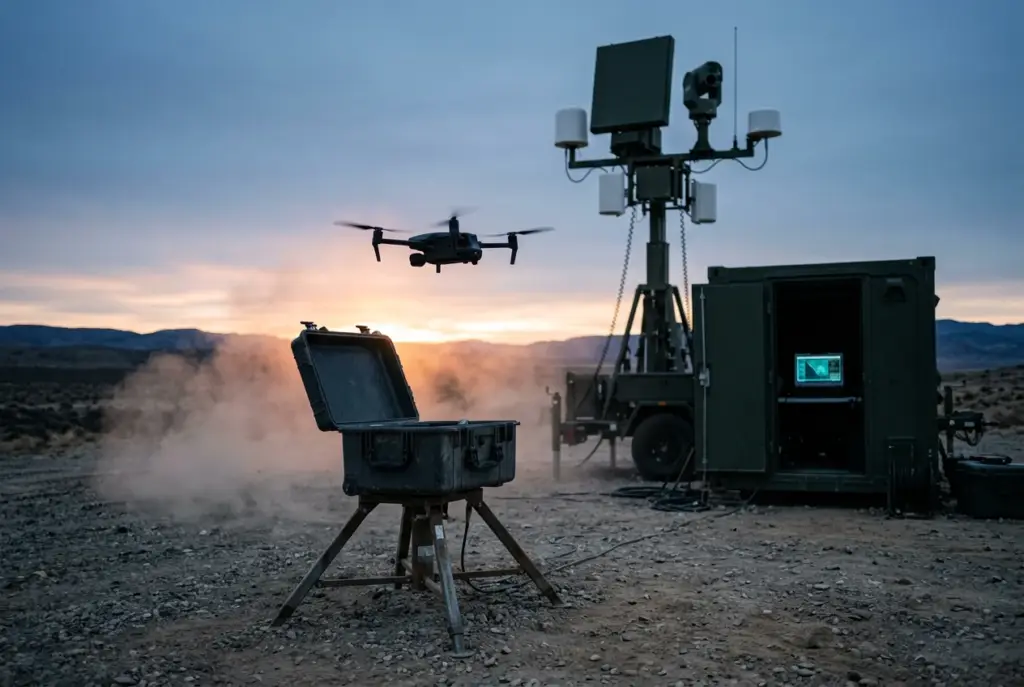
- Threat Detection & AI Multi-Sensor Fusion: Everything begins on the ground. Radar, RF scanners and EO/IR cameras watch the same airspace, and AI merges their readings into one picture. The software decides what each contact is, discards birds and friendly aircraft, and puts the most urgent threat at the top of the queue.
- Tracking, Targeting, and Path Matching: With a threat confirmed, the interceptor launches and ground control hands over what it knows. The drone’s own sensors take over from there. It works out an intercept course and matches the target’s flight path until it holds a visual or thermal lock.
- Interception and Neutralization Methods: Then comes the finish. The interceptor stops pursuing and starts defeating, whether by firing a net, jamming the control link or striking the target directly. The aim is a hostile UAV that can no longer complete its mission.
Core Types of Interceptor Drones & Defeat Mechanisms
Platforms such as the Indrajaal Zombee, an AI-powered autonomous drone built for high-speed kinetic takedowns of rogue swarms, show how far the category has come. Designs generally fall into four groups.
- Kinetic Collision (Hit-to-Kill) Interceptors: The simplest idea is also the most violent: hit the target hard enough to end the flight. Getting there takes speed to catch the threat, a frame strong enough to survive the collision, and sometimes a small explosive charge for certainty. Designers trade these three against each other constantly.
- Net-Capture and Physical Tethering: A net fired at the right moment wraps the propellers and the target drops. Many of these systems then open a parachute, so the tangled drone comes down gently. That makes them a sensible fit for airports and city districts, where debris falling on a crowd is the outcome everyone wants to prevent.
- Electronic Warfare (EW) Interceptors: Some carry a jammer in place of a warhead. Flying close, they flood the target with a concentrated RF signal and cut its link to the operator. The hostile drone typically hovers, heads home or lands where it is.
- Reusable vs. Expendable Platforms: Cost shapes this choice. Expendable kamikaze interceptors are cheap to build in volume, which suits a mass attack. Recoverable designs, such as parachute net systems and return-to-base EW drones, cost more at purchase but spread that cost across many engagements.
Key Use Cases & Deployment Environments
- Military Base and Mobile Force Protection: Recent conflicts have shown how a steady stream of cheap loitering munitions can wear down conventional defences. Interceptor drones suit mobile units because they provide cover without a heavy, fixed battery that has to be hauled and protected.
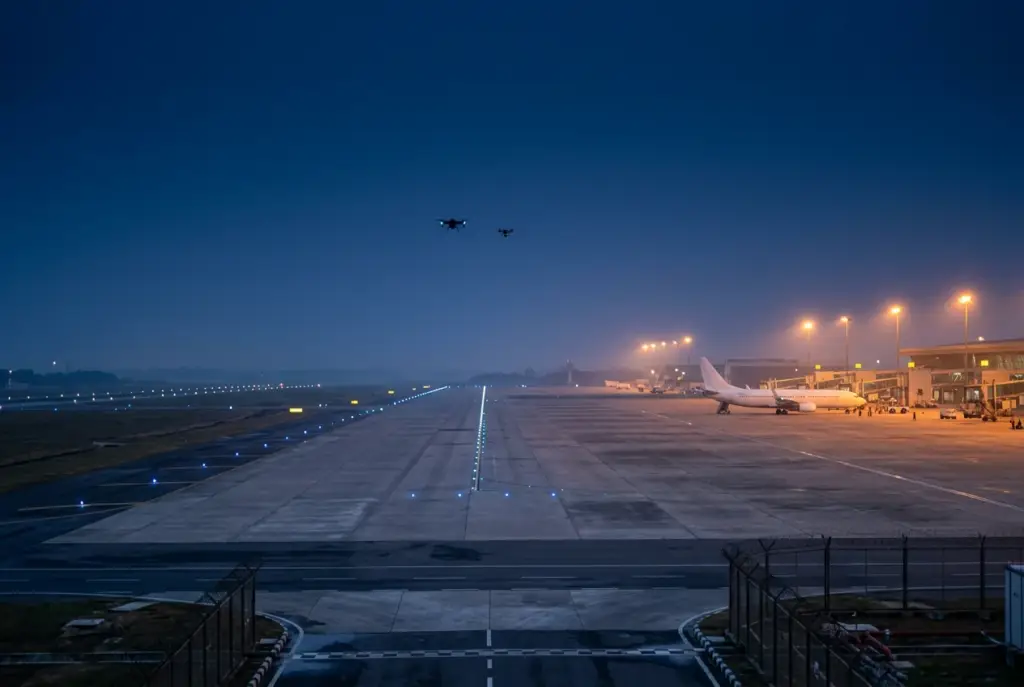
- Airport and Critical Infrastructure Security: A single unauthorized drone can close a runway for hours. Airports use interceptors to clear the sky quickly, and energy substations use them against surveillance flights and attacks that could take out power for a whole region.
- Border Patrol and Warzones: Drones have become the primary means of attack in many conflicts, with enemy kamikaze drones being able to penetrate deep into sovereign territory. Interceptor drones are the primary shield against kamikaze drones, as demonstrated during conflicts like the Russia-Ukraine war.
Interceptor Drone Market Trends & The Cost-Exchange Advantage
- Solving the “Cost-Exchange Ratio” Problem: Picture a missile worth around $4 million fired at a $20,000 drone. The defender wins the engagement and loses the budget. Interceptor drones priced between $1,000 and $30,000 change the arithmetic, so the side defending finally pays roughly the same as the side attacking.
- The Shift Toward Layered C-UAS Architectures: Buyers now ask how a product fits into a wider system. Low-cost kinetic interceptors take the lower tier, with lasers, microwave weapons and electronic warfare covering other ranges and threat types. An MP-IDSA (Manohar Parrikar Institute for Defence Studies and Analyses – an Indian defence think tank) primer from 2025 points the same way, arguing that counter-drone technology has to be affordable, autonomous and wired into existing command-and-control networks.
- The Rise of Autonomous Engagement: Heavy jamming makes a remote pilot unreliable, and GPS may be unavailable altogether. So the intelligence moves onto the drone, which classifies targets, calculates the intercept and decides when to engage with little human input.
The Cat and Mouse Game: Drone Countermeasures
Attackers adapt as quickly as defenders improve.
- Rear-View Cameras and Evasive Maneuvers: Some hostile drones now carry rear-facing sensors. When an interceptor closes from behind, they swerve unpredictably to shake the lock, which forces interceptor designers to rethink approach angles.
- Jamming Resilience: Where electronic warfare is everywhere, GPS and radio links fail. Both sides are turning to optical navigation and terrain-mapping AI to keep flying.
Frequently Asked Questions
Most operate within 3 to 10 kilometres, depending on battery and propulsion. Since they rely on ground radar for the first fix on a target, their practical reach is the airspace around the site they protect.
Yes. After ground sensors flag a target, many current systems launch, track and engage using onboard AI and computer vision, with nobody flying them by hand.
A typical interceptor drone costs between $1,000 and $30,000. Standard interceptor missiles range from $100,000 to well over $2 million, so drones are the more sustainable choice against low-cost threats.
After a hit-to-kill engagement both drones are usually destroyed and fall as debris. A net-capture system typically deploys a parachute, which brings the target down intact so security teams can recover and examine it.
Air defence has always been a contest of cost as much as capability. A system that spends millions to stop a $20,000 aircraft will lose that contest eventually, however good its radar is. Dedicated interceptor drones give a perimeter the speed to respond, the precision to hit small targets and a price that makes repeated engagements affordable. Operators who add them now will be better placed when the next wave of cheap threats arrives.
Secure Your Airspace with Next-Generation C-UAS
Find out where your airspace is exposed before a breach does it for you. Schedule a consultation with our defense technology team at Indrajaal to see how autonomous interceptor platforms can slot into your existing layered defence architecture.