

Key takeaways
- Over the past several years, drones have disrupted airports, compromised sensitive facilities, and raised serious security concerns worldwide, and traditional radar-only defense systems weren’t built to handle small, fast, low-altitude UAVs.
- AI-powered anti-drone systems combine radar, RF sensors, and optical cameras with machine learning models that classify aerial objects in real time, distinguishing drones from birds and other airborne clutter far more reliably than radar alone.
- Published, peer-reviewed research on drone-versus-bird classification has demonstrated detection accuracy in the range of 88 to 95 percent using machine learning approaches, with continued refinement reducing false alarm rates further.
- Because AI models improve continuously as they’re exposed to new data, detection accuracy isn’t fixed at deployment. It’s expected to get better over the system’s operational life, provided the training pipeline keeps up with new drone types and tactics.
- Applications span defense, critical infrastructure, airports, public events, and homeland security, each covered in dedicated depth elsewhere in this content series.
Table of contents
- The growing threat of drones in modern airspace
- What is an AI-powered anti-drone system?
- How AI Actually Improves Drone Classification: What the Research Shows
- Where AI-Powered Anti-Drone Systems Are Deployed
- Advancing Airspace Defence With AI: Indrajaal’s Approach
- Frequently Asked Questions (FAQs)
- Conclusion
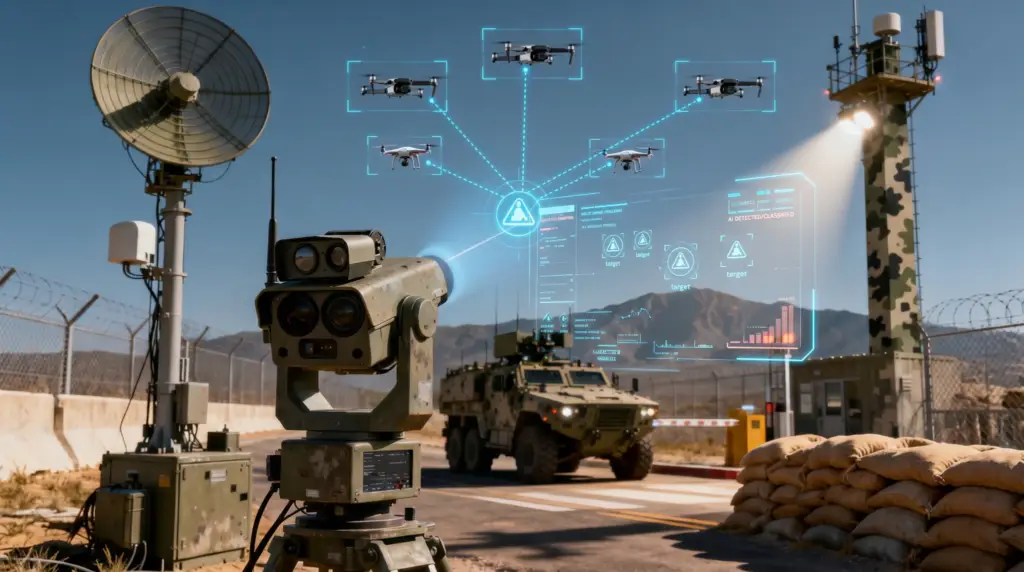
Over the past few years, drones have disrupted airports, compromised sensitive facilities, and raised serious security concerns across the world. What began as a tool for photography, mapping, and logistics has also become a potential threat when used irresponsibly or maliciously.
Small, inexpensive, and widely accessible, unmanned aerial vehicles (UAVs) are difficult to detect and even harder to control using traditional defence systems. Their ability to operate autonomously and navigate complex environments makes them a growing concern across both civilian and military airspace.
To address this evolving threat, AI-powered anti-drone systems have emerged as a critical layer of modern airspace defence. By combining artificial intelligence with advanced detection and response technologies, these systems enable real-time monitoring, accurate threat assessment, and autonomous mitigation of unauthorized drones.
The growing threat of drones in modern airspace
- Military and defence risks: Drones are increasingly used in modern warfare for surveillance, reconnaissance, and tactical operations. However, they are also deployed by adversaries for intelligence gathering, targeted attacks, and coordinated swarm missions. Traditional defence systems often struggle to counter multiple low-altitude, fast-moving UAVs, making AI-driven countermeasures essential.
- Threats to critical infrastructure: Power plants, oil refineries, communication networks, and government facilities are highly vulnerable to drone-based threats. Unauthorized UAVs can be used for surveillance, disruption, or even payload delivery, posing significant operational and safety risks.
- Airport and airspace disruptions: Unauthorized drones entering restricted airspace can lead to flight delays, shutdowns, and safety hazards. Incidents at major global airports have highlighted the limitations of conventional detection systems and the urgent need for more intelligent, responsive solutions.
- Border and homeland security: Drones are increasingly used for smuggling, surveillance, and unauthorized border crossings. Their ability to travel long distances undetected makes them a preferred tool for illicit activities, challenging traditional border security frameworks.
What is an AI-powered anti-drone system?
An AI-powered anti-drone system is a defence platform that uses artificial intelligence and multiple sensors to detect, identify, track, and respond to unauthorized drones.
These systems rely on technologies such as radar, radio frequency (RF) sensors, and optical cameras to monitor airspace. Artificial intelligence analyzes the data from these sensors in real time to distinguish drones from other aerial objects. Once a threat is identified, the system can trigger mitigation measures or alert security teams.
Because AI continuously learns from new data, these systems become more accurate and efficient over time.
How AI Actually Improves Drone Classification: What the Research Shows
This is where a lot of marketing language gets vague, so it’s worth being specific. Peer-reviewed research on drone-versus-bird classification, including work presented through the ICASSP Signal Processing Grand Challenge’s “Drone vs. Bird Detection” competition, has demonstrated machine learning classification accuracy in the range of roughly 88 to 95 percent depending on the specific sensor type, model architecture, and dataset used. (Source: PubMed Central) Some radar-based studies using time-domain features like Doppler velocity and acceleration have reported false alarm rates reduced close to zero once machine learning classification was layered on top of raw radar returns.
This matters because it’s genuine, checkable evidence for a claim vendors often make without support. A few specific capabilities drive this improvement:
- AI-driven detection and classification: Traditional radar systems often struggle to differentiate between drones, birds, and other flying objects. AI-powered systems use machine learning and computer vision to accurately identify and classify aerial threats. By training on large datasets of drone signatures and flight patterns, these systems significantly reduce false positives and improve detection reliability.
- Real-time tracking: Once a drone is detected, AI algorithms analyze its movement, speed, and behavior to determine intent. This enables security teams to distinguish between harmless activity and potential threats. AI can also predict flight paths, allowing for proactive responses before a drone reaches a restricted zone.
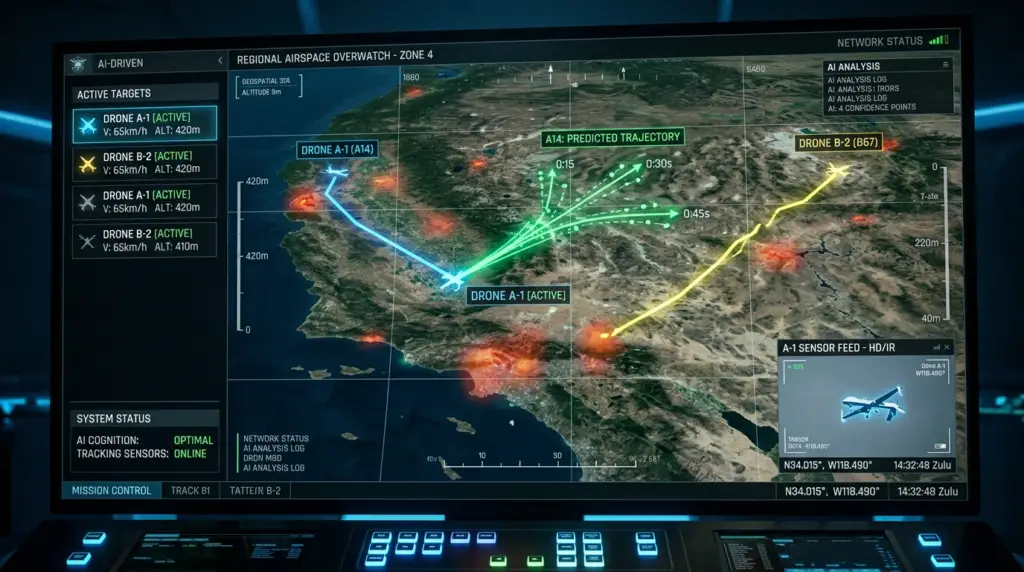
- Autonomous neutralization: Modern anti-drone systems go beyond detection to enable automated response mechanisms, including RF jamming and spoofing, protocol manipulation and kinetic interception. AI ensures that these countermeasures are deployed precisely and efficiently.
- AI-powered swarm defence: As drone swarms become more prevalent, AI enables systems to simultaneously track and respond to multiple UAVs. By analyzing group behavior and coordinating countermeasures, AI enhances defence against complex, multi-drone threats.
- Integration with defence and smart systems: AI-powered anti-drone systems can integrate with broader security infrastructure, including command-and-control systems, surveillance networks, and smart city platforms. This enables centralized monitoring, real-time alerts, and coordinated responses across multiple locations.
Where AI-Powered Anti-Drone Systems Are Deployed
Demand for AI-powered anti-drone systems is growing across several sectors where airspace security is genuinely critical, each covered in dedicated depth elsewhere in this content series:
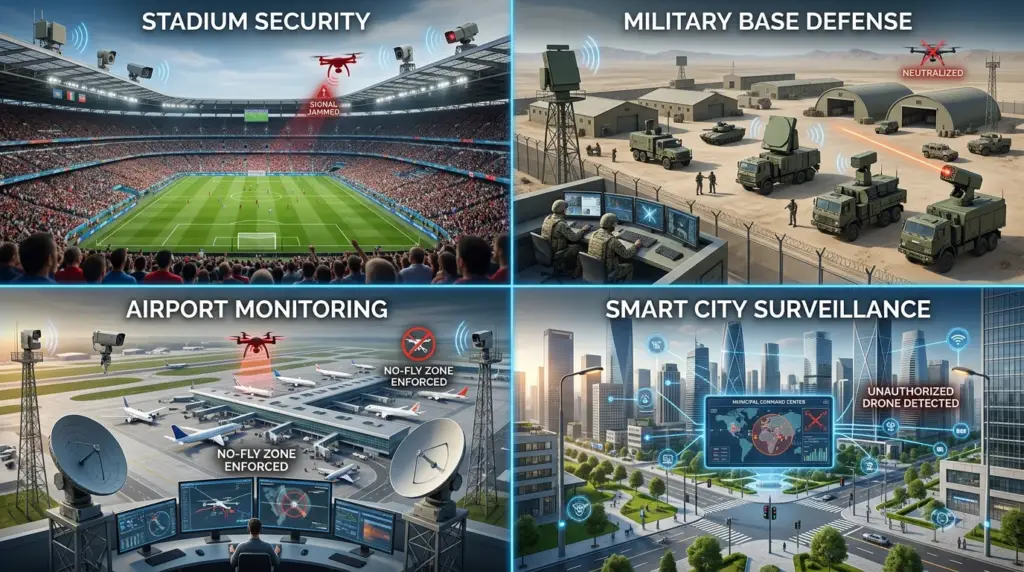
The demand for AI-powered anti-drone systems is growing across several sectors where airspace security is critical.
In defence environments, these systems protect military bases, borders, and strategic installations from aerial threats while enabling continuous monitoring of sensitive zones. This capability has become essential for national security as drone threats evolve.
Public events and VIP gatherings are also vulnerable. Stadiums, political rallies, and high-profile events use autonomous counter-drone systems to monitor airspace and protect large crowds from potential disruptions.
Urban and homeland security agencies deploy counter-UAV systems across cities to strengthen homeland security and prevent drone-based threats in urban areas.
Airports represent another high-risk environment. Modern anti-drone technology helps aviation authorities detect and respond to unauthorized drones, ensuring safer airspace and uninterrupted flight operations.
Critical infrastructure operators also rely on these systems to secure power plants, oil refineries, communication networks, and government facilities.
Advancing Airspace Defence With AI: Indrajaal’s Approach
As the threat landscape evolves, advanced solutions are emerging to deliver more intelligent and scalable airspace protection. Systems such as Indrajaal are designed to integrate AI-driven analytics with multi-layered sensor networks, enabling real-time detection, tracking, and response.
By combining radar, RF monitoring, and electro-optical technologies within a unified platform, these systems provide a comprehensive operational view of the airspace. Intelligent interfaces such as SkyOS further enhance situational awareness, allowing for faster and more coordinated decision-making. Such innovations represent a shift toward autonomous, networked defence architectures capable of securing complex and high-risk environments.
As drone threats become more sophisticated, the role of AI in counter-UAV defence will only grow stronger, shaping the future of security across defence, infrastructure, and public environments.
Frequently Asked Questions (FAQs)
What is an AI-powered anti-drone system?
An AI-powered anti-drone system is a defence technology that uses artificial intelligence and sensors to detect, track, and mitigate unauthorized drones in restricted airspace.
How does drone detection technology work?
Drone detection technology combines radar, RF sensors, cameras, and AI analysis to identify drones and track their movements.
Where are autonomous counter-drone systems used?
They are commonly used in military bases, airports, critical infrastructure facilities, and large public events.
Where are AI-powered anti-drone systems used?
AI-powered anti-drone systems are used in environments where airspace security is critical, including military bases, airports, border regions, and critical infrastructure such as power plants, oil facilities, and government buildings.
How does Indrajaal detect and respond to drone threats?
Indrajaal uses layered drone detection technology, including radar, RF monitoring, and electro-optical sensors, to continuously scan the airspace. This data is analyzed by SkyOS, which identifies threats, tracks drone activity, and enables rapid mitigation through an integrated counter-UAV system.
Conclusion
The AI layer is what turns a collection of radar, RF, and camera sensors into a genuinely reliable detection system, not just a data-collection exercise. Published research backs this up with real numbers, not just marketing language, and the gap between AI-assisted classification and radar or optical detection alone is measurable and significant. As drone threats keep evolving, that AI layer, continuously trained on new data rather than fixed at deployment, is what will keep pace with them.