

Soft kill vs hard kill anti-drone refers to two counter-drone neutralization methods. Soft kill anti-drone systems disable drones non-destructively using signal jamming or spoofing. Hard kill counter-UAS systems physically destroy drones using lasers, missiles, or interceptor drones. Modern counter-unmanned aerial system (CUAS) solutions use both methods together for maximum protection, applying soft kill first and escalating to hard kill only when required.
Key takeaways
- Soft kill neutralizes a drone without destroying it, using RF jamming, GPS jamming, or GPS spoofing to make it land, return home, or lose control. It’s safer, cheaper, and better suited to civilian environments.
- Hard kill physically destroys or disables a drone using lasers, missiles, anti-drone guns, or interceptor drones. It’s more effective against all drone types, including autonomous ones, but carries higher cost and collateral-damage risk.
- Neither method is universally “better.” The right choice depends on environment (civilian vs military), threat level, budget, and regulatory constraints.
- Soft kill is less effective against fully autonomous drones, since they don’t rely on the communication or GPS link that jamming and spoofing target, which is the core technical reason layered defense exists.
- The strongest real-world approach is layered: detect first, apply soft kill where possible, and escalate to hard kill only when the threat requires it. Platforms like Indrajaal are built around exactly this layered logic.
Table of contents
- What is a Soft Kill Anti Drone System?
- What is a Hard Kill Counter UAS System?
- Soft Kill vs Hard Kill Anti-Drone: Performance Comparison
- Cost Comparison: Short-Term and Long-Term
- Safety and Collateral Damage Comparison
- Operational Effectiveness in Real Defence Scenarios
- Layered defence: why modern systems use both
- Best Choice for Buyers
- Frequently Asked Questions
- Conclusion
What is a Soft Kill Anti Drone System?
A soft kill anti-drone system disables drones electronically, without destroying them. It works by disrupting the communication or navigation link between the drone and its operator.
Common soft kill methods include RF jamming, GPS jamming, and GPS spoofing. These typically cause the drone to land, return to its home point, or lose control entirely. Because soft kill leaves no debris and involves no physical destruction, it’s widely used in civilian and homeland security applications, and modern indigenous anti-drone system solutions increasingly build advanced soft kill capabilities in as standard.
What is a Hard Kill Counter UAS System?
A hard kill counter-UAS system destroys drones physically. It uses tools such as laser weapons, missiles, anti-drone guns, and interceptor drones to permanently remove the threat.
Hard kill ensures permanent neutralization and is used mainly in military defense contexts, where the priority is guaranteed threat removal rather than avoiding collateral effects. It’s a critical component of advanced CUAS solutions operating in genuine combat or high-threat environments.
Soft Kill vs Hard Kill Anti-Drone: Performance Comparison
Detection and Neutralization
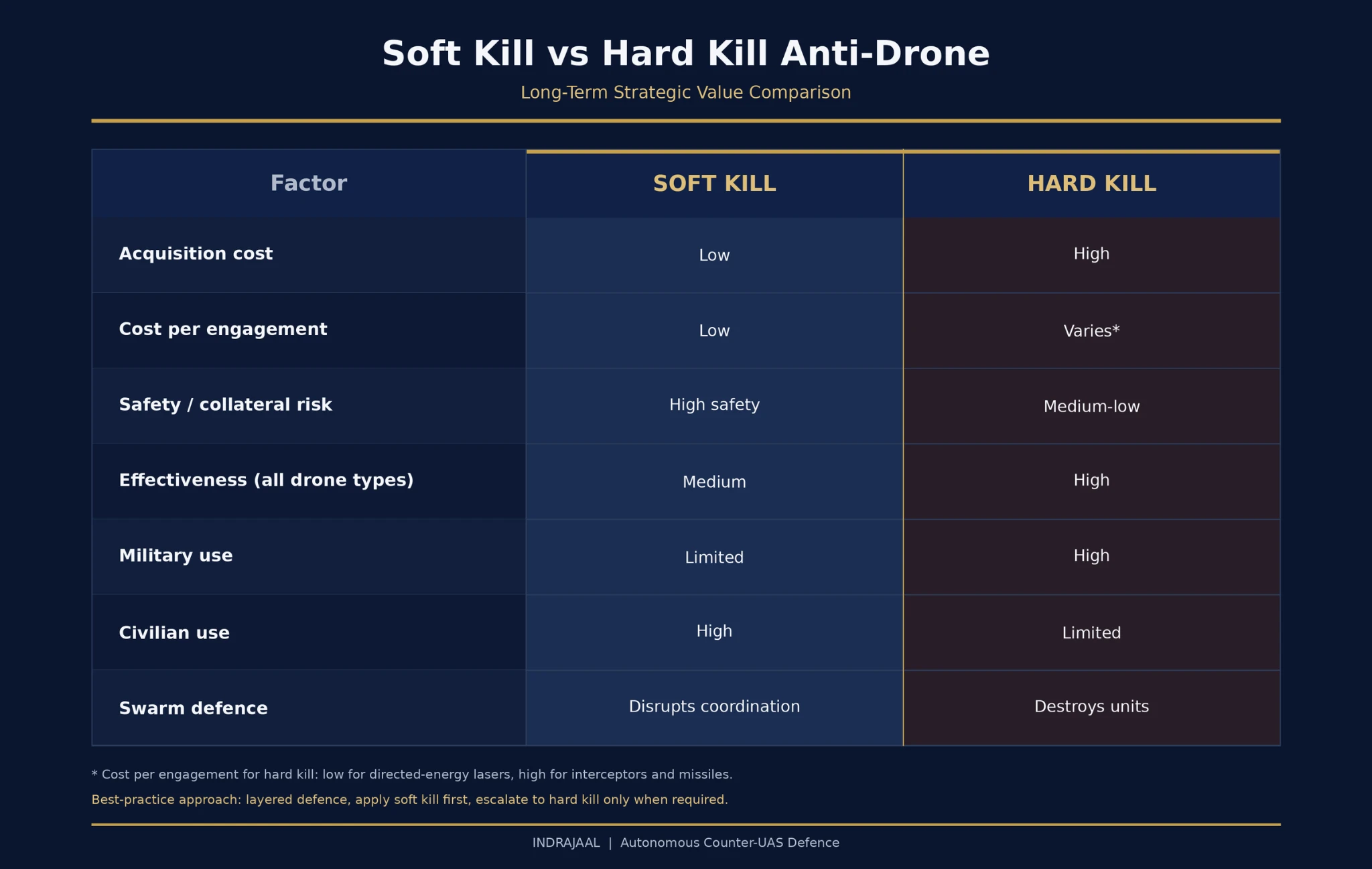
Soft kill anti-drone is highly effective against commercial drones that rely on an active communication link, but less effective against fully autonomous drones that don’t depend on one. Hard kill counter-UAS, by contrast, is effective against essentially all drone types and provides permanent neutralization. On raw effectiveness across the full threat range, hard kill scores higher.
Response Speed
Soft kill is fast, but its speed depends on successfully disrupting the drone’s signal, which isn’t guaranteed against every target. Hard kill delivers immediate physical destruction once engaged. For sheer neutralization speed against a confirmed threat, hard kill is faster.
Swarm Defence Capability
Soft kill can disrupt the communication links coordinating a swarm, potentially degrading the whole group at once. Hard kill options like laser systems can destroy multiple drones in sequence. Both have a role, but for guaranteed neutralization of a committed swarm, hard kill generally performs better.
Cost Comparison: Short-Term and Long-Term
Soft Kill Cost Advantage
Soft kill anti drone systems have:
- Lower acquisition cost
- Lower operational cost
- Lower maintenance
- This makes soft kill cost efficient.
Hard Kill Higher Cost
Hard kill systems require:
- Laser systems
- Weapons
- Interceptor drones
- This increases cost significantly
- Hard kill has higher long-term cost.
Safety and Collateral Damage Comparison
Soft Kill Safety Advantage
Soft kill anti-drone creates no physical destruction and no falling debris, making it genuinely safe for civilian use. It’s the clear choice for airports, cities, and critical infrastructure, environments where a falling drone or debris from a destroyed one would create its own serious hazard.
Hard Kill Risk
Hard kill counter-UAS creates debris and carries a higher collateral-damage risk by its nature, since a physically destroyed drone still has to come down somewhere. This makes it best suited to military use or genuinely remote, controlled environments rather than dense civilian areas.
Operational Effectiveness in Real Defence Scenarios
Modern indigenous anti-drone system solutions rarely choose one method exclusively. Instead, they use layered defense, combining soft kill and hard kill into a single escalation workflow:
- Detect the drone using layered sensors (radar, RF, EO/IR).
- Apply soft kill first, attempting non-destructive neutralization via jamming or spoofing.
- Escalate to hard kill only if soft kill fails or the threat level demands immediate, guaranteed removal.
This layered approach delivers maximum effectiveness while keeping collateral risk and cost as low as the situation allows. Advanced counter-unmanned aerial system solutions like Indrajaal are built specifically around this escalation logic, rather than forcing an operator to choose one method for every situation.
Layered defence: why modern systems use both
Modern indigenous anti-drone system architectures increasingly use layered defence strategies that combine both soft kill and hard kill technologies.
Instead of relying on a single method, layered systems begin with electronic disruption to safely disable the drone. If disruption fails or the threat continues, physical neutralisation methods are deployed as a secondary response. This structured escalation improves reliability while reducing unnecessary risk. However, in densely populated or sensitive civilian areas, hard-kill measures may not always be practical due to the risk of collateral damage, making soft-kill approaches the preferred first line of defence wherever possible.
Advanced indigenous solutions such as Indrajaal demonstrate how layered defence models are shaping the future of airspace security. By integrating detection, disruption, and interception into a unified system, such technologies provide faster response capability and stronger protection against evolving drone threats.
Layered defence is now considered one of the most effective approaches in modern counter-unmanned aerial system deployments, particularly in environments where safety, precision, and adaptability are essential.
Best Choice for Buyers
Choose soft kill if you need: airport protection, civilian safety, a lower-cost solution, or critical infrastructure protection in populated areas.
Choose hard kill if you need: military defense, combat protection, or guaranteed neutralization of high-threat targets in controlled environments.
Best overall: a layered indigenous anti-drone system. For most serious deployments, the strongest solution combines soft kill and hard kill in one escalation workflow, delivering maximum protection, the best performance across threat types, and the lowest risk appropriate to each situation. Modern anti-drone technology like Indrajaal is built around exactly this layered approach.
Evaluating soft kill and hard kill options for your site? Talk to Indrajaal’s experts about a layered deployment matched to your threat profile and environment.
Frequently Asked Questions
Both are important and serve different needs. Soft kill is safer and more cost-effective, making it ideal for civilian and infrastructure protection. Hard kill is more effective across all drone types and provides permanent neutralization, making it suited to military use. The best solution combines both in a layered system.
Soft kill anti-drone disables a drone non-destructively, typically using RF jamming, GPS jamming, or GPS spoofing to disrupt the link between the drone and its operator, causing it to land or return to base.
Hard kill counter-UAS physically destroys a drone using tools like laser weapons, missiles, anti-drone guns, or interceptor drones, ensuring permanent threat removal.
A layered CUAS combining both soft kill and hard kill is generally the best solution, since it applies non-destructive methods first and escalates to physical neutralization only when required, balancing effectiveness, safety, and cost.
Soft kill is significantly safer for populated areas because it produces no debris and no physical destruction. Hard kill carries collateral-damage risk from falling debris, making it better suited to military or controlled environments.
Conclusion
Drone threats are increasing rapidly, and choosing between soft kill and hard kill anti-drone methods is a critical part of defense planning, not a minor technical detail. Soft kill provides safe, cost-effective protection well suited to civilian and infrastructure environments. Hard kill provides powerful, permanent threat removal suited to military and high-threat contexts. For most organizations, though, the real answer isn’t one or the other: it’s a layered counter-unmanned aerial system (CUAS) that combines both, applying the proportionate method for each specific threat and ensuring complete airspace protection.